Agadir Food Guide: Fresh Atlantic Seafood, Souks and Where Locals Really Eat
Agadir Food Guide: Fresh Atlantic Seafood, Souks and Where Locals Really Eat
Agadir has an image problem. In travel writing, it tends to appear in the same sentence as “all-inclusive resort” and “European beach holiday,” which are fair descriptions of what a certain type of visitor does here. But those visitors miss the real Agadir completely — they eat buffet breakfasts in their hotels and never once walk into the Marché de Poissons where the day’s Atlantic catch is being unloaded, weighed, and cooked right in front of them before it has had time to forget the ocean.
The city was largely rebuilt after the catastrophic 1960 earthquake destroyed most of the old urban fabric, which means Agadir lacks the atmospheric ancient medina of Fes or the photogenic chaos of Marrakech. What it does have is an extraordinary geographic position: sitting at the mouth of the Souss Valley, one of Morocco’s most agriculturally productive regions, with the cold Canary Current bringing some of the richest marine biodiversity in the Atlantic directly to its doorstep. For a food traveler, that is a better asset than any old medina.
The Marché de Poissons: Where the Real Agadir Lives
The fish market near the port is not a tourist attraction. It is a working market that happens to be accessible to visitors willing to get there early and move out of the way of the men pushing trolleys. Arrive before 9am if you want to see the full volume of what comes in — sardines by the metric ton, whole swordfish, enormous cuttlefish, red mullet, sea bream, oysters, clams, octopus still trying to figure out what just happened.
The market has a cooking section. You pick your fish, pay by weight, hand it to one of the grill operators, and 10 minutes later you are eating it grilled at a plastic table with bread and condiments. This is not a romantic setting. There are no tablecloths. Cats circle the perimeter with professional patience. It is, however, one of the most genuinely pleasurable seafood experiences in Morocco.
A good order for two people: 300 grams of sardines, a handful of large shrimp, and whatever the vendor holds up with particular enthusiasm that morning. Pay for the fish, pay a small cooking fee (usually 10–20 dirhams extra), add a round of bread and harissa, and you have a breakfast or early lunch that costs 60 to 80 dirhams total and cannot be improved upon in any restaurant in the city.
The Souss Valley Identity: More Berber Than Arabic
The region around Agadir — the Souss Valley, stretching inland toward the Anti-Atlas mountains — is predominantly Amazigh (Berber) Tachelhit-speaking, and the food culture reflects this much more strongly than in Marrakech or Casablanca. You feel it in the emphasis on argan products, in the way couscous is still eaten as a daily staple rather than a ceremonial dish, and in the particular spice combinations that characterize the local cooking.
Amlou — the argan-almond-honey spread — is not a specialty here; it is a basic staple of the local diet. You will find it at breakfast tables, at produce stalls, in every argan cooperative shop. The version made in the Souss Valley is often coarser-ground than what you find marketed to tourists, with larger pieces of roasted almond visible in the paste and a more pronounced bitterness from freshly pressed argan oil. This is the version to seek out.
The local olive oil is also exceptional and underappreciated. The Souss Valley and the neighboring Taroudant area produce single-variety olive oils with a grassy, slightly bitter profile that serious oil enthusiasts travel specifically to find. At the weekly souks in the outlying villages, you can buy oil pressed within the previous few weeks from small producers who have no interest in international markets. This oil will not survive long after opening; use it immediately and profligately.
Talborjt: The Neighborhood That Feeds Real Agadir
If you want to understand where Agadir’s working population actually eats, the answer is Talborjt — the old residential neighborhood to the northeast of the city center that survived the 1960 earthquake in relatively better shape than the rest of the city. It has the density of the medina without the tourist overlay.
Walk the main street of Talborjt in the early morning and you will find: bisara vendors spooning thick fava bean soup into clay bowls, sfenj vendors pulling loops of fried dough out of oil to order, small bakeries with wood-fired ovens where the round khobz costs 2 dirhams, and women carrying tagines of meat and vegetables to the communal oven for the day’s slow cooking.
The restaurants in Talborjt are the kind where the menu is whatever is cooking, the price is whatever is fair, and the clientele is exclusively local. A full lunch — harira soup, a chicken or lamb tagine shared between two, bread, and tea — will cost 40 to 60 dirhams per person. Nobody here is performing their culture for you. They are just eating lunch.
For specific guidance: walk along Rue des Orangers or the smaller streets branching off it. Look for the places with hand-written menus in Darija (Moroccan Arabic) or Tachelhit. The presence of these languages on the menu, rather than French or English, is a reliable indicator of where you want to be.
Fresh Lobster and Shrimp at the Port: What to Know
Agadir’s port is one of the most significant fishing ports in Africa, handling catches not just of table fish but of industrial quantities of sardines (Morocco is one of the world’s leading sardine exporters) and of crustaceans that rarely make it out of the region before being consumed locally.
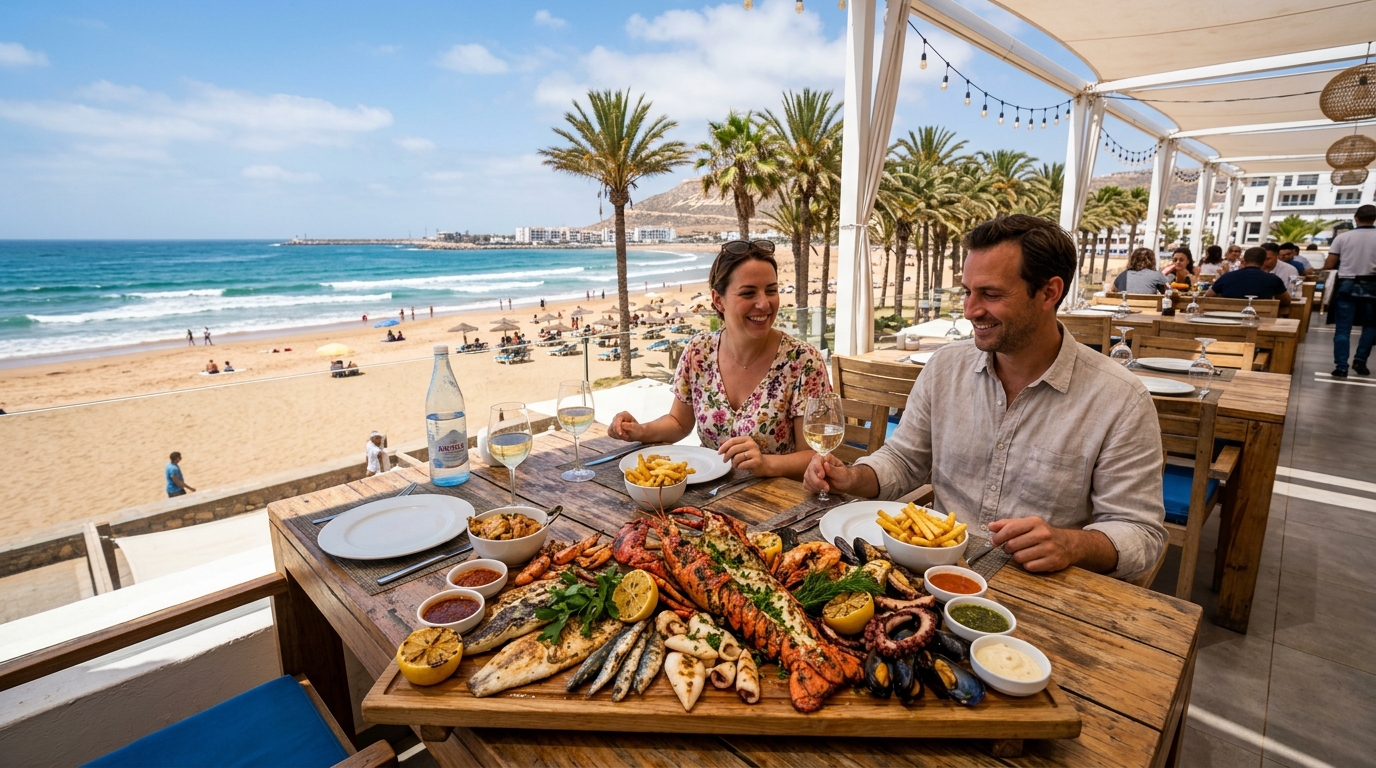
Lobster — homard in Darija-French — is available at the port-adjacent restaurants and at the fish market, and it is significantly cheaper here than in any European country. A whole Moroccan spiny lobster (which differs from the European variety in lacking large claws but having excellent tail meat) at a small port restaurant can cost 150 to 250 dirhams depending on size and season — a fraction of what it would cost in Lisbon or Marseille.
The local preparation is straightforward: split, grilled over charcoal, brushed with chermoula or herb butter, served with lemon and bread. No sauce, no complexity. It does not need it.
The same applies to the large king prawns (crevettes royales) that appear in the market from late summer through winter. Buy them at the market, have them grilled, eat them with your hands. This is the Agadir protocol.
Camel Milk from the Souss: An Acquired Taste Worth Acquiring
The semi-arid interior of the Souss region and the pre-Saharan landscape toward Guelmim still support pastoral camel herding, and camel milk from this region flows into the Agadir market in small quantities. You find it at a few specific stalls in the Souk el-Had, Agadir’s enormous weekly Sunday market.
Camel milk is thinner than cow’s milk, with a slight saltiness and a faint gamey note that disappears when it is chilled. Locals drink it fresh as a digestive aid and traditional remedy. Some small cafés near the Souk el-Had serve it warm with a pinch of ginger. It is worth trying once, either out of curiosity or because you are increasingly convinced that everything the Souss produces tastes better than its lowland equivalent.
Souk el-Had: The Biggest Market in Morocco
Souk el-Had (literally “Sunday Market”) claims to be the largest weekly market in Morocco, and it might be right. It covers several city blocks and sells everything from live chickens to Amazigh silver jewelry, plastic household goods, fresh produce, dried herbs, and enough processed-cheese brands from France to stock a Paris supermarket.
For the food traveler, the interesting sections are the fresh produce stalls and the spice sellers. The Souss Valley supplies most of Morocco’s citrus, tomatoes, and vegetables, and the freshness of what appears at this market reflects that. In September and October, the tomatoes are exceptional — small, meaty, and actually red inside rather than the pale pink of cold-storage tomatoes. Buy a bag, eat them with salt and argan oil, and consider whether you have ever really understood what a tomato can be.
The spice stalls here sell local blends you will not find in Marrakech’s tourist-facing spice shops: dried desert herbs, local varieties of cumin and coriander sold whole and freshly ground, black cumin, dried rose hips, and the distinctive local harroua (nigella seeds used in Souss bread-making).
The Beach Restaurant Trap and How to Avoid It
Agadir’s beach strip is lined with restaurants that exist primarily to serve European tourists seeking familiar food in a warm setting. This is a legitimate service and no judgment. But if you are reading this guide, you presumably want something else.
The specific thing to avoid: any restaurant on the main beach promenade (Boulevard du 20 Aout) that posts photographs of dishes on a board outside or has a host standing on the street. These places charge two to three times the price of the equivalent Talborjt restaurant for food that is rarely better and sometimes much worse.
The alternative is to walk one or two streets inland from the beach, toward the residential neighborhoods behind the tourist strip. Here you find the places that feed the service workers, the hotel staff, the fishermen on their days off. The food is Moroccan, properly spiced, cooked to order, and priced for the people eating it.
FAQ
Is the Agadir fish market open every day? Yes, the Marché de Poissons near the port operates daily, with the largest quantities arriving early in the morning (6–10am). The cooking area is also active through lunchtime. On Sundays, many vendors also set up at the Souk el-Had, so both options are available.
Where can I buy real argan oil in Agadir without getting overcharged? Visit the women’s cooperatives on the road toward Taroudant (the N10) rather than the tourist-facing shops near the beach. The cooperatives sell culinary argan oil (roasted, darker, used for cooking and amlou) at fixed prices. Look for cooperative signage from UCFA. Expect to pay 60–80 dirhams for a 250ml bottle of culinary oil — if it is cheaper than that in a tourist shop, it is diluted.
Is Agadir better for food than Essaouira or Marrakech? It depends entirely on what you are looking for. For Atlantic seafood and Souss Valley Berber cuisine, Agadir is arguably the best city in Morocco. For historic medina street food and the full range of Moroccan cuisine, Marrakech and Fes have more variety. Essaouira has the best atmosphere for port-side fish grilling. Do not choose — visit all three.
Are there good vegetarian options in Agadir? Yes, particularly in the Talborjt neighborhood and at the Souk el-Had. The Souss Valley agricultural tradition produces an abundance of excellent vegetable dishes, and the local couscous with seven vegetables is one of the best purely plant-based dishes in Moroccan cooking. Amlou, argan oil with bread, and fresh produce from the market round out a completely satisfying vegetarian food experience.
Experience the true heart of Moroccan heritage through its traditions. Join us in preserving these ancestral rituals.
What People Are Saying
No comments yet. Be the first — we'd love to hear from you.
The Moroccan Food
A Moroccan cultural writer dedicated to documenting the authentic voice, history, and heritage of the Kingdom. Writing from within — to share what truly makes Morocco extraordinary.
Our Mission →