Aït Benhaddou: What Is the Kasbah That Every Film Director in Hollywood Knows About?
Aït Benhaddou: The Pre-Saharan Kasbah That Survived a Thousand Years and Hollywood
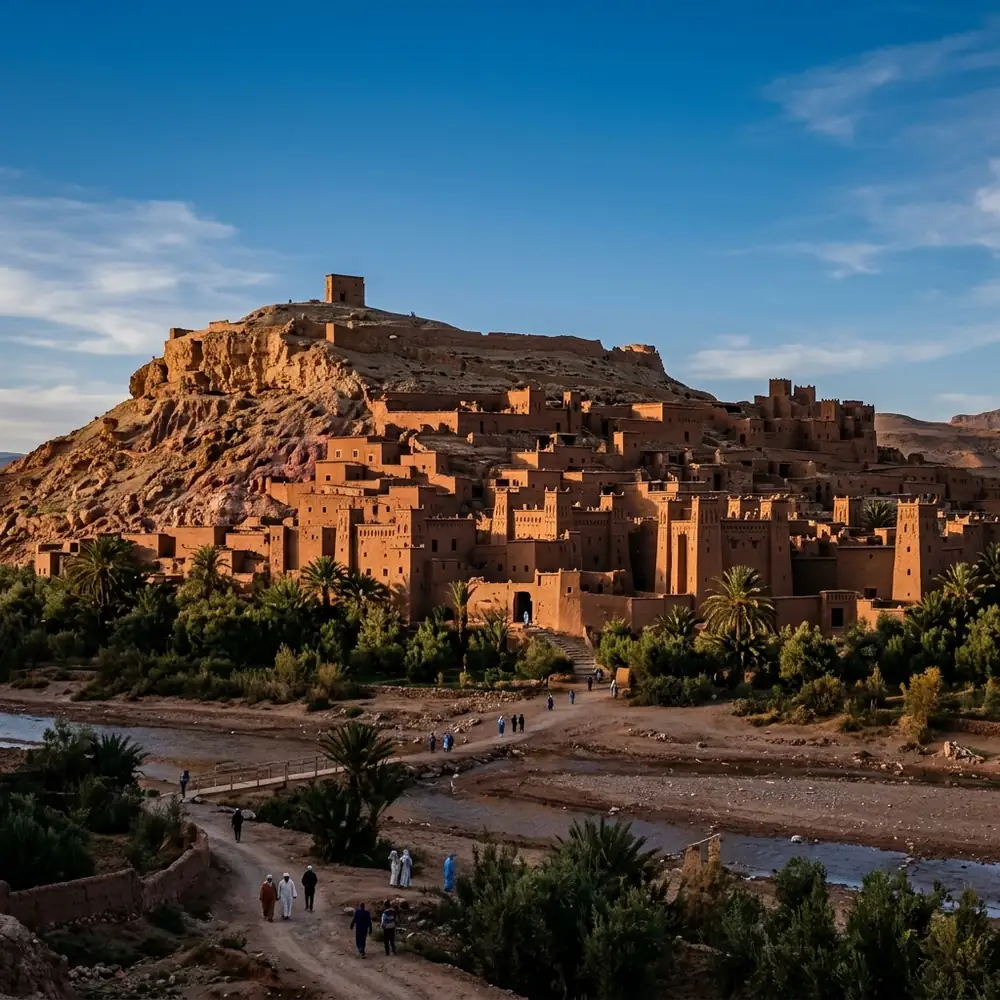
Here is what most visitors know before they arrive at Aït Benhaddou: they’ve seen it on screen. Gladiator. The Mummy. Lawrence of Arabia. Sodom and Gomorrah. Game of Thrones, three separate seasons. The film crews discovered it in the 1950s and they haven’t really stopped coming. From a distance — from the far bank of the Oued Mellah river, where most people first see it — the Ksar (the collective term for this type of fortified village) looks exactly like what every film director wants when they need “ancient and monumental and not European.” The pisé walls glow amber in afternoon light in a way that no set designer has ever successfully replicated.
What most visitors don’t know before they arrive — and what I want to make sure is clear — is that Aït Benhaddou existed for roughly 900 years before anyone pointed a camera at it. And the story of what it was before the film crews arrived is considerably more interesting than anything that was filmed there.
What Is a Ksar and Why Was Aït Benhaddou Built Where It Is?
A Ksar (plural: Ksour) is a specific architectural typology unique to the pre-Saharan and Saharan regions of Morocco and the broader Maghreb: a collective, fortified settlement built from pisé — rammed earth mixed with straw and gypsum — designed to house an entire community within a single defensive perimeter.
The site of Aït Benhaddou was not chosen for its scenic quality. It was chosen because of water and commerce. The Oued Mellah river (the name means “salt river” in Darija) provided year-round water access in one of the driest inhabited landscapes on Earth. More importantly, the kasbah sits on one of the major trans-Saharan caravan routes — the road connecting the Drâa Valley to the imperial city of Marrakech, via the Tizi n’Telouet pass through the Atlas mountains.
For roughly nine centuries, every caravan moving between the Saharan trading posts and the Moroccan imperial cities passed through or near this point. Salt, gold, ivory, enslaved people, ostrich feathers, indigo — all of it moved along this road. The families who built and maintained Aït Benhaddou were positioned at a natural chokepoint in the trans-Saharan trade network, and their fortified kasbah was both their home and their commercial infrastructure.
What Is the Architecture of Aït Benhaddou Made Of and How Has It Survived?
Pisé construction has been used in Morocco’s pre-Saharan regions for at least two thousand years. It is, in its way, a remarkable material: completely local (the clay soil is the building material), thermally extraordinary (thick pisé walls keep interiors at roughly fifteen degrees cooler than outside in summer and considerably warmer in winter), and structurally sound for centuries if maintained.
The maintenance is the key word. Pisé is not permanent in the way that stone is permanent. It requires regular application of fresh clay plaster to protect the wall surfaces from rain erosion. A pisé building that is maintained is almost indefinitely durable. A pisé building that is abandoned will be significantly degraded within fifty years and essentially gone within two hundred.
The towers (borj) of Aït Benhaddou — and there are six major ones, arranged to provide overlapping fields of visibility along the approaches to the settlement — are decorated with geometric relief work in the upper sections: Amazigh geometric patterns worked into the clay surface while it was still wet, expressing family identity and regional artistic tradition. Each tower belongs to a specific family. The ornamentation signals ownership as clearly as a name on a door.
The granary (Ighrem) sits at the highest point of the Ksar — deliberately positioned because stored grain is the most precious thing a community controls, and height gives defenders the maximum advantage if someone comes for it. The view from the granary roof — Atlas mountains behind you, pre-Saharan plain stretching south toward Ouarzazate — is the view that caravan lookouts had for nine hundred years. It is still worth climbing to.
Why Do People Still Live There and What Is That Like?
A common misconception about Aït Benhaddou: it is not uninhabited. Several Amazigh families still live inside the Ksar walls. Not many — perhaps six to ten families at any given time — but their presence is what makes it a living site rather than a museum. They conduct their daily lives inside a UNESCO World Heritage building while film crews occasionally set up equipment in their courtyards. This is a situation that I find genuinely extraordinary to think about for too long.
The families who remain are mostly elderly or specifically committed to maintaining the tradition of habitation. The younger generation has largely moved across the river to the modern village of Aït Benhaddou, which has electricity, running water, and schools. The Ksar has electricity now — wires were run in as a compromise between preservation and livability — but daily life inside the old walls is substantially more demanding than in the modern village.
During film productions, which happen every few years, the inhabited sections are respected by the crews. The Moroccan film industry has learned, sometimes the hard way, that the local families are not props and their homes are not sets. The relationship between the permanent inhabitants and the recurring film industry presence is complicated in ways that would require its own separate article to explore properly.
The Invisible Invitation
Cross the river on foot — there’s a shallow ford, and in summer you can do it in sandals — and walk up through the Ksar’s main gate in the late afternoon when the tour groups have gone. The light at that hour is almost absurd in its warmth: the pisé walls go from amber to deep orange to something close to red as the sun drops. Find the path up to the granary roof and stand there. The Atlas mountains will be blue-grey behind you, the plain in front of you will be absolutely flat and stretching to the horizon, and somewhere below in the Ksar a family will be cooking dinner and the smell of woodsmoke will be climbing the old walls. Nobody will be filming anything. It will be exactly what it has always been.
SEO Meta Description: What is Aït Benhaddou in Morocco? A historian’s guide to the UNESCO Ksar’s 9th-century trade route history, pisé architecture, and why it became Hollywood’s favorite backdrop.
Experience the true heart of Moroccan heritage through its culinary traditions. Join us in preserving and honoring these ancestral recipes.
What People Are Saying
No comments yet. Be the first — we'd love to hear from you.
Omar Idrissi
Culturally Verified & Fact-CheckedThe Moroccan Food editorial team brings together native culinary researchers, heritage preservationists, and experienced home cooks across Marrakech, Fes, and Casablanca. Every recipe and cultural guide is reviewed against ancestral oral traditions and authentic regional practices.