Morocco's Al Boraq High-Speed Train: When Will It Reach Marrakech, Agadir, and Fes?
Morocco’s Al Boraq High-Speed Train: When Will It Reach Marrakech, Agadir, and Fes?
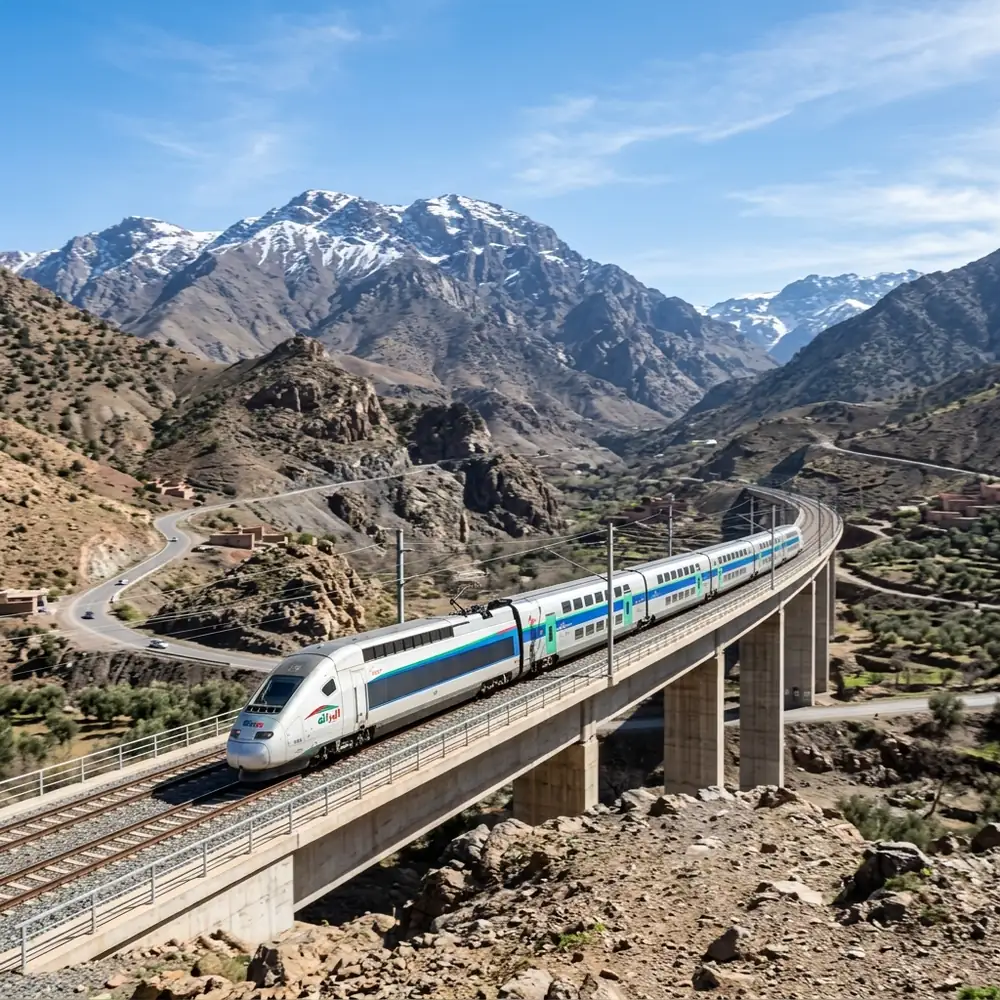
When Morocco launched the Al Boraq in 2018 — Africa’s first high-speed rail service — the world paid attention. Tangier to Casablanca in 2 hours and 10 minutes instead of 4 hours and 45 minutes. A machine built in France, running at 320 km/h across terrain that most people associate with camels.
But here is what the press releases did not emphasize: the Al Boraq only covers one route. And that route, while important, connects the north to the economic capital. The tourist heart of Morocco — Marrakech, the Saharan south, the Atlas Mountains — remains off the high-speed network.
In 2026, that is changing. Slowly, significantly, and not entirely according to the original timeline.
What the Al Boraq Is Today
The current service runs daily between:
Tangier Ville → Kénitra → Rabat Agdal → Casablanca Voyageurs
adventure time: approximately 2h10.
Tickets cost between 250–350 MAD (25–35 EUR) depending on class and how far in advance you book. Trains run frequently throughout the day, with first-class seats offering a legitimately comfortable experience: wide seats, power outlets, WiFi (variable quality), and a cafe car.
If you have only done the old overnight train between Marrakech and Fes, the Al Boraq is a revelation.
The Expansion Plans: What Is Confirmed
Morocco’s National Railway Office (ONCF) has officially announced a multi-phase expansion of the high-speed network. Here is what is confirmed with real funding and contracts:
Phase 1: Casablanca → Marrakech (High Speed)
Status: Under active construction
Target completion: 2029–2030 (aligned with World Cup)
Current adventure: 3h00–3h30 depending on service
Target adventure: Under 90 minutes
This is the most advanced project. The route south of Casablanca crosses the Chaouia plain — relatively flat terrain — before reaching Marrakech. Technically, it is the most straightforward of all the proposed extensions.
The new line will not follow the old rail corridor exactly. It will run partly elevated and partly below grade through the Casablanca suburbs, then across the agricultural plains.
Phase 2: Kénitra → Fes (High Speed)
Status: Partially constructed
Target completion: 2030
Current adventure: Approximately 1h40 on conventional rail
Target adventure: Under 60 minutes
The Kénitra–Fes section is important because it would allow passengers to travel Tangier–Casablanca–Fes on high-speed rail in a single seamless adventure. Given that Fes is Morocco’s cultural capital and one of the most visited cities, this matters enormously for tourism.
Phase 3: Casablanca → Agadir (High Speed)
Status: Planned; environmental impact studies underway
Target completion: 2035 (realistic)
Current adventure: 8–9 hours by train, 4+ hours by road
This is the ambitious one. The route from Casablanca to Agadir must cross or navigate around the High Atlas Mountains — a challenge with no easy solution. Options include a long tunnel through the mountains or a western coastal route that adds distance but avoids serious gradients.
The honest assessment: the Casablanca–Agadir high-speed link will not be ready for 2030. The engineering challenges are significant, funding timelines are long, and Morocco’s construction capacity is already stretched by other World Cup projects. Improved conventional rail to Agadir is the realistic 2030 target.
A Note on the Casablanca–Marrakech Situation in Practice
If you are visiting Morocco between now and 2029, the practical reality is this:
The CTM bus from Casablanca to Marrakech (around 100 MAD, 3.5 hours) is often more convenient than the current train — particularly for departure and arrival timing.
The existing conventional rail between Casablanca and Marrakech runs, but the adventure takes 3–4 hours and the connection via Settat is less comfortable than the Al Boraq.
Once the new high-speed line opens, this calculation completely reverses. A 90-minute Casablanca–Marrakech train will be one of the most useful connections in North Africa.
How This Changes Morocco Travel Planning
Think about what a functional high-speed network between Tangier, Casablanca, Marrakech, and Fes actually means:
- Tangier to Marrakech in under 4 hours (currently 9+ hours by train or a complicated adventure with connections)
- Day trips between Casablanca and Marrakech become genuinely feasible
- Flying domestically between Casablanca and Marrakech — which many people currently do — becomes largely unnecessary and more expensive than the train
For travellers, this will redraw the mental map of how to move through Morocco. The “you have to rent a car to see anything properly” advice, while still useful, will become less universally true.
The Agadir Problem and the Creative Solutions
Agadir is Morocco’s largest coastal resort city. About 3.5 million tourists visit annually, mostly Europeans arriving directly by charter flight. Currently, Agadir has no rail connection at all — not even conventional rail.
ONCF’s 2030 plan includes:
- A new conventional rail line connecting Agadir to the national network via Marrakech
- A new Agadir train station (currently being designed)
- Improved coach connections serving as rail substitutes until the line opens
The goal is that by 2030, arriving in Agadir by train — while not high-speed — will at least be possible. That is itself a significant upgrade from the current situation of zero.
Frequently Asked Questions
Can I take the Al Boraq from Marrakech to Tangier today? No. The Al Boraq currently only operates on the Tangier–Casablanca corridor. To travel between Marrakech and Tangier, you need to take conventional rail via Casablanca and Rabat, which takes approximately 8–10 hours total.
Is the Al Boraq comfortable? Very. First class particularly so. Wide reclining seats, power outlets at every seat, air conditioning, and a bar car serving coffee and light food. It compares favourably with European TGV services.
How do I book Al Boraq tickets? Through the ONCF website (oncf.ma) or at any train station ticket office. Advance booking is recommended for weekends and holidays.
Will the Casablanca–Marrakech high-speed line be ready before the World Cup? The target is 2029–2030. Given the scale of the project, a 2030 opening is realistic but not guaranteed. Some travel writers are pessimistic about the timeline; the Moroccan government remains publicly committed to it.
Experience the true heart of Moroccan heritage through its culinary traditions. Join us in preserving and honoring these ancestral recipes.
What People Are Saying
No comments yet. Be the first — we'd love to hear from you.
The Moroccan Editorial Team
Culturally Verified & Fact-CheckedThe Moroccan Food editorial team brings together native culinary researchers, heritage preservationists, and experienced home cooks across Marrakech, Fes, and Casablanca. Every recipe and cultural guide is reviewed against ancestral oral traditions and authentic regional practices.