Al-Qarawiyyin: The World’s Oldest Operating University
Al-Qarawiyyin: The World’s Oldest Operating University
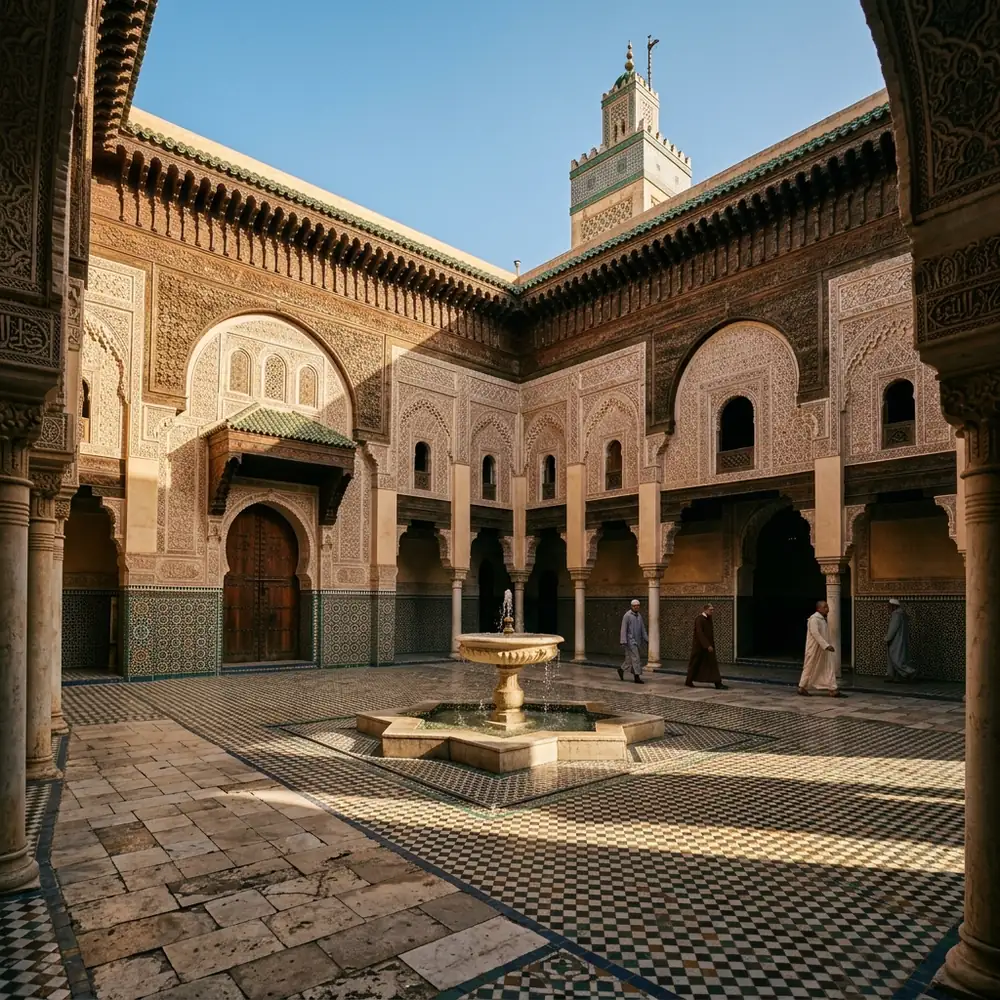
Did you know that the oldest continuously operating educational institution in the world was founded in Morocco by a visionary woman in the 9th century? Al-Qarawiyyin in Fes is a breathtaking, sprawling mosque and university that served as the intellectual epicenter of the Islamic Golden Age. Explore the ancient library and the geometric courtyards where global astronomy, mathematics, and philosophy were born.
In our Kingdom, the pursuit of knowledge is a holy endeavor. When a wealthy refugee named Fatima al-Fihri arrived in Fes in the year 859, she did not build a palace; she spent her entire inheritance constructing a humble mosque for her community. Our ancestors passed down the story of how this small prayer hall rapidly expanded into an academic powerhouse that attracted the greatest minds of Europe and the Arab world. Today, I invite you to walk the shaded cloisters. This is not a museum; it is a living, breathing sanctuary of scholars.
How did Fatima al-Fihri build the university?
The foundation of Al-Qarawiyyin is a story of extreme personal devotion and brilliant, sustainable architecture.
- The special fast: Historical accounts claim that Fatima fasted every single day from the moment construction began until the final stone was laid, treating the building process as a deep spiritual act.
- The local earth: She insisted that all building materials be sourced directly from the exact land she purchased, digging deep trenches to extract yellow clay and stone to ensure the site was completely pure.
- The Andalusian expansion: Over the centuries, subsequent dynasties expanded the humble mosque, adding breathtaking Andalusian courtyards, carved cedar wood ceilings, and massive green-tiled pavilions.
What is the legacy of the Al-Qarawiyyin Library?
Hidden within the university complex is one of the most important and closely guarded libraries on earth.
- The ancient manuscripts: The library holds thousands of priceless <truncated 47280 bytes> Judaism, blue represents the sky, the heavens, and the power of God.
- The cooling effect: Pragmatically, the thick, chalky blue wash aggressively reflects the harsh summer sun, keeping the interiors of the thick, mud-and-stone houses incredibly cool.
- The mosquito repellent: Locals also swear that the specific chemical composition of the blue pigment fiercely repels mosquitoes and other insects that plague the mountain springs.
How does the Andalusian influence show in the architecture?
Because the city was founded and populated by exiles from Granada and Cordoba, the architecture is distinctively non-Moroccan.
- The red-tiled roofs: Unlike the flat, terraced roofs of Marrakech or Fes, the houses of Chefchaouen feature steeply pitched roofs covered in curved, red Andalusian clay tiles to shed the heavy winter mountain snow.
- The central plaza: The town is anchored by the Plaza Uta el-Hammam, a wide, cobblestone square lined with cafes and shaded by massive trees, feeling entirely like a Spanish village square.
- The constant washing: The women of the village are obsessively dedicated to the blue wash, fiercely scrubbing and repainting the lower halves of the walls every single spring to maintain the brilliant hue.
Imagine stepping into a narrow, winding alleyway that goes straight up a mountain. Every single surface—the walls, the cobblestones, the heavy wooden doors, and the flower pots—is painted a different, brilliant shade of sky blue, indigo, or cobalt. A local woman walks past in a traditional red-and-white striped Rif mountain skirt, the colors popping violently against the blue walls. Our mountains are steep, and our walls are bright; come walk into the sky.
Meta Description: Discover Chefchaouen, the famous Blue City of the Moroccan Rif Mountains. Learn how Jewish and Andalusian exiles influenced the stunning blue walls and pitched red roofs.
Experience the true heart of Moroccan heritage through its culinary traditions. Join us in preserving and honoring these ancestral recipes.
What People Are Saying
No comments yet. Be the first — we'd love to hear from you.
Diafa Editor
Culturally Verified & Fact-CheckedThe Moroccan Food editorial team brings together native culinary researchers, heritage preservationists, and experienced home cooks across Marrakech, Fes, and Casablanca. Every recipe and cultural guide is reviewed against ancestral oral traditions and authentic regional practices.