The Almohad Empire: The Berber Dynasty That Ruled From Senegal to Spain and Built the Koutoubia
The Almohads: The Amazigh Empire Whose Buildings Are in Three Countries
The Almohad dynasty’s architectural legacy is distributed in a way that few other medieval dynasties’ can match: the Koutoubia mosque in Marrakech, the Giralda in Seville, and the Hassan Tower in Rabat are all Almohad constructions from the same late 12th century building program, all designed in the same architectural tradition, all expressing the same relationship between minaret proportions, sebka lattice decoration, and the Moroccan-Andalusian synthesis that the Almohad empire briefly unified under a single political authority.
Standing in front of the Koutoubia in Marrakech today and knowing that the Giralda — now the bell tower of Seville’s cathedral, its top section a 16th-century Renaissance addition — was built by the same architects, from the same design principles, at the same time, as part of the same imperial building program, is one of those historical facts that reorganizes the mental map of the medieval Mediterranean world. The Almohads were not a Moroccan dynasty that occasionally reached into Spain. They were a trans-Mediterranean empire whose political center was in Morocco but whose cultural and architectural ambition extended equally in all directions.
Who Were the Almohads and Where Did They Come From?
The Almohad movement began not as a political project but as a religious reform movement — the Tawhid (monotheist) movement founded by Ibn Tumart, a scholar from the Masmuda Amazigh tribe of the High Atlas who had studied in the Islamic east (Iraq, Syria) and returned to Morocco with a rigorous, reform-minded theological position that he began propagating in the Atlas villages in the 1120s.
Ibn Tumart’s theological reform — insisting on a strict interpretation of divine unity (tawhid, from which the Arabic name al-Muwahhidun, “those who affirm divine unity,” gave the dynasty its name, corrupted by European sources into “Almohad”) — had as its political corollary the rejection of the existing Almoravid dynasty as insufficiently orthodox. He organized the High Atlas Amazigh tribes into a movement that combined religious conviction with tribal solidarity and military capacity, and his successor Abd al-Mumin converted this religious-tribal movement into a conquering army that overthrew the Almoravids in Morocco (1147), swept east through Algeria and Tunisia, and crossed the straits to take control of the Andalusian territories.
What Was the Almohad Empire at Its Peak?
At its maximum extent in the late 12th century under Caliph Yaqub al-Mansur, the Almohad empire controlled:
Morocco — the entire territory, with Marrakech as the capital. Algeria, Tunisia, and western Libya — the full Maghreb. Al-Andalus — the remaining Muslim-controlled territories of the Iberian Peninsula, approximately the southern half of modern Spain and Portugal. And, at its southernmost extension, the Saharan territories and the northern fringes of what is now Senegal and Mauritania.
This was the largest empire in the western Islamic world and one of the largest political entities in the medieval Mediterranean — controlling territory that spanned from the Atlantic coast of Morocco to the borders of Egypt, and from the Atlas mountains to sub-Saharan Africa.
The combination of this geographical extent with the Almohads’ genuine intellectual ambition — they patronized the philosophers Ibn Rushd (Averroes) and Ibn Tufayl, whose work very influenced European scholasticism; the physician and philosopher Maimonides was also active in Almohad territory, though he eventually fled their religious pressure — makes the Almohad empire one of the most significant cultural forces of the 12th-century world.
What Are the Almohad Buildings and What Makes Their Architecture Specific?
The Almohad architectural signature is concentrated in the minaret form: a square tower with a sebka (diamond-grid with fleur-de-lis fillets) decorating the upper section, a lantern atop the shaft, and proportions that follow a specific rule — the shaft’s width is approximately one-fifth of its height.
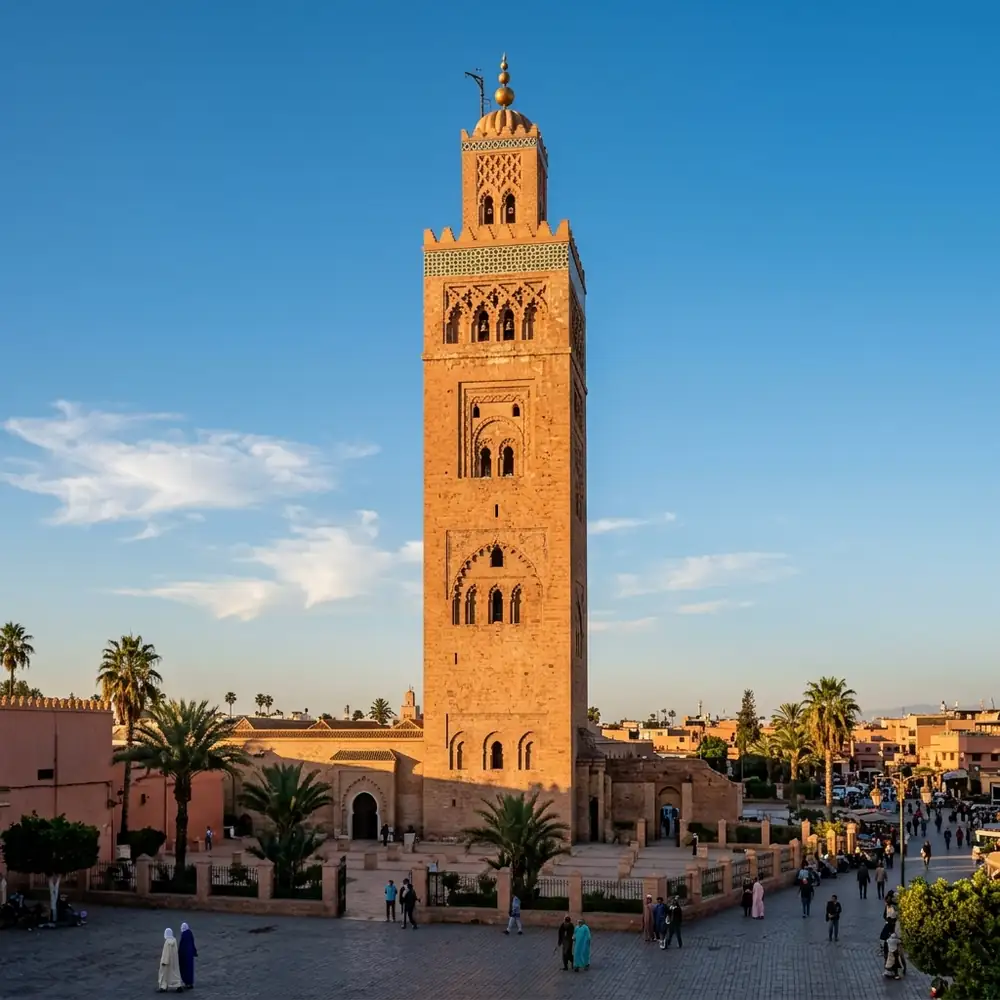
The Koutoubia minaret in Marrakech (completed approximately 1195) is the best-preserved Almohad minaret and the model against which the others are understood. The sebka decoration is visible on all four faces, the lantern with its brass jamur (sphere finials) intact, the proportions exactly as the Almohad canon specified. It is, by any standard, one of the most accomplished pieces of Islamic monumental architecture anywhere.
The Hassan Tower in Rabat — begun under Yaqub al-Mansur as the minaret of what was to be the largest mosque in the western Islamic world — was never completed. The sultan died in 1199 before the project was finished; the mosque was left as a forest of columns without a roof, and the minaret stands to approximately two-thirds of its intended height. Even incomplete, it is substantial enough that the proportions read correctly and the sebka decoration on the completed sections is of the same quality as the Koutoubia.
The Giralda — the minaret that became a Christian bell tower after the Reconquista — is visible in central Seville and has been incorporated into the Cathedral of Santa María de la Sede so extensively that its Almohad character requires some imagination to extract from its Renaissance top section. But the lower shaft — below approximately forty meters — is Almohad construction of the 1190s, built by the same architects who were simultaneously working in Marrakech and Rabat.
The Invisible Invitation
Stand in front of the Koutoubia in Marrakech at dusk — the hour when the tower is lit from below and the sebka decoration is visible in relief against the pale limestone, the sky behind it the specific blue of Marrakech dusk, the sound of the muezzin beginning from somewhere in the medina. You are looking at a building from 1195 that was designed by architects who were also designing in Seville at the same moment. The empire that commissioned it stretched from this square to that Spanish city. The architectural language they used is visible in both. Eight centuries later, the Koutoubia is still the height reference for every building in Marrakech’s medina — nothing may be built taller, by a city ordinance that maintains the minaret’s visual dominance over the skyline. The Almohads are eight centuries gone. Their proportional rule is still governing the height of every building in their former capital. This is the longevity of a good architectural decision.
SEO Meta Description: Who were the Almohad dynasty? The Amazigh empire from Morocco to Spain — Ibn Tumart’s reform movement, the Koutoubia, Hassan Tower, and Giralda as one architectural program, and Averroes as court philosopher.
Experience the true heart of Moroccan heritage through its culinary traditions. Join us in preserving and honoring these ancestral recipes.
What People Are Saying
No comments yet. Be the first — we'd love to hear from you.
Omar Idrissi
Culturally Verified & Fact-CheckedThe Moroccan Food editorial team brings together native culinary researchers, heritage preservationists, and experienced home cooks across Marrakech, Fes, and Casablanca. Every recipe and cultural guide is reviewed against ancestral oral traditions and authentic regional practices.