Argan Oil of the Souss: UNESCO Biosphere Economics, Sustainable Extraction & Women's Cooperative Wealth
Argan Oil of the Souss: UNESCO Biosphere Economics, Sustainable Extraction & Women’s Cooperative Wealth
Across the sun-drenched coastal plains and rolling limestone foothills of southwestern Morocco stands an ancient, spiny tree of miraculous biological resilience: Argania spinosa, the argan tree. Thriving in hyper-arid soils where virtually no other tree can survive, this endemic botanical titan is the cornerstone of the Arganeraie UNESCO Biosphere Reserve, an ecological sanctuary covering over 830,000 hectares across the Souss-Massa and Essaouira basins.
Known by the indigenous Amazigh people as Arjan (the tree of life), argan oil is neither a passing cosmetic trend nor a simple cooking fat. It is a recognized Protected Geographical Indication (IGP Huile d’Argane), the very first African agricultural product to obtain formal geographical protection from the European Union. Beyond its golden culinary fragrance and dermatological potency, argan oil represents the most successful model of female economic emancipation and ecological desert barrier management in modern North Africa.
This definitive economic and scientific dossier examines the official production metrics of the argan sector, its unique fatty acid and antioxidant profile, the vital work of over 350 rural female cooperatives, and the national Arganiculture strategy transforming barren hillsides into high-yield agroforestry plantations.
The UNESCO Biosphere: Morocco’s Living Desert Wall
The argan tree is an evolutionary marvel. With root systems capable of penetrating up to 30 meters deep into subterranean limestone fissures, a single mature argan tree acts as a living hydraulic pump, stabilizing fragile topsoils and preventing the hyper-arid Sahara desert from marching northward into the fertile agricultural heartlands of Morocco.
In 1998, UNESCO formally designated the 830,000-hectare habitat as the Arganeraie Biosphere Reserve, followed in 2014 by the inscription of the ancestral practices and savoir-faire of argan production on the UNESCO Representative List of the Intangible Cultural Heritage of Humanity.
Several ecological factors define this unique biosphere:
- Oceanic Microclimate: Coastal maritime fog from the Atlantic rolls inland across the Souss plain, condensing on the thick, waxy leaves of the argan tree and providing hydration during prolonged summer droughts.
- Extreme Heat Tolerance: The tree can withstand ambient temperatures exceeding +50°C. During acute droughts, it sheds its foliage and enters metabolic hibernation, reviving within days of the first autumn rains.
- Sylvopastoral Equilibrium: Under ancestral customary law (Agdal), argan groves are protected communal assets. Grazing herds of goats and camels are barred from forest tracts during fruit ripening periods, ensuring regeneration of young wild saplings.
Official Sector Statistics: ANDZOA & MAPMDREF Data
The modern governance of the argan value chain is steered by the National Agency for the Development of Oasis Zones and the Argan Tree (ANDZOA) alongside the Ministry of Agriculture, Maritime Fisheries, Rural Development, Water and Forests (MAPMDREF).
The table below compiles certified data from multi-year sector surveys, international trade registries (Morocco Foodex), and cooperative censuses:
| Key Sector Metric | Official Data | Institutional Source |
|---|---|---|
| Total Biosphere Surface Area | 830,000 Hectares (Spanning 7 Provinces) | ANDZOA Forestry Cadastre |
| Estimated Tree Population | Approximately 20 Million Wild Trees | High Commission for Waters and Forests |
| Annual Oil Production Volume | 4,200 to 5,300 Metric Tons | MAPMDREF National Argan Survey |
| Fruit Required for 1 Liter of Oil | 30 to 35 kg of Fresh Fruit (~2.5 kg Dried Kernels) | National Argan Federation (FIMARGANE) |
| Active Certified Cooperatives | 360+ Licensed Cooperatives (100% Women-Operated) | Office for the Development of Cooperation (ODCO) |
| Direct Female Beneficiaries | Over 32,000 Rural Cooperative Members | Ministry of Solidarity and Social Inclusion |
| Global Export Market Value | Exceeds 1.85 Billion MAD ($185M+ USD) | Morocco Foodex (EACCE) Export Registry |
| Domesticated Orchard Objective | 50,000 Hectares by 2030 (Génération Green Plan) | Agricultural Development Fund (FDA) |
These quantitative indicators highlight the scale of the argan sector as a bedrock of rural Moroccan employment, regional stabilization, and foreign exchange revenue.
Biochemistry of Liquid Gold: Cosmetic vs Culinary Purity
What elevates authentic Moroccan argan oil above olive, avocado, or almond oils is its uniquely balanced lipid profile and concentrated bioactive unsaponifiable fraction:
Fatty Acid Composition (Codex Alimentarius & Moroccan Standard NM 08.5.090)
- Monounsaturated Oleic Acid (Omega-9): Comprises 43 to 49 percent of total fatty acids, contributing to cardiovascular health and cellular longevity.
- Polyunsaturated Linoleic Acid (Omega-6): Represents 29 to 36 percent, essential for maintaining epidermal moisture barriers and regulating inflammatory pathways.
- Saturated Palmitic & Stearic Acids: Balanced at 11 to 15 percent and 4 to 7 percent respectively, giving the oil structural stability and resistance to rancidity.
The Power of the Unsaponifiable Fraction
Beyond healthy fats, argan oil contains an extraordinary concentration of non-lipid micro-nutrients:
- Alpha-Tocopherol (Vitamin E): Natural argan oil contains between 600 and 700 mg/kg of active vitamin E, more than double the concentration found in premium extra virgin olive oil. This potent antioxidant neutralizes free radicals and shields skin cells from oxidative stress.
- Schottenol and Spinasterol: Rare phytosterols almost non-existent in other commercial vegetable oils, celebrated in clinical dermatological trials for anti-inflammatory and cellular repair mechanisms.
- Squalene: An organic precursor that mirrors human sebum, allowing the oil to absorb rapidly into deep dermal layers without leaving greasy residues.
The Crucial Distinction: Culinary vs Cosmetic
- Cosmetic Argan Oil: Pressed directly from raw, unroasted kernels. The resulting oil is pale golden, has a very faint herbal scent, and preserves maximum vitamin E and phytosterols for facial care, hair hydration, and scar tissue recovery.
- Culinary Argan Oil: The kernels are gently roasted over low wood embers before mechanical or stone pressing. This artisan toasting triggers subtle Maillard reactions, producing a rich, dark amber oil bursting with intoxicating aromas of toasted hazelnuts, warm sesame, and brioche.
The Cooperative Revolution: Amazigh Women at the Center
Before the late 1990s, the argan market was dominated by informal middlemen who purchased whole nuts at negligible prices, leaving rural families impoverished.
The cooperative model, pioneered by Moroccan university researchers and government social agencies, transformed the entire socioeconomic landscape:
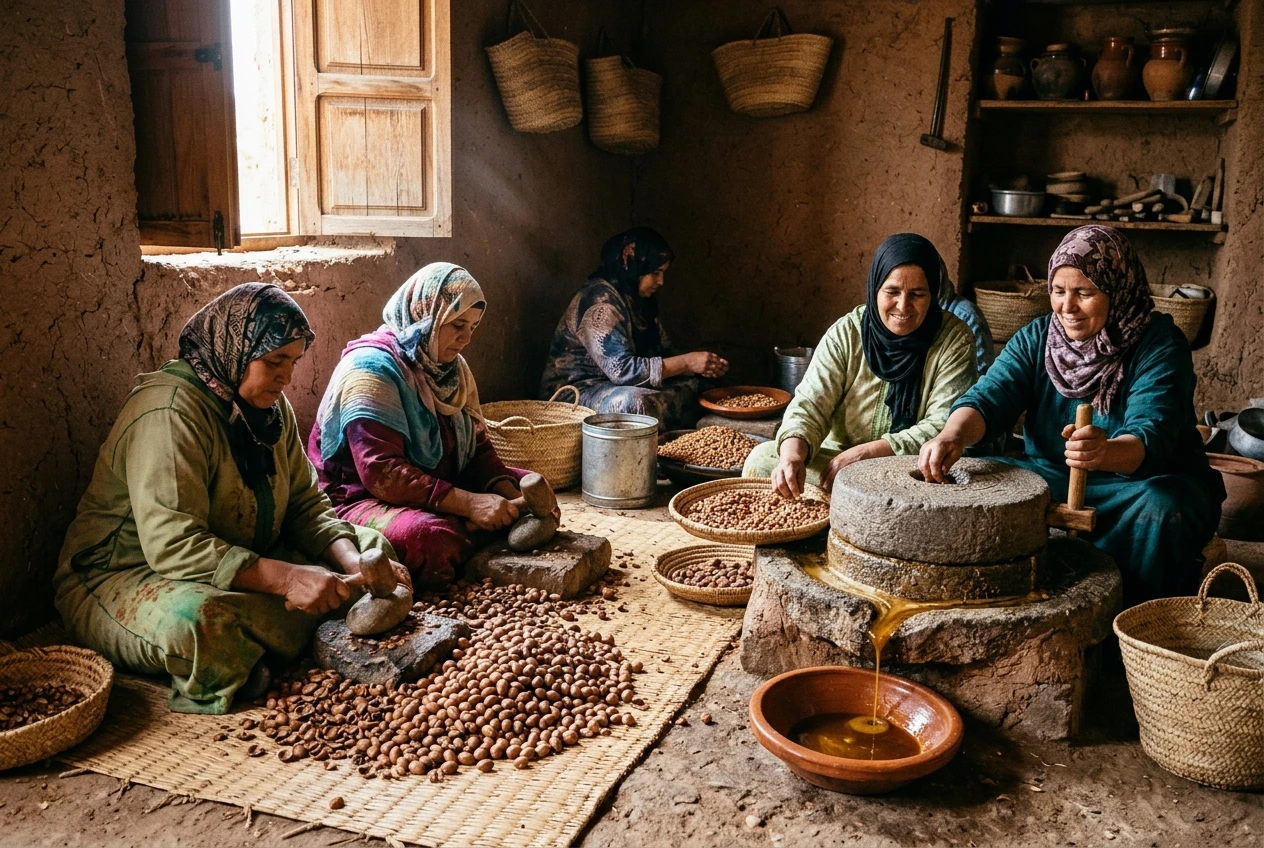
- Nut Cracking Mastery: Cracking an argan nut requires surgical precision. The inner nut shell is sixteen times harder than a hazelnut. Women sit on woven carpets, placing each nut on a flat river anvil (Tazeyt) and striking it with a smooth quartzite stone (Agou) without crushing the delicate oily kernels inside. No industrial machine has yet matched the speed and defect-free precision of human hands.
- Cold Mechanical Pressing: While traditional rotary stone mills (Azrg) are preserved for artisan demonstrations, certified cooperatives press kernels using stainless steel hydraulic cold-presses below 40°C, followed by natural cellulose filter presses, guaranteeing zero water contamination and long shelf life.
- Social Transformation: Cooperative revenues flow directly into female bank accounts. In remote hamlets of the Anti-Atlas, these wages have funded secondary school transport for rural girls, equipped villages with solar power, and fostered a new generation of female community leaders and entrepreneurs.
Culinary Art: The Soul of the Southern Feast
In Moroccan gastronomy, culinary argan oil is never treated as a cheap frying medium; it is a sacred finishing oil, celebrated for its complex nutty bouquet:
- The Sacred Trio of Amlou: The crown jewel of Amazigh hospitality. Whole sweet almonds from the Anti-Atlas are toasted, finely ground on granite stones into a silky paste, and whipped with raw mountain wildflower honey and pure toasted culinary argan oil. Eaten warm with fresh crusty barley bread (Khobz Beldi), it is the ultimate morning energy elixir.
- The Souss Tagine Finish: A traditional Dada never pours argan oil into a blazing hot tagine. Instead, right before serving a slow-simmered tagine of tender kid goat with caramelized prunes or wild sea bass with baby turnips, two tablespoons of unheated culinary argan oil are swirled across the top. The residual steam activates the roasted hazelnut aromatics, creating a lingering savory depth.
- Breakfast Dipping: Poured pure into hand-painted ceramic saucers alongside black olives, goat cheese (Jben Beldi), and hot mint tea, providing sustained morning vitality.
Frequently Asked Questions (FAQ)
What makes IGP Argan Oil different from generic argan oil on the market?
The IGP (Indication Géographique Protégée) seal guarantees that the argan fruit was harvested exclusively within the delimited geographical zone of southwestern Morocco, processed under strict sanitary protocols defined by ONSSA, cold-pressed without chemical solvents (such as hexane), and bottled according to certified traceability standards.
Why do some commercial argan oils smell sour or goat-like?
Inferior, uncertified argan oils are sometimes pressed from nuts that passed through the digestive tracts of tree-climbing goats. High-end, certified IGP cooperatives strictly forbid the use of goat-digested nuts; they harvest fruit directly from the branches or collect freshly fallen fruit protected from livestock, ensuring a clean, sweet nutty aroma free of rancid or animal odors.
How should I store pure culinary argan oil to preserve its flavor?
Store culinary argan oil in an airtight dark glass bottle in a cool pantry away from direct sunlight and stovetop heat. When kept properly, it retains its fresh roasted flavor and antioxidant richness for up to 24 months.
Experience the true heart of Moroccan heritage through its culinary traditions. Join us in preserving and honoring these ancestral recipes.
What People Are Saying
No comments yet. Be the first — we'd love to hear from you.
Houssam Elmrabet
Culturally Verified & Fact-CheckedHoussam Elmrabet is a Moroccan researcher in territorial marketing and cultural heritage preservation. His work documents regional gastronomic identities, local agricultural heritage, and how ancestral culinary traditions define authentic territorial branding across the Kingdom.