Atlas Mountains Trekking in Morocco: Multi-Day Hikes, Berber Homestays, and What to Pack for the High Peaks
Atlas Mountains Trekking in Morocco: Multi-Day Hikes, Berber Homestays, and What to Pack for the High Peaks
The first time I brought a friend from London to the Toubkal circuit, she spent the first hour of the walk staring at her feet, watching the rocky path, adjusting her pack. Then we rounded a spur at about 2,600 meters, the Mizane Valley opened below us in a sweep of terraced barley fields and walnut trees and Berber houses the same color as the earth, and she stopped walking entirely. Just stopped. Stood there for a long time.
That’s what the Atlas does to people. Not the obvious drama of the summit — though Jbel Toubkal at 4,167 meters is drama enough — but this quieter, more accumulated shock of scale, of beauty, of realizing that a country you thought you knew contains entire worlds you hadn’t imagined.
This guide is for the people who want to go into those worlds properly.
Understanding Atlas Mountain Trekking: The Basics
The High Atlas range runs 2,400 kilometers across Morocco, Algeria, and Tunisia, but the portion accessible from Marrakech — the Western High Atlas, centered on Toubkal National Park — is what most people mean when they talk about trekking in Morocco. It’s within three hours of Marrakech, well-serviced by local guides and muleteer networks, and contains terrain ranging from comfortable valley walks to serious alpine ascents.
There are essentially three types of experiences available here:
Day hikes from Imlil: The main trailhead village, Imlil, sits at 1,740 meters and can be reached from Marrakech by taxi or shared transport in about ninety minutes. From Imlil, several excellent half-day and full-day walks are accessible without specialized equipment — through Aït Mizane village, up to the Toubkal refuge, or along the Azzaden Valley.
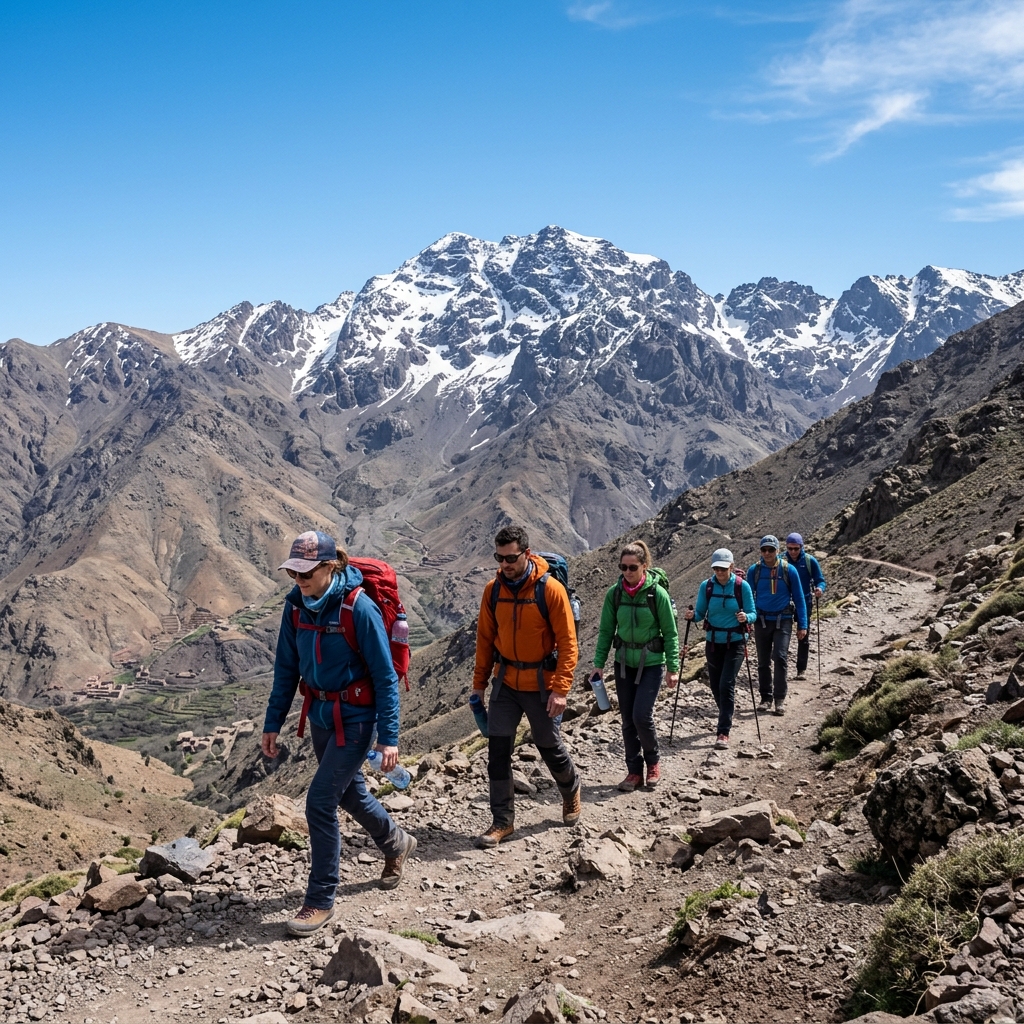
The Toubkal Summit: The most popular multi-day trek — usually done over two or three days — involves ascending to the CAF refuge at 3,207 meters and then summiting Toubkal at 4,167 meters. No technical climbing is required in summer, but the altitude is serious and should be respected. In winter and spring, the final section requires crampons and an ice axe.
Longer circuits: The full Toubkal circuit (typically 5–7 days) takes you over multiple passes above 2,500 meters, through Berber villages that see far fewer tourists than Imlil, and through landscape that shifts from alpine to sub-Saharan in ways that feel geologically improbable.
The Berber Villages: Why the adventure Matters More Than the Summit
I’ve guided people to the top of Toubkal dozens of times over the years. What I find more interesting, and what people remember longer, isn’t the summit — it’s the villages.
Around Imlil and throughout the Toubkal massif, Amazigh (Berber) communities have farmed these valleys for centuries. The houses are built from local stone and mud brick, often three or four stories, with the animals living on the ground floor and the family above — a system that makes complete thermal sense at altitude. Flat rooftops double as summer dining areas and winter storage. Water comes from mountain springs via a network of irrigation channels (seguias) that predate French colonialism by many centuries.
The villages aren’t museums. They’re working agricultural communities. Children walk to school. Women bake bread in communal ovens. Men tend walnut and apple orchards. And if you’re there as a trekker with an overnight program, you’re likely to sleep in a Berber home rather than a formal hotel — which is one of the great privileges available to travelers in Morocco.
Berber Homestays: What to Expect
Most trekking programs in the Atlas include at least one night in a gite — a simple Berber family home that takes paying guests. The experience varies enormously depending on the family and the village, but certain constants apply.
The food will be extraordinary. This is not false advertising. Berber mountain cooking — tagines slow-cooked over charcoal, fresh bread baked daily, mountain herbs gathered that morning, walnut oil from the family orchard — is some of the most honest and satisfying food in Morocco. If you’re offered dinner and breakfast by your hosts, accept enthusiastically.
The sleeping arrangements will be simple: mattresses on the floor in a shared room, or occasionally private rooms in better-equipped gites. Bring a warm sleeping bag liner even in summer — temperatures at altitude drop sharply after dark.
The social dynamic will reward openness. Some trekkers try to keep a tourist-to-service relationship with their homestay hosts. The better approach is to sit around the dinner table, accept the inevitable mint tea, attempt whatever fragment of Tachelhit or Darija you’ve learned, and let the evening unfold. What still surprises me even today is how quickly the warmth of a proper Berber household becomes the best memory of a trip.
Tip: learn to say ‘Tanmirt’ (thank you in Tachelhit, the language of the Souss and High Atlas Amazigh communities). The reaction you’ll get is worth every moment of the effort.
Choosing a Guide: The Essential Decision
The Atlas is not a place to navigate without local knowledge — not because it’s technically impossible, but because trails are not always well-marked, weather can change with astonishing speed, and the cultural connections that make the experience more than just physical exertion require a guide who knows the villages and the families.
Hire a licensed mountain guide (guide de montagne) rather than a general tourist guide. Mountain guides are trained specifically for the terrain, carry first aid qualifications, and are registered with the government. In Imlil, several guide cooperatives operate — ask your riad in Marrakech to arrange the connection or contact the Bureau des Guides in Imlil directly.
A good guide will also arrange mules for carrying heavy bags, which I strongly recommend for multi-day treks. The mule network employs local muleteer families and transforms a potentially grueling experience into a genuinely pleasurable one. Your legs do the walking; the mule does the heavy lifting.
What to Pack: The Honest List
For summer trekking (June–September):
- Layers, always. A T-shirt start and a fleece-and-windproof finish. Temperatures above 3,000 meters can be cold even in July at night.
- Proper trekking boots with ankle support. Not trail runners. The terrain is rocky and sometimes loose.
- Sunscreen SPF 50+ and a hat with a proper brim. At altitude, UV radiation is significantly stronger than at sea level.
- A 2–3 liter water capacity (bottles or reservoir) and water purification tablets.
- Headlamp, with spare batteries.
- A trekking pole — surprisingly helpful on steep descents over loose rock.
- Altitude medication: discuss with a doctor before departure if you’re planning to summit Toubkal.
For winter or spring trekking (November–May):
- Add crampons and an ice axe for the Toubkal summit — genuinely non-negotiable in these conditions.
- Serious insulation: down jacket, warm sleeping bag.
- Waterproof outer layers.
The Best Seasons
June through September: The classic trekking season. Reliable weather, warm days, cold nights at altitude. The Atlas is green in early summer from snowmelt and increasingly parched by August. Avoid the peak of August in Imlil itself — the trailhead village gets genuinely busy.
October and November: My personal favorite period. The crowds have thinned dramatically, the light is extraordinary, the walnut trees turn gold, and the air has a clarity that makes distant peaks look almost close enough to touch.
Winter (December–March): The Atlas is transformed by snow. Toubkal summit requires proper alpine experience and equipment. But the lower valleys are beautiful, frequently snow-dusted, and almost empty of tourists. Worth considering for experienced hikers.
April and May: Variable. Snow still on the high passes, mud in the valley paths. The almond blossom in the lower valleys (late February through March) is spectacular. A specialist season for those who know what they’re getting into.
Getting Started
Start from Marrakech, which has excellent transport connections to Imlil (take a shared taxi from the Bab Rob taxi stand, or arrange a private transfer). Spend at least two nights on the mountain — one night is never enough to feel the rhythm of the place. And resist the temptation to rush to the summit. The Atlas reveals itself gradually, and the people you meet along the way — the muleteer who tells you about his children studying in Marrakech, the gite owner who shows you how to make bread — are the point as much as the view from the top.
The mountain is patient. Walk at its pace, not yours.
Experience the true heart of Moroccan heritage through its culinary traditions. Join us in preserving and honoring these ancestral recipes.
What People Are Saying
No comments yet. Be the first — we'd love to hear from you.
Hamid Ouazzane
Culturally Verified & Fact-CheckedThe Moroccan Food editorial team brings together native culinary researchers, heritage preservationists, and experienced home cooks across Marrakech, Fes, and Casablanca. Every recipe and cultural guide is reviewed against ancestral oral traditions and authentic regional practices.