The Best Moroccan Food in Marrakech: A Local's Honest Guide to Where and What to Eat
If you walk through the medina of Marrakech, you will be handed a menu every fourteen seconds. Marrakech has thousands of restaurants, cafes, and street food stalls. Yet, somehow, many visitors end up eating the exact same dry chicken skewer at the exact same tourist traps.
You deserve better. The food in this city is incredible, provided you know exactly where to look and what to order. Let’s talk about the best Moroccan food Marrakech has to offer, focusing on the places locals actually frequent and the regional specialties you simply cannot leave without trying.
The Night Stalls of Jemaa el-Fna (And How to Survive Them)
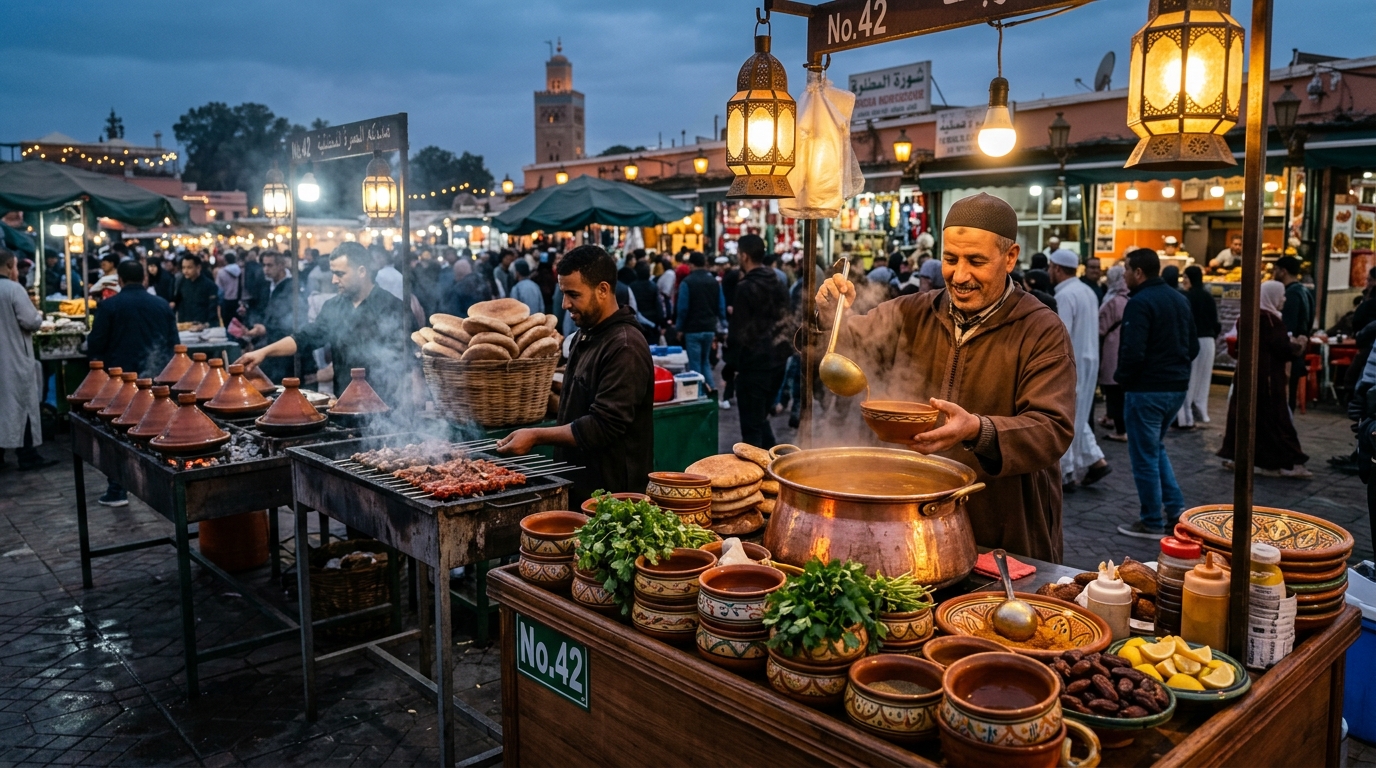
When the sun sets, Jemaa el-Fna transforms into the biggest open-air kitchen on the continent. The smoke rising from the grills is a beautiful sight. But it can be overwhelming. Vendors will aggressively try to charm you into sitting at their stall.
My advice? Skip the huge seafood displays—you are in a desert city, not on the coast. Instead, look for the stalls with a single massive pot of harira soup, surrounded by locals sitting shoulder-to-shoulder on wooden benches. A bowl of harira here, served with a sticky, sweet chebakia cookie, costs almost nothing and tastes like homemade perfection.
For grilled meats, find the stalls specializing solely in kefta (seasoned minced meat) and lamb skewers. The rule is simple: eat where you see Moroccan families eating. If the menu has 40 different items including pizza, keep walking.
The Secret Mechoui Alley
Hidden away near Rahba Kedima (the spice square) is “Mechoui Alley.” You won’t find comfortable seating here. Instead, you’ll find clay ovens buried deep into the ground. Every morning, whole lambs are lowered into these pits and slow-roasted for hours until the meat literally melts off the bone.
You walk up to a vendor, order a quarter kilo of mechoui, and they serve it to you on a piece of paper with a pinch of salt and ground cumin. You eat it with your hands using fresh, warm khobz (Moroccan bread). It is, without a doubt, one of the best eating experiences in the world. Get there before 1 PM, because they always sell out.
Tanjia Marrakchia: The City’s Signature Dish
If there is one dish that defines Marrakech, it is the Tanjia. Do not confuse this with a Tagine.
A Tanjia is a clay urn. The dish is traditionally prepared by the men of the city. They take chunks of beef or lamb, garlic, cumin, saffron, pickled lemons, and a dollop of smen (aged, fermented butter), place it all in the urn, seal it with paper and string, and take it to the farnatchi—the man who tends the wood fire heating the local hammam (bathhouse).
The urn is buried in the hot ashes and left to slow-cook overnight. The result is an intensely savory, sticky, tender meat stew with a flavor profile unique to Marrakech. You will find it in small local joints deep in the medina. Order it, and your understanding of Moroccan cuisine will permanently change.
Couscous with Smen and Msemen Breakfasts
Most restaurants serve couscous every day, but real Moroccan families only eat it on Fridays after midday prayers. If you find a spot serving “Friday Couscous” specifically, that’s where you want to be. The local Marrakech style often incorporates a heavy dose of smen, giving the broth a funky, deep umami flavor that pairs perfectly with caramelized onions and raisins (tfaya).
For breakfast, skip the hotel buffet. Walk out into the medina alleys and look for a woman working a flat griddle over a gas burner. She is making msemen—a square, flaky, layered flatbread. Ask for one cooked fresh, spread with soft cheese and a drizzle of local honey, paired with a glass of blistering hot mint tea. It is the only way to start a morning in Marrakech.
Frequently Asked Questions
Is street food safe to eat in Marrakech? Yes, generally. Stick to busy stalls with high turnover where you can see the food being cooked fresh in front of you. Avoid raw salads or unpeeled fruit at street stalls if you have a sensitive stomach.
What is the best drink to have in the medina? The fresh orange juice carts in Jemaa el-Fna are legendary for a reason. The oranges are incredibly sweet. Just ask for it “without sugar” and “no ice” to get the pure, safe, freshly squeezed juice.
Do I need reservations for medina restaurants? For the high-end riad restaurants, yes. For the local spots and street stalls, absolutely not. Just walk up, find a seat, and enjoy.
Experience the true heart of Moroccan heritage through its culinary traditions. Join us in preserving and honoring these ancestral recipes.
What People Are Saying
No comments yet. Be the first — we'd love to hear from you.
The Moroccan Food
Culturally Verified & Fact-CheckedThe Moroccan Food editorial team brings together native culinary researchers, heritage preservationists, and experienced home cooks across Marrakech, Fes, and Casablanca. Every recipe and cultural guide is reviewed against ancestral oral traditions and authentic regional practices.