Bissara: The Ultimate Northern Moroccan Winter Comfort Food
When cold mountain fog rolls down the limestone crests of the Rif and blankets the blue alleys of Chefchaouen, northern Morocco runs on one single source of heat: Bissara. Long before dawn breaks over the Atlantic coast in Tangier or the mountain terraces of Taounate, small corner shops fire up giant aluminum and tin cauldrons. The steam carries a thick, grounding perfume of slow-simmered dried fava beans, sweet garlic, and sharp mountain olive oil that cuts clean through the winter chill.
Bissara is not merely a soup. In the Moroccan north, it is an everyday social equalizer. At seven in the morning, a government official, a carpenter, a taxi driver, and a university student sit elbow to elbow on low wooden benches, each hunched over an identical earthenware bowl (zlafa), tearing off steaming pieces of dense country bread (khobz ed-dar) to scoop up the golden mash before heading into the cold. It costs barely a few dirhams, yet its richness rivals any elaborate palace feast.
Here is the complete story of Bissara, the regional nuances between fava beans and green peas, the strict culinary rules passed down through rural households, and how to make an authentic pot at home without shortcuts.
The Two Faces of Bissara: Fava Beans vs. Split Peas
While visitors often hear of Bissara as a single generic recipe, every northern cook knows there are two distinct variations depending on geography and harvest:
1. Bissara d’el Foul (Dried Split Fava Beans)
This is the ancestral foundation of the dish, dominant across the Rif mountains, Chefchaouen, Tetouan, and down toward Fes. It relies on peeled, dried fava beans (foul gnaoua or foul yabess). When dried fava beans cook down slowly with water and garlic, their starches release into a velvety, creamy paste with a deep, earthy flavor and a light beige-golden hue.
2. Bissara d’el Jilbana (Dried Split Green Peas)
In towns across the Gharb plains and coastal communities near Larache and Asilah, green split peas (jilbana yabsa) take center stage, either alone or blended half-and-half with dried fava beans. Green pea Bissara yields a sweeter, lighter broth with an olive-green tone. Many home cooks prefer this blend for evening meals because split peas digest slightly lighter than whole fava beans.
In genuine mountain households, winter always belongs to pure fava beans. Their high iron content and slow-burning complex carbohydrates keep field laborers and mountain families satiated for six to eight hours in freezing weather.
The Sacred Trinity of Bissara: Beans, Garlic, and Fire
Unlike vegetable soups that build flavor on aromatic bases of chopped onions, celery, and tomatoes, true northern Bissara permits no extraneous additions. Traditional cooks follow a minimalist philosophy where each raw ingredient must be exceptional:
- The Beans: High-quality dried split beans must be thoroughly rinsed in cold water until the water runs clear. Old, dusty beans from the back of a cupboard will remain grainy and take hours longer to soften.
- Whole Fresh Garlic (Thouma): Never powdered or sautéed in oil beforehand. Whole cloves are peeled and dropped directly into the cold water alongside the beans. As the water boils, the garlic softens completely, losing its harsh sharpness and melting into a mellow, buttery sweetness that perfumes the entire broth.
- Cold Water and Pure Boiling Heat: The beans must start in cold water so the starch granules hydrate evenly from the inside out. Once the pot hits a rolling boil, the cook must stand watch with a flat wooden spoon to skim away the dense white foam (kefsha) that rises to the surface. Skimming this foam is crucial: it removes bitter compounds and prevents the soup from boiling over into a volcanic mess on your stovetop.
The Skimming Ritual: Why Patience Matters
If you watch a rural mountain cook tending a terracotta pot (qdra) over an outdoor majmar brazier, you will notice they do not leave the kitchen during the first twenty minutes of boiling.
As the fava beans heat up, proteins and saponins form a thick, stubborn froth on top of the broth. If this foam is stirred back into the liquid, the final soup will turn cloudy, slightly bitter, and significantly harder to digest. A patient cook lifts off every trace of white froth with a shallow ladle. Only after the surface water runs clear does the lid go on loosely, turning the flame down to a gentle, steady purr for sixty to ninety minutes until the beans collapse into mush at the touch of a spoon.
The Finishing Touches: Cumin, Soudaniya, and Liquid Gold
In traditional Moroccan cookery, Bissara is never spiced inside the cooking pot. No salt, no pepper, and no cumin touch the beans while they simmer on the flame. Salt added too early can toughen the skins of legumes, lengthening the cooking time unnecessarily.
Instead, Bissara is salted right at the end when blending, and seasoned individually in the serving bowl. The ritual of eating involves three mandatory finishing touches:
- Freshly Ground Mountain Cumin (Kamoun Beldi): Cumin from the anti-Atlas or eastern plains has an intense aroma that aids digestion and balances the heavy starch of the legumes. It is dusted liberally over the surface just before eating.
- Fiery Cayenne Pepper (Soudaniya): Sun-dried, finely pounded red chili flakes give each spoonful a pleasant warmth that clears the sinuses on cold mornings. In local eateries, a tin of red pepper sits on every table alongside a tin of cumin.
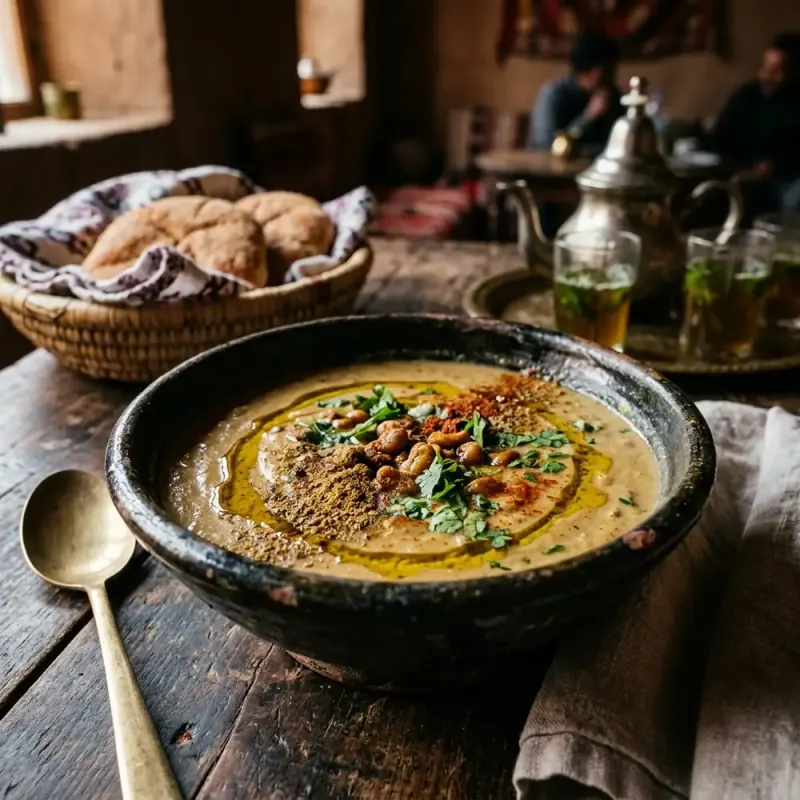
- First-Cold-Pressed Extra Virgin Olive Oil (Zit Zitoune): This is non-negotiable. Bissara is merely a vehicle for high-grade olive oil. Just before serving, the cook creates a deep spiral of dark green, peppery, unfiltered olive oil across the top of the bowl. As you scoop each bite with bread, you pull through both the warm, creamy bean mash and the fruity pool of green oil.
Authentic Northern Moroccan Bissara Recipe
This recipe serves four people generously and follows the time-tested northern method.
Ingredients:
- 500 g dried split fava beans (foul gnaoua), carefully sorted and rinsed
- 1.8 liters cold water
- 8 to 10 cloves fresh garlic, peeled and left whole
- 1.5 teaspoons fine sea salt (added at the end)
- 4 tablespoons extra virgin olive oil (for blending)
For the Table Garnishes:
- 100 ml premium extra virgin olive oil (preferably cold-pressed and pungent)
- 2 tablespoons freshly toasted, ground cumin (kamoun)
- 1 tablespoon hot ground red chili (soudaniya)
- Warm crusty Moroccan round bread (khobz) or semolina bread (harcha)
Step-by-Step Instructions:
- Rinse the Beans: Place the split fava beans into a large bowl. Cover with cold water, swirl with your fingers, and drain. Repeat three times until the rinse water is completely clear and free of dust.
- Bring to a Boil: In a heavy-bottomed Dutch oven or deep soup pot, combine the rinsed beans, peeled whole garlic cloves, and 1.8 liters of cold water. Do not add salt or oil at this stage. Set the pot over medium-high heat.
- Skim the Foam: As the water reaches a boil, a dense white head of foam will rise to the top. Use a wide metal spoon or skimmer to remove every trace of this foam over the course of 10 to 15 minutes.
- Simmer Gently: Once the broth stays clear, lower the heat to medium-low, cover the pot partially with a wooden spoon holding the lid slightly ajar, and let it simmer for about 75 minutes. Stir every 15 minutes to ensure the beans do not stick to the bottom of the pot.
- Blend to Silk: When the beans are completely soft and fall apart into puree between your fingers, remove the pot from the heat. Add the sea salt and 4 tablespoons of olive oil. Using an immersion blender (or a traditional Moroccan wire food mill), blend until the soup becomes smooth, glossy, and pale gold. If the soup feels too thick, stir in half a cup of boiling water until it reaches the consistency of heavy pancake batter.
- Serve Piping Hot: Ladle the steaming Bissara into wide, shallow clay bowls. Drizzle a generous pool of raw olive oil over each portion. Dust heavily with ground cumin and a pinch of fiery red pepper. Serve immediately with warm bread.
How to Eat Bissara Like a Local
In Morocco, spoons are considered optional when Bissara is served. The authentic way to eat is using khobz (round Moroccan flatbread).
Tear off a piece of bread roughly the size of your thumb, press the crust between your thumb and forefinger to form a small spoon-shaped pouch, dip into the bowl to capture a pocket of olive oil and hot bean puree, and eat in one swift motion. A small dish of purple cured Moroccan olives (zitoun meslala) and raw red onion wedges often sits on the side, providing a crisp, sharp crunch that cuts through the velvety richness of the soup.
Frequently Asked Questions
What is the difference between Bissara and Egyptian Foul Mudammas?
While both dishes rely on fava beans, Egyptian Foul Mudammas uses whole unpeeled brown fava beans that are slow-stewed overnight and served chunky with tahini, lemon juice, and cumin. Moroccan Bissara uses peeled split fava beans (or split peas) simmered with garlic until fully melted, then pureed into a silky, velvety soup served strictly with olive oil and cumin.
Can I make Bissara with split peas instead of fava beans?
Yes, absolutely. In northern coastal cities like Larache and Asilah, green split peas are widely used. The cooking method is identical, though green split peas tend to cook slightly faster (around 50 to 60 minutes) and produce a sweeter, green-tinted soup. You can also mix equal parts fava beans and split peas for a balanced flavor.
Why did my Bissara turn thick like cement after cooling?
Split fava beans contain enormous amounts of natural starch that continue absorbing liquid even after the pot leaves the stove. As Bissara cools, it naturally sets into a firm paste. To reheat, simply place it back on low heat, whisk in boiling water a little at a time, and stir until it loosens back into a velvety, pourable consistency.
Is Bissara healthy and good for weight loss?
Bissara is one of the most nutrient-dense plant-based dishes in the Mediterranean diet. It contains zero cholesterol, no dairy, and no added sugars. A single bowl provides over 15 grams of plant protein, rich dietary fiber that supports gut health, iron, and potassium, while the raw olive oil provides healthy monounsaturated fats. It promotes long-lasting fullness without blood sugar spikes.
Experience the true heart of Moroccan heritage through its culinary traditions. Join us in preserving and honoring these ancestral recipes.
What People Are Saying
No comments yet. Be the first — we'd love to hear from you.
Samira
Culturally Verified & Fact-CheckedSamira researches rural foodways and wild mountain herbs across the High Atlas and Rif, championing local farmers and small-scale cooperatives.