Buying a Riad in Morocco in 2026: Legal Traps, Taxes, and the Honest ROI Calculation
Buying a Riad in Morocco in 2026: Legal Traps, Taxes, and the Honest ROI Calculation
Every year, several hundred Europeans and North Americans buy riads in Morocco. Some of them have wonderful experiences and end up with thriving boutique guesthouses or beautiful retirement homes. Others spend years in legal disputes, discover structural problems that were hidden by clever staging, or find that the title deed they were handed is not actually valid.
This guide is for the ones who want to be in the first group.
What Is a Riad, Legally Speaking?
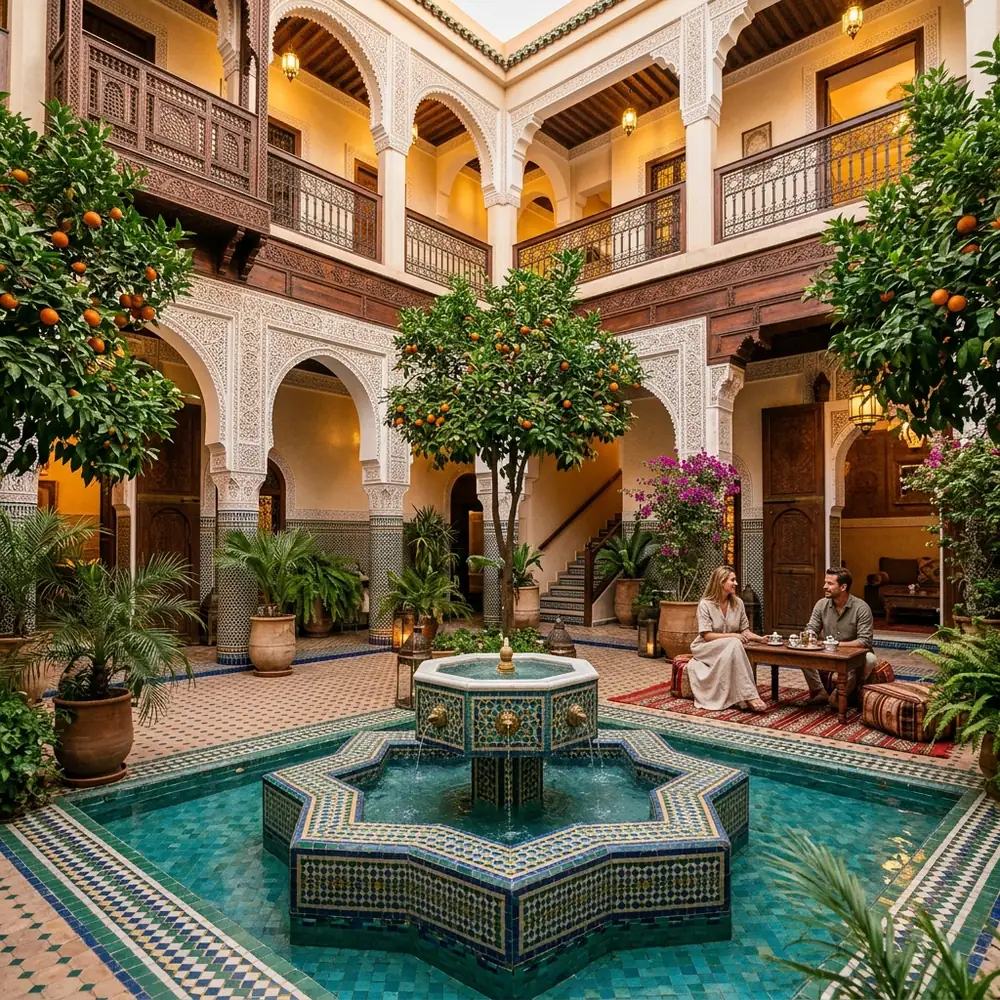
A riad (from Arabic “ryad,” meaning garden) is a traditional Moroccan courtyard house. Blank exterior walls, all light directed inward to a central courtyard with a fountain or orange trees. They exist primarily in the old medinas of Marrakech, Fes, Meknes, Essaouira, and Chefchaouen.
Legally, many riads sit on land designated as historical heritage zones, which creates specific planning restrictions. You cannot simply knock down walls or add floors. Any structural modification requires approval from INSAP (National Institute of Archaeological Sciences) and the Regional Directorate of Cultural Affairs.
This is not a reason to avoid buying. It is a reason to understand what you are getting into.
Can Foreigners Buy Property in Morocco?
Yes, fully. Morocco allows 100% foreign ownership of real estate with no nationality restrictions.
Your rights as a foreign buyer:
- Own property directly in your personal name
- Establish a Moroccan company (SARL or SA) to hold property
- Repatriate funds from a future sale, provided the original purchase was made in foreign currency and properly documented through the banking system
What you cannot do: Purchase agricultural land outside certain approved investment structures, or property in certain restricted military or border zones.
Step-by-Step: How a Riad Purchase Works
Step 1: Finding the Property
Most riads for sale are listed through local agencies (agences immobilières). There is no central MLS-style database like in Europe or the US.
Warning: A single riad is often listed by multiple agencies simultaneously at different prices. The agency showing it to you first is not necessarily the one with a legitimate sale mandate. Always ask to see the written mandate from the owner.
International platforms like Mubawab and Avenue de l’Immobilier list properties with more standardised information, but local agencies often have access to unlisted properties.
Step 2: Verify the Title Deed (Titre Foncier)
This is the most critical step in Moroccan property law. Two main title types exist:
Titre foncier (registered): The property is registered with Morocco’s Conservation Foncière (land registry). Your ownership is protected by the state. This is the gold standard.
Melkia (traditional/unregistered): A historical Islamic ownership certificate. Common in old medinas where properties predate the formal registry. Not worthless, but carries legal risk.
Never buy without verifying title at the Conservation Foncière. This verification (called “état de situation”) costs a few hundred dirhams and tells you: who legally owns the property, whether there are mortgages or liens attached, and whether the title is contested.
If the seller refuses this verification: walk away. Every time.
Step 3: Independent Structural Survey
Old riads have specific vulnerabilities that staging can hide:
- Foundation problems near old water channels
- Roof and terrace waterproofing failures penetrating interior walls
- Informal electrical and plumbing installed decades ago
- Structural walls altered without planning permission
Always commission an independent structural survey before making any offer. Moroccan architects familiar with traditional construction charge 2,000–5,000 MAD for this. EU-standard surveying firms also operate in Casablanca and Marrakech.
Step 4: The Compromis de Vente
Once you agree a price, the standard procedure is a “promise of sale” signed by both parties with a deposit (typically 10–25% of the purchase price).
This document is legally binding. If you withdraw without valid cause, you lose the deposit. If the seller withdraws, they owe you double — in theory. Enforcing this in Moroccan courts takes years in practice.
Have a qualified Moroccan lawyer review the compromis before you sign. Budget 2,000–5,000 MAD for this.
Step 5: The Notaire
The final deed must be signed before a Moroccan notaire, who represents both parties, verifies the title, collects transfer taxes, and registers the new ownership. For purchases involving foreign buyers, a modern notaire (rather than a traditional adoul) is the appropriate choice.
The Taxes You Need to Budget For
At purchase:
- Transfer tax: 4% of purchase price (3% if under 4 million MAD)
- Conservation Foncière registration fee: 1% of purchase price
- Notary fees: 0.5–1% of purchase price
- Agency commission: Typically 2.5–3% — paid by the buyer in Morocco (different from most European countries)
Total transaction costs: budget 7–10% on top of the property price.
During ownership:
- Taxe d’habitation and Taxe de services communaux: Annual municipal taxes based on the estimated rental value of the property. Primary residences held personally may be partially exempt.
On sale:
- Capital gains tax (TPI): 20% of net gain. Properties held for more than 10 years are exempt from TPI — a significant consideration for long-term investors.
ROI: What Riads Actually Return
The optimistic scenario:
A Marrakech medina riad purchased for 3,000,000 MAD (~270,000 EUR):
- Annual gross rental income (well-managed guesthouse): 400,000–700,000 MAD
- Operating costs (staff, maintenance, platform fees, utilities): 200,000–350,000 MAD
- Net annual income: 150,000–350,000 MAD
- Gross yield: 5–12% — strong by European standards
The honest scenario:
Same property, same price:
- Renovation costs before operating: 500,000–1,500,000 MAD (structural surprises are common)
- Time to obtain operating licences: 3–6 months minimum
- Year 1 occupancy typically 40–50%
- Net income in year 1: often minimal or negative
The honest summary:
Riads are good medium-to-long-term investments if you:
- Have capital for purchase plus renovation plus 1–2 operating loss years
- Have trustworthy local management if you are not resident
- Plan to hold for 7–10+ years to benefit from TPI exemption and appreciation
- Did thorough legal and structural due diligence first
They are poor investments if you expect quick returns from a light renovation.
Frequently Asked Questions
Can I get a Moroccan mortgage as a foreigner? Yes, but conditions are strict: 30–50% down payment typically required, interest rates higher than EU equivalents. Most foreign buyers purchase in cash.
Is Essaouira cheaper than Marrakech? Significantly — 40–60% less for a comparable property. The trade-off is lower tourism density and lower rental income potential.
Do I need to live in Morocco to own property there? No. Many foreign owners are non-resident. You will need a local property manager if renting out.
What happens in a legal dispute? Moroccan courts have jurisdiction over Moroccan real estate regardless of nationality. Proceedings are slow. Prevention through thorough due diligence is vastly preferable to litigation.
Experience the true heart of Moroccan heritage through its culinary traditions. Join us in preserving and honoring these ancestral recipes.
What People Are Saying
No comments yet. Be the first — we'd love to hear from you.
The Moroccan Editorial Team
Culturally Verified & Fact-CheckedThe Moroccan Food editorial team brings together native culinary researchers, heritage preservationists, and experienced home cooks across Marrakech, Fes, and Casablanca. Every recipe and cultural guide is reviewed against ancestral oral traditions and authentic regional practices.