The Chellah: Where Roman Ruins Became a Medieval Royal Necropolis Became a Garden of Storks
The Chellah: Three Civilizations, One Site, and the Storks Who Own It Now
There is a particular quality that sites of layered historical occupation develop — where one civilization’s infrastructure has been built upon, reused, broken apart, and overgrown by the successive presence of two or three others — and that quality is density in a specific sense: not the spatial density of crowded buildings but the temporal density of many different human purposes compressed into a single place. The Chellah outside Rabat has this quality more completely than almost any site I know in Morocco.
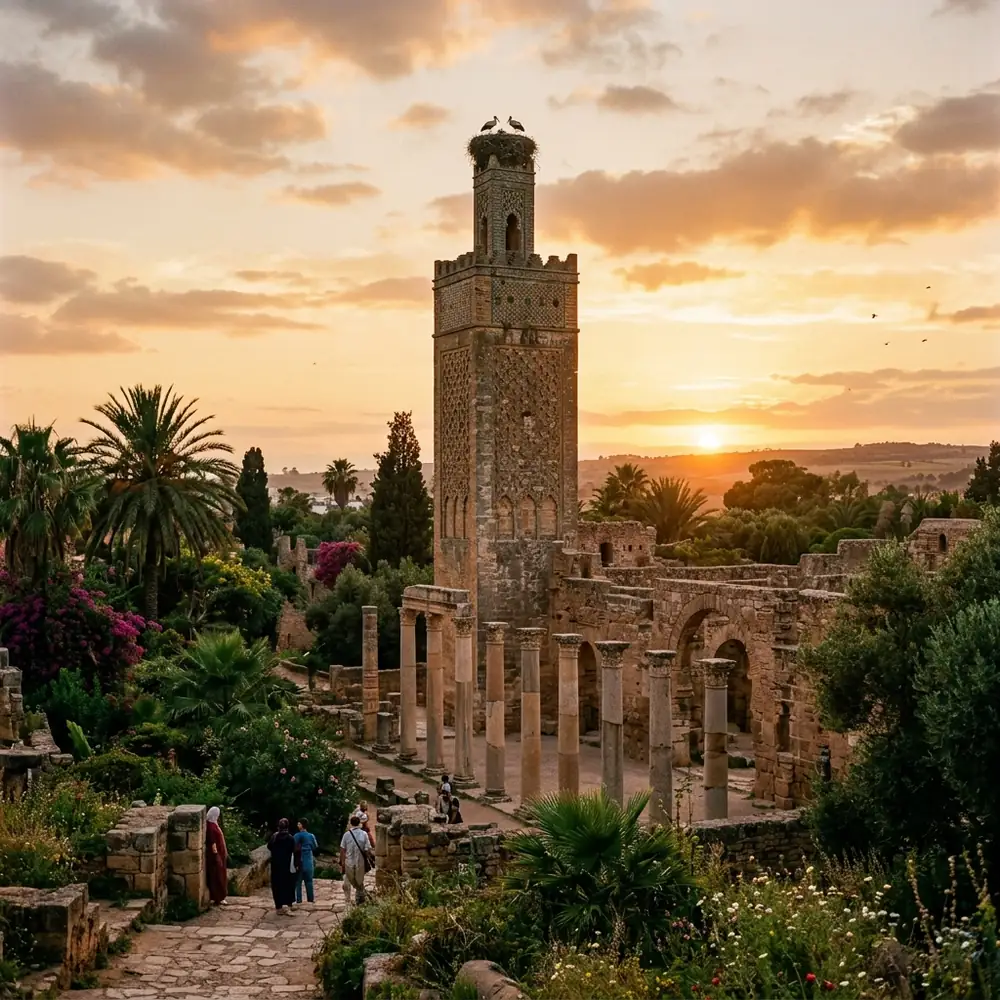
On the same ten hectares: a Roman city (Sala Colonia), occupied from at least the 1st century BCE through the 3rd century CE, whose forum, baths, and street grid are partially excavated and visible. Directly overlaid on parts of the Roman city: a Merinid royal necropolis, constructed by Sultan Abu al-Hassan in the 14th century, containing the tombs of several Merinid sultans and their family members, with an attached mosque and madrasa whose ruins are substantially intact. Over both: a dense growth of vegetation — fig trees, reeds, wild herbs — that has been colonizing the ruins since the site was abandoned in the 15th century and that has now become so established it is itself part of the Chellah’s character. And on the medieval minarets and the tops of the crumbling Merinid walls: the nests of a large colony of white storks (Ciconia ciconia), who arrive in spring to breed and whose nests — enormous, accumulated over decades of repeated use — have reshaped the tops of medieval architecture into something that was not planned by any human architect.
The storks, in my opinion, are the most important part of the Chellah experience, and I will return to them.
What Was Roman Sala Colonia and What Remains of It?
Sala Colonia — the Roman administrative city on the Bou Regreg river’s southern bank — was a significant presence in the Roman province of Mauretania Tingitana, which encompassed northern Morocco from approximately 40 CE (when the region was absorbed into the Roman Empire) through the late 3rd century when Roman control of the region’s southern territories effectively ended.
What remains visible at the Chellah: portions of the Roman forum, the forum’s surrounding colonnade with some columns still standing, the traces of the Roman street grid (visible as slight depressions in the ground that correspond to the Roman cardo and decumanus), fragments of the Roman baths, and the remnants of walls. None of this is as spectacular as the comparable Roman remains in Tunisia or Libya, and the partially excavated, partially overgrown condition of the Roman sections makes them require some imagination to read — you are looking at archaeological evidence rather than a preserved monument.
The Roman necropolis at Chellah predates the Merinid one and its grave markers and sarcophagi fragments are scattered through the site, partly incorporated into later structures. The Merinid builders used Roman stone elements extensively in their 14th-century construction — reuse of existing masonry being standard practice in medieval building — and Roman dressed stone is visible embedded in Merinid walls throughout the site.
What Is the Merinid Necropolis and What Are Its Most Important Elements?
Sultan Abu al-Hassan — the most ambitious builder of the Merinid dynasty, responsible for the magnificent white marble minbar of the Taza mosque and the Chellah’s construction — commissioned the necropolis and its attached mosque and madrasa as the dynastic burial complex of the Merinid ruling family. Abu al-Hassan himself is buried at Chellah, as is his wife Shams al-Duha, whose tomb is particularly notable for its elaborate zellige and carved plaster decoration.
The mosque is now roofless — the wooden roof structures that covered it in the 14th century have long since decayed — but the minaret survives substantially intact, its exterior decorated with the sebka lattice pattern that is the Merinid architectural signature. The minaret’s top section has been occupied by a stork nest for at least several decades; the nest now forms a significant portion of the minaret’s visible silhouette.
The madrasa adjacent to the mosque — smaller than the great Fassi madrasas but using the same three-zone decorative vocabulary — retains portions of its carved plaster and zellige tilework in reasonable condition given the centuries of exposure without roof cover. The zellige is faded and weathered but the geometric patterns remain legible.
Why Are the Storks the Most Important Part?
Because they are the element of the Chellah that cannot be planned, cannot be architecturally specified, and cannot be replicated anywhere else. The white storks chose this specific site for reasons that are theirs — the fishing access of the Bou Regreg below the walls, the elevated platform of the medieval ruins, the absence of human disturbance within the enclosure — and have been returning to the same nests, on the same broken minarets and walls, for generations. Each year’s nest is built on the previous year’s nest, and the accumulated material — branches, reeds, debris — has created structures on the medieval masonry that are themselves decades old.
The visual effect of white storks standing on medieval Moroccan minarets, against a sky that is either the clean blue of a Rabat summer or the heavy grey of an Atlantic winter, is one of those images that resists adequate description and that photographs consistently fail to convey at full impact. The storks are large — wingspan over two meters — and their presence on architectural elements that were designed for human use creates a scale comparison that makes the medieval construction look both larger and more fragile simultaneously.
In spring, when the storks are breeding and the nests contain eggs or chicks, the colony is noisy — the specific clacking of stork beaks, which is their primary communication sound, is audible from the lower parts of the Chellah and is one of the most distinctly Chellah sounds, specific to this place.
The Invisible Invitation
Come to the Chellah in the late afternoon when the site is nearly empty of visitors — it closes at sunset and the last hour before closing is usually quiet. Walk directly to the minaret with the stork nest at its top. Stand beneath it and look up. The stork standing on the edge of the nest — one parent guarding while the other feeds — will look down at you with the perfect equanimity of an animal that has never been threatened by human presence at this specific location. The Roman stone beneath your feet and the medieval minaret above you and the stork on top of it are three different temporal registers present simultaneously. The stork is the one paying the least attention to this fact and possibly has the best relationship with it. Go before sunset. The light on the minaret in the last thirty minutes before closing is the same light that has been falling on it for seven hundred years. The stork has been watching it for decades. You have perhaps fifteen minutes. Use them.
SEO Meta Description: What is the Chellah in Rabat? Roman Sala Colonia, Merinid royal necropolis, the Abu al-Hassan mosque ruins, and the white stork colony on medieval minarets — three civilizations in one site.
Experience the true heart of Moroccan heritage through its culinary traditions. Join us in preserving and honoring these ancestral recipes.
What People Are Saying
No comments yet. Be the first — we'd love to hear from you.
Omar Idrissi
Culturally Verified & Fact-CheckedThe Moroccan Food editorial team brings together native culinary researchers, heritage preservationists, and experienced home cooks across Marrakech, Fes, and Casablanca. Every recipe and cultural guide is reviewed against ancestral oral traditions and authentic regional practices.