Cornes de Gazelle: The Delicate Almond Pastry of Moroccan Royalty
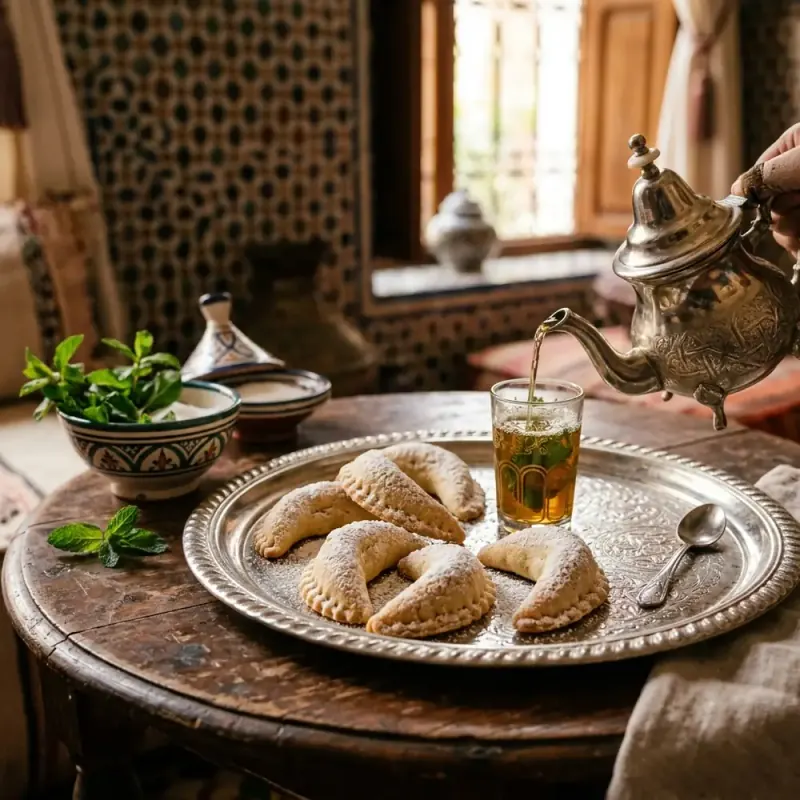
If a silver tray of pastries arrives at a Moroccan reception without Kaab el Ghazal, the gathering is simply not complete. In our pastry hierarchy, honey-drenched chebakia belongs to the lively communal spirit of Ramadan, and crumbly ghoriba belongs to everyday afternoon tea. But the Gazelle Horn (Corne de Gazelle in French, or Kaab el Ghazal in Darija) stands alone on a pedestal. It is the aristocrat of Moroccan confectionery: quiet, pale, understated, and astonishingly luxurious.
For centuries, women in the old quarters of Fes, Rabat, and Tetouan judged the refinement of a household by the translucency of its pastry skin and the fineness of its almond paste. A thick, doughy crescent is considered a culinary failure. A genuine Gazelle Horn must possess a pastry casing so thin you can see the golden almond filling beneath it, baked only until the crust sets without taking on more than a whisper of pale blonde color.
To bite into a properly prepared Kaab el Ghazal is an unforgettable sensory experience. The outer shell shatters with the faintest crispness, giving way immediately to a dense, chewy, moist almond center that releases clean notes of orange blossom water, cinnamon, and the mystical resin of mastic gum.
Here is the deep culinary heritage behind Morocco’s most revered pastry, the unforgiving technical rules that define its mastery, and the authentic recipe used in traditional medina homes.
The Linguistic Mystery: Ankle or Horn?
The name of this pastry carries a fascinating linguistic history. In Moroccan Arabic, it is called Kaab el Ghazal (كعب الغزال), which translates literally to “the ankle of the gazelle”, referring to the slender, delicate curve of a desert gazelle’s lower leg.
When French culinary writers documented North African sweets in the nineteenth and twentieth centuries, they misheard or poetically reinterpreted kaab (ankle) as qarn (horn), christening the pastry Cornes de Gazelle. Today, both terms are understood worldwide, but in Moroccan kitchens, elders still affectionately call them K’yebat (little gazelle heels).
Whatever you choose to call them, their shape is unmistakable: an elegant, tapering crescent with plump bellies and pointed tips, curved like a waxing crescent moon.
What Separates Real Kaab el Ghazal from Commercial Replicas
Because almonds are precious and time-consuming to prepare, modern commercial bakeries frequently cut corners. If you purchase a gazelle horn from a tourist bakery and find it dry, tough, or cloying, you have fallen victim to commercial shortcuts.
In a genuine artisanal kitchen, three uncompromising standards are observed:
- One Hundred Percent Pure Almonds: Authentic recipes permit zero fillers. Commercial bakeries often bulk their paste with semolina, potato starch, or cheap blanched peanuts flavored with artificial almond extract. True Moroccan almond paste (ouqda) is made solely from sweet local almonds (louz beldi), ground fresh with granulated sugar.
- Double Stone Grinding: The almonds are blanched, dried on clean linen towels overnight, and passed through a heavy mill twice. The first grind produces a coarse sand; the second grind with fine sugar creates a malleable, cohesive paste that can be rolled between your palms like clay without crumbling.
- The Translucent Wrapper (L’ajina): The dough is not puff pastry, phyllo, or shortcrust. It is a simple elasticity dough made from fine wheat flour, melted clarified butter, and orange blossom water. It is rested for hours and rolled out paper-thin on an oiled marble slab until you can read printed text through the sheet.
The Secret Aromatics of the Medina
The filling is not merely ground nuts and sugar; it carries a delicate balance of botanicals that gives Moroccan sweets their distinctive identity:
- Steam-Distilled Orange Blossom Water (Ma Zhar): True orange blossom water comes from bitter Seville orange groves around Khemisset and Fes. It is distilled in heavy copper alembics during the April blossom harvest. A couple of tablespoons of genuine floral water perfume the almonds without introducing excess moisture that would make the filling weep during baking.
- Mastic Gum (Meska Horra): Tiny, pale yellow translucent tears of resin harvested from the mastic tree on the Greek island of Chios. Moroccan pastry cooks grind three or four tears with a half-teaspoon of sugar in a heavy brass mortar. When incorporated into the almond dough, mastic gum gives the filling its iconic elastic chewiness (ta’laka) and a faint piney freshness.
- Ceylon Cinnamon (Qerfa): Only a tiny pinch is used. Too much cinnamon darkens the pale golden color of the almonds, which old Fassi families consider unrefined. The cinnamon must linger in the background like a distant warm shadow.
- Aged Salted Butter (Smen) or Clarified Butter: A single teaspoon of clarified butter worked into the almond paste keeps the fats lubricated during baking, ensuring the interior remains moist for weeks.
The Forgotten Technique: The Overnight Dry
The most common mistake made by beginner bakers is baking the pastries immediately after shaping. If a fresh, moist gazelle horn is placed straight into a hot oven, the moisture inside the almond paste expands into steam before the outer wrapper can set. The result is catastrophic: the pastries balloon, tear, crack open at the seams, and lose their elegant crescent form.
To achieve bakery-grade perfection, shaped gazelle horns must sit uncovered on baking trays in a cool, drafty room for twelve to twenty-four hours before entering the oven.
During this prolonged rest, the outer skin dries out, forming a smooth, leathery parchment barrier that locks the moisture inside. Just before baking, each horn is pricked three or four times with a clean dressmaker’s needle along its spine, providing tiny escape chimneys for steam. When baked in a moderate oven, the crust hardens into an eggshell-thin shell while the almonds steam gently inside without expanding.
Master Recipe for Traditional Kaab el Ghazal
This recipe yields approximately 35 to 40 traditional pastries.
For the Almond Filling (L’ouqda):
- 500 g raw sweet almonds (preferably skin-on Moroccan beldi almonds)
- 250 g fine white granulated sugar
- 30 g unsalted butter, softened at room temperature
- 2 to 3 tablespoons pure food-grade orange blossom water
- 3 small tears of genuine mastic gum (meska horra), crushed with a pinch of sugar
- 1/4 teaspoon ground Ceylon cinnamon
- A tiny pinch of fine sea salt
For the Pastry Casing (L’ajina):
- 250 g fine pastry flour (bleached all-purpose, sifted)
- 50 g unsalted butter, melted and cooled
- 1 egg yolk (optional, for elasticity)
- 1 tablespoon powdered sugar
- 1/4 teaspoon fine sea salt
- 80 to 100 ml orange blossom water diluted with cold water, to bind
Step 1: Preparing the Almond Paste
- Blanch the almonds in boiling water for 60 seconds. Drain immediately, squeeze each nut out of its brown skin, and spread them in a single layer over clean kitchen towels. Allow the blanched almonds to dry completely at room temperature for at least 8 hours or overnight. Moisture is the enemy of good paste.
- In a food processor, pulse the dry almonds once to a coarse meal. Add the 250 g of granulated sugar and process in batches until the mixture transforms into a smooth, slightly warm, pliable dough that holds together when squeezed.
- Transfer the almond paste to a wide clay dish (gasaa). Knead in the softened butter, crushed mastic gum, cinnamon, salt, and orange blossom water one tablespoon at a time. Knead for 5 minutes until glossy and smooth.
- Roll the almond paste into small sausage shapes (fingers) weighing roughly 20 grams each, tapering both ends slightly. Cover with plastic wrap so they do not dry out.
Step 2: Preparing and Rolling the Casing
- Sift the flour into a bowl with the powdered sugar and salt. Make a well in the center, add the melted butter and egg yolk, and rub the fats into the flour with your fingertips until crumbly.
- Gradually drizzle in the orange blossom water mixture while gathering the dough. Knead vigorously for 10 minutes until you have a smooth, elastic, firm dough that is not sticky.
- Divide the dough into four balls, wrap tightly in cling film, and let rest at room temperature for at least 1 hour (or up to 4 hours) to relax the gluten.
Step 3: Shaping the Crescents
- Lightly grease your work surface with a few drops of vegetable oil (never flour, which dries out the wrapper). Roll out one portion of dough until it is paper-thin and nearly transparent.
- Place an almond sausage onto the lower third of the dough. Fold the bottom edge of dough up and over the almond filling.
- Using the sides of your hands and fingers, press the dough tightly around the almond filling, pushing out any trapped air bubbles. Shape the filling into an upright crescent moon, pinching the top ridge slightly higher than the base.
- Using a fluted pastry wheel (jerrara), cut around the base of the crescent, leaving a 3 mm border of dough.
- Transfer the shaped horn to a parchment-lined baking sheet. Repeat with remaining dough and almond paste.
Step 4: The Crucial Resting and Baking
- Leave the filled trays uncovered in a cool room for at least 12 hours (overnight) to let the outer casing form a dry skin.
- The next morning, preheat your oven to 160°C (320°F).
- Using a clean needle, gently prick each horn 3 times on the backside and twice along the top spine.
- Brush each pastry very lightly with melted clarified butter.
- Bake for 12 to 15 minutes on the middle rack. The bottoms should turn a delicate pale golden color, while the tops must remain pale white or light ivory. Do not allow them to brown.
- Remove from the oven and allow them to cool completely on the baking sheet before touching them. When warm, they are fragile; as they cool, the casing firms up.
Regional Variations: Tetouani Glazed Kaab
While the classic Fassi style is baked plain to showcase the translucent skin, coastal Tetouan and Chefchaouen boast a glamorous celebratory variation called Kaab el Ghazal M’fannad (or Kaab M’sakkar).
Immediately after baking, warm pastries are quickly dipped into an orange blossom water syrup, drained on a wire rack for two minutes, and then rolled in mounds of triple-sifted icing sugar until coated in a snow-white blanket. In northern weddings, these snowy crescents are displayed in silver pyramids beside mint tea.
How to Store Gazelle Horns
Because pure almond paste contains natural oils and sugar that act as natural preservatives, Kaab el Ghazal keeps remarkably well. Store cooled pastries in an airtight metal tin or glass jar with sheets of wax paper separating each layer.
Keep them in a cool, dry pantry away from direct sunlight; they will remain moist and chewy for up to three weeks. In fact, many connoisseurs argue that gazelle horns taste even better three days after baking, as the floral water and almond oils meld together inside the pastry.
Frequently Asked Questions
Why did my Gazelle Horns crack and blister in the oven?
Cracking occurs for two reasons: skipping the overnight drying step or leaving trapped air pockets between the almond paste and the dough. If the wrapper does not dry into a firm skin before baking, the expanding almond steam tears the tender pastry. Always dry the shaped horns for at least 12 hours and prick each one with a needle before baking.
Can I make Kaab el Ghazal with store-bought almond flour?
While store-bought blanched almond flour can be used in an emergency, the texture will not be identical. Commercial almond flour has had some of its natural oils pressed out and is often too dry. If using almond flour, grind it in a food processor with the sugar to release its oils, and you may need to add an extra half-tablespoon of softened butter to achieve the necessary elasticity.
Should Gazelle Horns be browned when baked?
No. Unlike European croissants or cookies that rely on deep golden-brown caramelization, Moroccan Gazelle Horns must remain pale ivory or light cream on top. Only the very underside resting on the baking parchment should have a delicate golden hue. Overbaking dries out the almond filling and makes the pastry brittle.
Are Gazelle Horns served warm or cold?
They are always served at room temperature. Fresh from the oven, the hot almond paste is too soft and the delicate wrapper can tear easily. Allowing them to cool completely locks in the moisture and allows the perfumed flavors of orange blossom water, cinnamon, and mastic gum to mature to their peak.
Experience the true heart of Moroccan heritage through its culinary traditions. Join us in preserving and honoring these ancestral recipes.
What People Are Saying
No comments yet. Be the first — we'd love to hear from you.
Khadija
Culturally Verified & Fact-CheckedKhadija is an artisanal pastry baker focused on the heritage of Moroccan confectionery, from hand-shaped almond gazelle horns to honey-soaked Ramadan pastries.