Dakhla Oyster & Marine Terroir: How Sustainable Atlantic Aquaculture Is Transforming the Moroccan Sahara
Dakhla Oyster & Marine Terroir: How Sustainable Atlantic Aquaculture Is Transforming the Moroccan Sahara
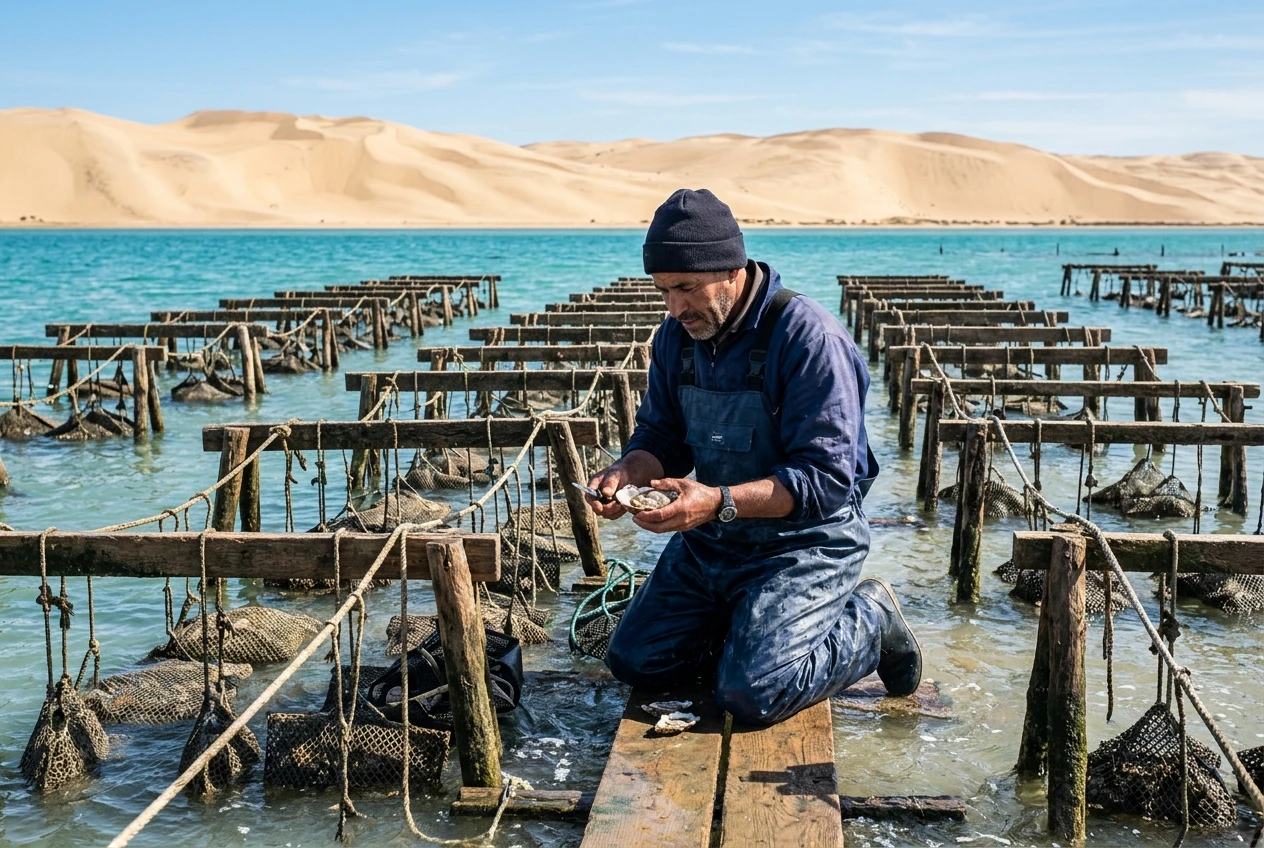
Where the golden sand dunes of the Moroccan Sahara slip quietly into the crystalline turquoise swells of the Atlantic Ocean, one of the most remarkable agricultural and gastronomic revolutions of North Africa is unfolding. Dakhla Bay (Baie d’Oued Ed-Dahab), a sheltered 37-kilometer natural marine lagoon located in Morocco’s southern provinces, has emerged as a premier center for high-grade sustainable oyster farming and marine aquaculture.
For generations, travelers associated the southern Sahara exclusively with nomadic pastoralism, camel caravans, and deep-desert oasis agriculture. Today, the world’s leading marine scientists, culinary critics, and green investors recognize Dakhla as a coastal terroir of peerless purity. Shielded from industrial runoff by hundreds of kilometers of pristine desert coastline, Dakhla’s waters benefit from the cold, nutrient-dense Canary Current upwelling, supplying juvenile shellfish with an endless banquet of wild oceanic phytoplankton.
This comprehensive report examines the geography, official production statistics, sanitary classifications, ecological protections, and culinary prestige of the Dakhla oyster, illustrating how modern Morocco marries ancestral territorial sovereignty with visionary marine stewardship.
The Geography of Dakhla Bay: An Ecological Sanctuary
Dakhla Bay is a geological wonder. The peninsula extends southward parallel to the Saharan mainland for nearly 40 kilometers, creating an enclosed inland lagoon protected from the violent oceanic swells of the open Atlantic.
Several distinct ecological factors converge to make Dakhla an optimal nursery for bivalve mollusks:
- The Canary Current Upwelling System: Cold, mineral-dense water surges from the ocean abyss toward the sunlit continental shelf, delivering exceptional concentrations of dissolved oxygen, silicates, and organic phosphates.
- Perpetual Sunlight & Photosynthesis: With more than 300 days of cloudless desert sunshine per year, photosynthetic phytoplankton blooms continuously, allowing oysters to feed around the clock without artificial feeding.
- Tidal Dynamics: The bay experiences vigorous semi-diurnal tides that flush and renew over 60 percent of the lagoon water volume every 24 hours, preventing siltation and maintaining crystalline water transparency.
- Absolute Terrestrial Isolation: Bordered by desert hammada and sand dunes, there are zero agricultural pesticide residues, zero industrial chemical effluents, and zero heavy metal contaminants entering the bay.
Recognized internationally under the Ramsar Convention as a wetland of global ecological significance, Dakhla Bay provides a secure haven for migratory flamingos, monk seals, dolphins, and sustainable artisanal aquaculture.
Official Statistics & Economic Metrics (ANDA & MAPMDREF)
The structured development of aquaculture in the Dakhla-Oued Ed-Dahab region is orchestrated by the National Agency for the Development of Aquaculture (Agence Nationale pour le Développement de l’Aquaculture - ANDA) in direct alignment with the Halieutis and Génération Green national strategies.
The following quantitative metrics represent official multi-year survey data compiled from the Ministry of Agriculture, Maritime Fisheries, Rural Development, Water and Forests (MAPMDREF) and ANDA sector reports:
| Quantitative Indicator | Official Metric | Regulatory & Statistical Source |
|---|---|---|
| Total Shellfish Farms in Operation | 82 Active Operational Concessions | ANDA Regional Census (2025/2026) |
| Dedicated Marine Surface Area | 1,480 Hectares Reserved for Marine Farming | Dakhla Bay Regional Aquaculture Plan |
| Annual Oyster Production | 420 Metric Tons (Scaling to 1,200 MT Target) | MAPMDREF Maritime Fisheries Directorate |
| Direct Coastal Employment Created | 1,850+ Direct & Indirect Jobs (70% Youth & Women) | Regional Investment Center (CRI Dakhla) |
| Sanitary Water Classification | Class A (European Union Direct Consumption Norm) | ONSSA Monitoring Network (Bacteriological Level 0) |
| Private & Public Capital Mobilized | 280 Million MAD in Shellfish Infrastructure | ANDA Investment Tracking Unit |
| Major Port Infrastructure Investment | 12.4 Billion MAD (Dakhla Atlantic Megaproject) | Ministry of Equipment and Water |
These verified figures demonstrate that aquaculture in the Moroccan Sahara is not a localized cottage trial, but a sophisticated industrial sector founded upon strict biological capacity limits and rigorous sanitary controls.
The Scientific Superiority of the Dakhla Cupped Oyster
The primary species cultivated in the bay is the Pacific cupped oyster (Crassostrea gigas), introduced into Dakhla’s waters where it displays unprecedented growth velocity.
In traditional European oyster nurseries along the coasts of Brittany, Normandy, or the Marennes-Oléron basin, a juvenile oyster typically requires between 24 and 36 months to achieve commercial market size (Grade No. 2 or Grade No. 3). During northern winters, near-freezing sea temperatures force European oysters into metabolic dormancy, halting growth for four to five months every year.
In Dakhla Bay, the marine ecosystem operates on an uninterrupted 12-month biological cycle:
- Stable Water Temperatures: Water temperatures fluctuate gently between 17°C in winter and 22°C in summer, remaining perpetually within the metabolic sweet spot for bivalve growth.
- Accelerated Maturation: Dakhla oysters reach commercial maturity in just 8 to 11 months from spats, more than twice as fast as European competitors, while developing exceptionally dense, calcified shells.
- Remarkable Meat-to-Shell Ratio: The continuous feeding cycle produces a flesh fill index (indice de remplissage) consistently surpassing 14 to 16 percent, qualifying Dakhla oysters for the prestigious “Spéciale de Claire” commercial tier.
Every batch harvested is tracked under the direct supervision of the National Food Safety Office (ONSSA). Water columns and shellfish tissues are systematically tested weekly for marine biotoxins (DSP, PSP, ASP), heavy metals (cadmium, lead, mercury), and pathogenic coliform bacteria. Because Dakhla waters hold Class A certification, oysters can be packed and consumed immediately upon landing without requiring artificial depuration tanks.
The Port of Dakhla Atlantique: Unlocking Global Export Corridors
The economic transformation of the Sahara’s marine economy is anchored by the construction of the Dakhla Atlantic Port (Port Dakhla Atlantique), located at Ntireft, 40 kilometers north of the bay.
Representing a strategic investment exceeding 12.4 billion Moroccan Dirhams, this deep-water mega-infrastructure provides:
- A dedicated fishing and aquaculture harbor basin with 1,650 linear meters of deep-draft quays.
- A 1,000-hectare industrial and logistics free zone equipped with cutting-edge flash-freezing, cold-chain packaging, and certified air-freight staging platforms.
- Direct deep-sea maritime connectivity linking the Moroccan Sahara directly to the European mainland (Algeciras, Rotterdam, Marseille), West Africa (Dakar, Abidjan), and North America.
This infrastructure guarantees that fresh live Dakhla oysters, harvested at sunrise from Atlantic lagoon trestles, reach luxury dining tables in Paris, Dubai, Madrid, and Casablanca within 24 to 36 hours of landing.
Sensory Profile & Gastronomic Service
Culinary masters and international sommeliers revere the Dakhla oyster for its unique territorial terroir, which tastes completely different from Atlantic estuary or Mediterranean oysters.
The Tasting Notes
- The Initial Attack: Clean, powerful ocean salinity, reflecting the high Atlantic oceanic salt concentration (36 practical salinity units).
- The Body: A rich, velvety, almost buttery flesh texture with a distinctly crisp bite, free of muddy or vegetal aftertastes.
- The Finish: A long, lingering note of sweet hazelnut, toasted sesame, and sweet limestone minerality, produced by the unique local plankton profile.
How to Enjoy Dakhla Oysters in Morocco
While traditional French bistros serve oysters strictly raw with red wine vinegar and shallots (mignonette), Moroccan culinary tradition brings its own refined touch:
- Raw with Wild Souss Lemon: Enjoyed completely raw, unaccompanied save for a single squeeze of wild sun-ripened Souss lemon (Citrus limon) and a light grind of Tellicherry black pepper.
- Charcoal-Grilled with Argan & Cumin Butter: At the rustic seafood cabins lining the Dakhla lagoon shore, master oyster grillers place closed oysters directly over glowing acacia embers for two minutes until the shell gently pops. The oyster is drizzled with warm, cold-pressed culinary argan oil infused with cracked cumin seeds and fresh wild thyme.
Frequently Asked Questions (FAQ)
Are Dakhla oysters safe to eat raw year-round?
Yes. Because Dakhla Bay maintains Class A sanitary water classification monitored weekly by ONSSA and experiences zero winter freezing or summer industrial run-offs, the oysters maintain pristine bacteriological safety across all four seasons.
How does Dakhla’s aquaculture protect the local environment?
Oyster farming is extractive-free and non-polluting. Oysters do not require fish meal, antibiotics, chemical treatments, or chemical growth stimulants; they feed entirely on wild microscopic marine algae. By filtering up to 50 liters of water per day per adult oyster, the farms actively clarify the lagoon water, creating thriving habitat pockets for juvenile Atlantic fish and crustaceans.
Can tourists visit the oyster farms in Dakhla?
Yes. Several certified oyster farms located along the Dakhla lagoon rim welcome international visitors. Guests can observe the wooden growing trestles, witness sorting and grading, and enjoy freshly shucked oysters paired with chilled white wines and Moroccan citrus salads overlooking the pink flamingos and kite-surfers on the bay.
Experience the true heart of Moroccan heritage through its culinary traditions. Join us in preserving and honoring these ancestral recipes.
What People Are Saying
No comments yet. Be the first — we'd love to hear from you.
Houssam Elmrabet
Culturally Verified & Fact-CheckedHoussam Elmrabet is a Moroccan researcher in territorial marketing and cultural heritage preservation. His work documents regional gastronomic identities, local agricultural heritage, and how ancestral culinary traditions define authentic territorial branding across the Kingdom.