Djemaa el-Fna: What the UNESCO Square Actually Looks Like After Midnight
Djemaa el-Fna: The Square That Only Fully Opens at Night
There is a version of Djemaa el-Fna that most visitors experience: the daytime version, which is crowded, loud, aggressively commercial, full of snake charmers who will demand payment if you look at the snake, henna artists who will grab your wrist and start drawing before you've agreed to anything, and orange juice vendors who will, if you photograph their stall without paying, follow you for an unsettling distance.
I am not going to tell you that version isn't real. It is entirely real, and it has been real since Marrakech became a major tourist destination in the 1970s and the square figured out that it was sitting on an inexhaustible supply of curiosity and disposable income.
But here's what I will tell you: that version of Djemaa el-Fna is not what UNESCO was inscribing when it declared the square a great piece of Oral and Intangible Heritage in 2001. What UNESCO was trying to protect was something considerably older and considerably more interesting, and it still exists in the square, and it is most visible after ten o'clock in the evening when the tourist groups have returned to their riads and hotels and the square begins its second, longer, more local life.
What Did Djemaa el-Fna Used to Be and What Has It Lost?
The name translates, depending on whom you ask and which etymology they favor, to "Assembly of the Dead" or "Mosque of the Annihilation" — there was historically an execution ground here, which is the most common explanation — or simply "the square at the end of the mosque" in a more mundane reading. The name's obscurity is appropriate because the history of the space is genuinely layered and partially undocumented.
What is well documented is that the square has functioned for at least five centuries as the primary public gathering space of Marrakech — the city's forum, in the Roman sense, where commerce and entertainment and information and social life intersected. In a pre-literate society with no newspapers and no broadcast media, the square was where news traveled, where announcements were made, where traveling merchants presented their wares, and where professional performers maintained the oral literary tradition that was the community's primary form of storytelling and cultural memory.
The Halqa — the performance circle — was and remains the organizing unit of the square. A performer sets up in an open area, begins performing, and the audience forms a circle around them. The circle grows as the performance gains momentum and shrinks as it loses it. Multiple Halqas operate simultaneously across the square, and the skilled audience member moves between them, sampling, comparing, deciding where to plant their feet for the evening.
The Ahlawi — the traditional storytellers who performed serialized oral epics, often continuing a single narrative across multiple evenings over weeks — were once the central figures of the square's cultural life. They were the HBO of their era: episodic, highly skilled, economically dependent on the audience returning for the next installment. The last generation of genuine Ahlawi in Djemaa el-Fna are now very old. The tradition has not been adequately transmitted. This is one of the things UNESCO was trying to address when it intervened in 2001, with mixed success.
What Is Actually Happening in the Square at Different Hours?
By day, the snake charmers, the monkey handlers (a genuinely cruel practice that I wish I could tell you is declining — it isn't), the orange juice stalls, the tourists, the photographers, the henna artists. This is the commercial surface, and it will not interest you for long.
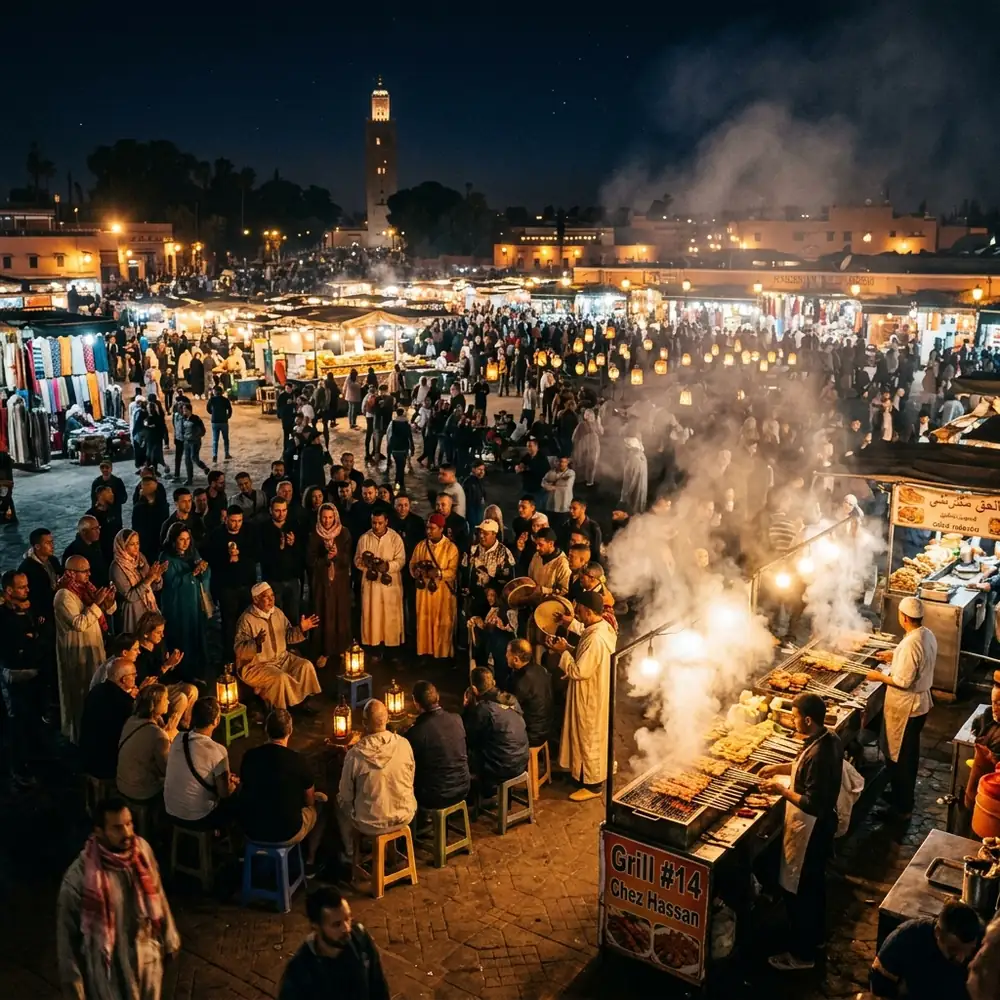
At sunset, the food stalls appear. This is the largest outdoor food market in Morocco — approximately a hundred stalls selling everything from harira and merguez to grilled sheep heads (which are exactly what they sound like and are eaten enthusiastically by the Marrakchi men who order them) to snail broth ladled into small ceramic bowls and drunk with a toothpick to extract the snail. The smoke from a hundred grills rises into the evening air and is visible from the rooftop terraces surrounding the square, and the smell of it — charred meat, cumin, the sweetness of cooking onions — carries across much of the medina.
The storytellers and musicians who remain in the genuine tradition operate from around nine or ten in the evening, when the tourist-facing Halqas have wound down. A Gnawa musician setting up his Guembri at ten-thirty at night is not performing for tourists. An old man with a crowd of thirty Moroccan men around him, speaking in Darija too fast for any non-native speaker to follow, is not performing for tourists. These circles exist in the square simultaneously with the commercial tourist experience but are entirely separate from it, operating by their own internal logic of performance and response.
The best nights in Djemaa el-Fna are the nights of celebration — the first night of Ramadan, the night of Aid al-Fitr, certain local saints' days — when the square fills with Marrakchis rather than visitors and the ratio of performance to commerce inverts completely. These nights, which are not reliably predictable from outside and require being in Marrakech at the right moment, show you what the square actually is when it operates as itself.
Why Did UNESCO Inscribe the Square Rather Than a Building?
Because the square is not a building. This was the conceptual innovation of the 2001 inscription, and it has been influential in how UNESCO thinks about intangible heritage since.
The heritage of Djemaa el-Fna is not the physical space — the paving, the surrounding buildings, the Koutoubia minaret visible from most angles of the square, the fountain. The physical space is replaceable and has in fact been modified and rebuilt across its history. The heritage is the practice of the square: the accumulation of performance traditions, the Halqa as a social form, the oral literary culture that has used this space as its primary venue for five hundred years. This is what UNESCO determined was in danger of disappearing, and this is what the inscription was designed to protect.
Whether the protection has worked is a question without a clean answer. The commercial pressure on the square has intensified since 2001, not decreased. The population of genuine traditional performers has declined. The space has become more tourist-facing with each decade. And yet the Gnawa musicians are still there after midnight. The old men still gather in circles. The snail broth is still served.
The Invisible Invitation
It is half past eleven on a Thursday night in Djemaa el-Fna. The food stalls are beginning to close, the smoke from the grills is thinning. Most of the tourists have gone. On the far side of the square, away from the main stall area, there is a circle of thirty or forty people around something you can hear before you can see: the deep, three-stringed pulse of a Guembri, the overlapping clatter of Qaraqeb, a voice singing in a mode you have never heard in any music that has come to you through headphones. The circle is entirely Moroccan. You are not invited, exactly. But you are not excluded either. Stand at the edge, in the dark, and listen. The square is telling you something tonight.
SEO Meta Description: What is Djemaa el-Fna in Marrakech really like? A local guide to the UNESCO square's oral storytelling tradition, food stalls, late-night culture, and what happens after the tourists leave.
Experience the true heart of Moroccan heritage through its culinary traditions. Join us in preserving and honoring these ancestral recipes.
What People Are Saying
No comments yet. Be the first — we'd love to hear from you.
Youssef Amazigh
Culturally Verified & Fact-CheckedThe Moroccan Food editorial team brings together native culinary researchers, heritage preservationists, and experienced home cooks across Marrakech, Fes, and Casablanca. Every recipe and cultural guide is reviewed against ancestral oral traditions and authentic regional practices.