Essaouira: What the Atlantic Wind Does to a City Over Four Centuries
Essaouira: The Wind City and Why It Has Always Attracted People Who Don't Quite Fit Elsewhere
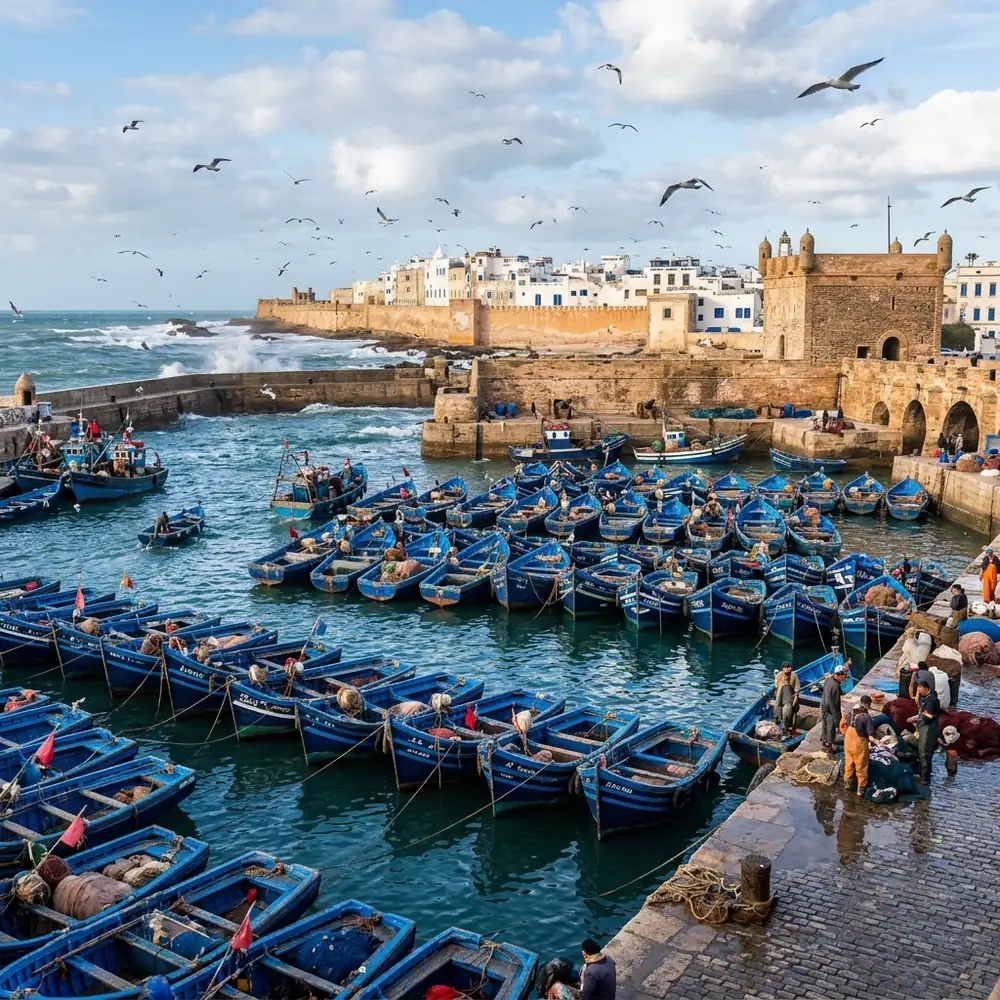
Jimi Hendrix may or may not have visited Essaouira in 1969. The city maintains that he did; the historical record is ambiguous; Hendrix scholars are divided; the local tourism industry is unanimously certain. There is a café named after him. There is a plaque. None of this conclusively settles the question, and I mention it not to resolve it but because the Hendrix story — real or mythologized — says something accurate about the kind of place Essaouira is and has been. It attracts artists and wanderers and people in the middle of a personal reinvention, and has done so with consistency since at least the 18th century when the Sultan Sidi Mohammed ibn Abdallah commissioned the Portuguese architect Théodore Cornut to rebuild the coastal fortress town as a planned trading city.
It is also extraordinarily windy. I want to be honest about this because it shapes the entire experience of being in Essaouira in a way that no photograph conveys. The alizé — the trade wind — blows from the north for the majority of the year. Not a gentle breeze. A sustained, strong, constant wind that stings your face with fine Atlantic salt spray and makes any meal eaten outside a wrestling match with your napkin and a theological position paper on why outdoor dining is overrated. The kite surfers and windsurfers on the beach south of the city come specifically for this wind. So do some people who are not kite surfers but who find, to their surprise, that the constant assault of moving air produces a kind of alertness and physical presence that more protected environments don't.
What Is Essaouira's History and Why Did It Matter Commercially?
The site was inhabited long before the Portuguese or the Alaouite Sultans — Phoenician and Roman-era remains have been found in the region, and the small island of Mogador (from which Essaouira derived its Portuguese name Mogador) shows evidence of Phoenician occupation going back to the 7th century BCE, when it was used as a dye production site for Tyrian purple — the extraordinarily valuable purple dye extracted from murex sea snails that the Phoenicians monopolized across the Mediterranean.
The planned 18th-century city that gives Essaouira its current character was conceived by Sultan Sidi Mohammed ibn Abdallah as a direct challenge to the European dominance of Moroccan Atlantic trade. By concentrating commerce in a newly planned, well-defended port with a controlled customs regime, the Sultan intended to redirect the trade that had been flowing through Agadir and other less-controlled ports into channels the Moroccan state could tax and oversee. He succeeded. Essaouira became within decades the busiest trading port in Morocco, with substantial Jewish, European, and West African merchant communities established within its medina.
The Jewish community — Moroccan Jews who dominated much of the trading infrastructure between Morocco and European commercial partners — was central to Essaouira's 18th and 19th century commercial life in a way that is still visible in the urban fabric. The mellah (the Jewish quarter) in Essaouira is one of the better-preserved in Morocco, and the synagogues — some still functional, some converted but architecturally intact — are accessible to visitors. The Simon Attias Synagogue is the most visited and gives you a sense of how completely integrated the Jewish commercial community was into the city's physical and social structure.
What Is Gnawa Music Doing in Essaouira?
Essaouira has the largest annual Gnawa music festival in the world — the Gnaoua World Music Festival, held every June since 1998, which brings approximately 500,000 people to a city of 75,000. This seems like a lot, because it is a lot. But the connection between Essaouira and Gnawa music is not a recent marketing decision. It is historical and geographic.
The sub-Saharan African communities whose spiritual and musical traditions became the Gnawa tradition arrived in Morocco primarily through the trans-Saharan trade routes, and the Atlantic coastal cities — including Essaouira — were significant end-points of those routes. The enslaved people who came north through the Saharan corridor, and the free West African merchants and artisans who traveled the same routes, established communities in the coastal cities. The Gnawa community in Essaouira has been there for centuries.
The festival uses this historical connection as its organizing principle, and in its best editions it does something genuinely interesting: it places traditional Gnawa performers in conversation with international musicians from jazz, blues, reggae, and world music traditions, based on the real structural and historical connections between Gnawa music and African American musical traditions. Whether these conversations produce great music depends on the specific collaborations in a given year, but the principle is sound and when it works it reminds you that musical genealogies cross continents in ways that political boundaries don't.
What Do People Actually Do in Essaouira?
Walk on the ramparts. Eat fish that was caught this morning. Buy thuya wood carvings from the workshops around the port — thuya (Tetraclinis articulata) is a fragrant, deeply grained Moroccan hardwood specific to the northwest and southwest regions, used by Essaouira's woodworkers for centuries to produce bowls, boxes, frames, and furniture that smell of something between cedar and camphor for years after purchase. Shop in the medina, which is smaller and considerably less pressured than Marrakech or Fes. Drink coffee in a café on the main square and watch the population of cats, which is substantial and extremely confident.
And contend with the wind. The wind is always there. In summer, when the rest of Morocco is very hot, Essaouira is cool and grey and the alizé moderates the temperature to something almost comfortable. In winter, the wind is colder and the sea is rougher and the city is emptier and, many people who know it well will tell you, considerably more itself.
The Invisible Invitation
Go in the off-season — October, November, February. The festival crowd is gone, the summer tourists are gone, the city is doing what it does when it isn't performing for anyone. The ramparts in November are windy enough that you hold your hood. The sea below them is genuinely rough — green and white and making the kind of noise that large water makes against old stone. The fishermen are bringing in the morning catch at the port and the gulls are extremely interested. The medina smells of thuya sawdust and salt and the particular woodsmoke from the fish grills at the port entrance. Buy a whole grilled sardine from a man who is grilling them over charcoal right now. Eat it standing up. The wind will take the smoke. It takes everything.
SEO Meta Description: What makes Essaouira Morocco unique? A guide to the Atlantic wind city — Phoenician purple dye history, the Jewish mellah, Gnawa festival origins, and why it attracts artists and wanderers.
Experience the true heart of Moroccan heritage through its culinary traditions. Join us in preserving and honoring these ancestral recipes.
What People Are Saying
No comments yet. Be the first — we'd love to hear from you.
Youssef Amazigh
Culturally Verified & Fact-CheckedThe Moroccan Food editorial team brings together native culinary researchers, heritage preservationists, and experienced home cooks across Marrakech, Fes, and Casablanca. Every recipe and cultural guide is reviewed against ancestral oral traditions and authentic regional practices.