Essaouira: The Wind City, Its Particular Blue, and Why Musicians Keep Coming Back
Essaouira: What the Wind Produces When It Blows Through the Same City for Three Centuries
I should address the Jimi Hendrix question immediately, since it comes up in almost every travel account of Essaouira and sits uncomfortably between historical fact and tourism mythology.
Jimi Hendrix did visit Essaouira in 1969. He stayed for a few weeks. He was reportedly enchanted by the city and by a kasbah visible from the beach called Borj el-Berod, which some accounts say inspired the song “Castles Made of Sand.” There is no particular evidence for the “Castles Made of Sand” connection and the song predates the 1969 visit. The local guides who have been offering the “Jimi Hendrix’s castle” tour for thirty years are selling a plausible story, not a documented fact.
The city is beautiful regardless of Hendrix’s opinion of it in 1969.
Essaouira is, more honestly, interesting because of what it actually is: a city whose history involves Portuguese fortification, Moroccan imperial redesign by the Alaouite Sultan Sidi Mohammed ben Abdallah in the 18th century (who hired the French military architect Théodore Cornut to design its current layout), a substantial Jewish merchant community that made it one of Morocco’s most international trading ports in the 18th and 19th centuries, and a consistently cosmopolitan cultural character that drew artists and musicians long before Hendrix and has continued to do so since.
What Is Essaouira’s Physical Character and Why Does the Wind Matter?
The wind in Essaouira is not incidental. The city receives consistent Atlantic trade winds — the alizé — for approximately ten months of the year, and the wind has shaped the city’s character as much as its architecture or its history. The medina’s street plan, with its grid of parallel streets running perpendicular to the wind direction, was designed specifically to moderate the wind’s force at street level — the Portuguese military architects who preceded Cornut understood that the coastal position was worth defending against both Portuguese and wind.
The wind keeps Essaouira cooler than inland Moroccan cities at the same latitude — it is pleasant in July and August when Marrakech is brutal — and it produces the particular quality of light that Essaouira is associated with: a slightly diffuse, wind-scattered Atlantic light that is different from the hard-edged clarity of the desert south or the warm ochre of Marrakech. The light in Essaouira is silvery-blue-white, and it makes the blue-and-white painted buildings of the medina look more vivid and at the same time more luminous than they would in different light.
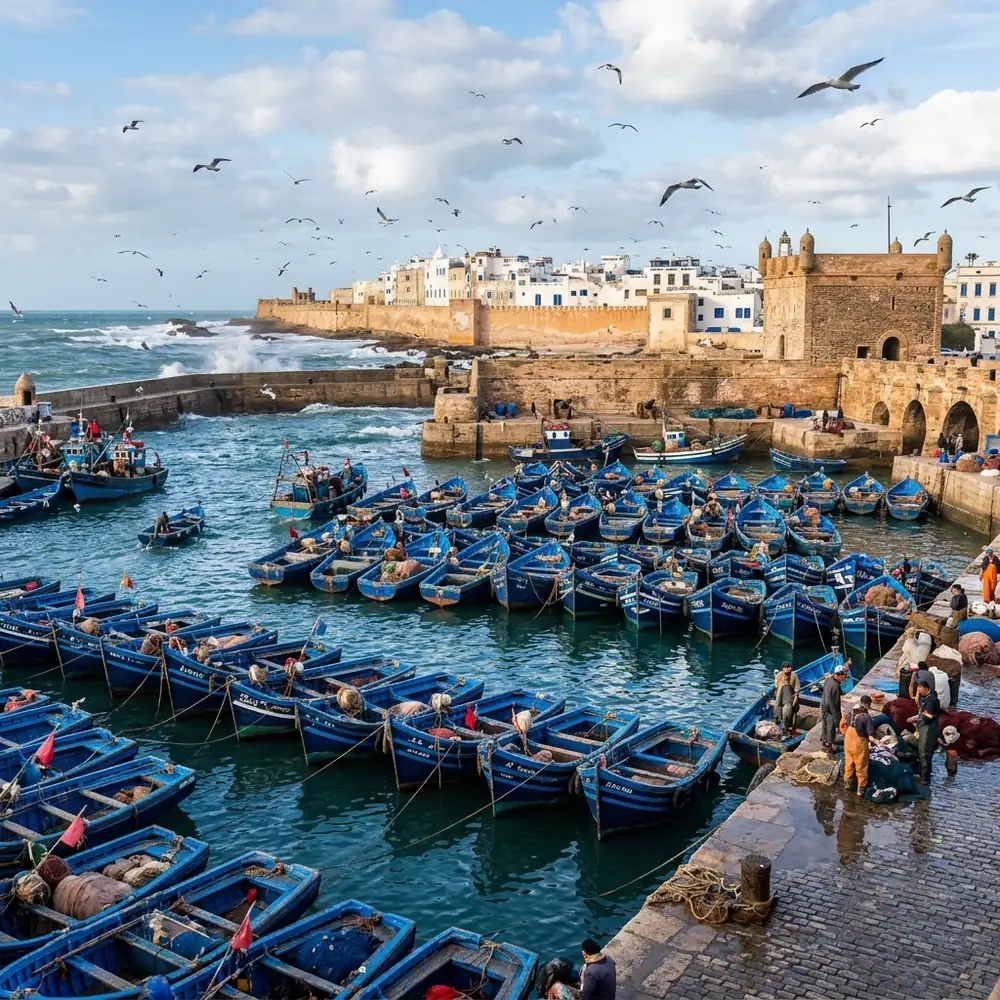
The wind also shaped the local fishing and maritime economy: Essaouira’s harbor, protected by the offshore Îles Purpuraires, provided shelter from the Atlantic swells for vessels that could not have survived the open coast, and the consistent wind direction made the approach and departure of sailing vessels predictable in a way that the variable wind conditions of Morocco’s Atlantic coast generally didn’t permit.
What Is the Gnawa Music Connection and Why Is Essaouira the Festival Location?
The Gnawa World Music Festival — held annually in Essaouira in June since 1998 — is the largest celebration of Gnawa music in Morocco and has become one of the most attended music festivals in North Africa, drawing international audiences and international musicians who collaborate with Gnawa masters in sessions that are simultaneously public concerts and genuine musical exchanges.
The choice of Essaouira for the festival is not arbitrary. The city has a long Gnawa community presence — as a port city and former slave-trade node, it received sub-Saharan African populations through the same routes that produced the Gnawa brotherhood elsewhere in Morocco — and its cosmopolitan cultural history made it receptive to the kind of cross-cultural exchange that the festival represents. The festival’s architecture — large outdoor stages in the medina’s open spaces, free admission, the city’s concentrated geography making the music accessible throughout the old town — has proven exceptionally effective at creating the communal experience the festival aims for.
The relationship between the festival’s public concert format and the Gnawa’s private healing ceremony tradition is complicated, as I have written elsewhere. The festival’s existence has financially supported Gnawa musicians who might not otherwise have sustainable income from their tradition, and it has also created a performed version of Gnawa music that is calibrated for stage rather than ceremony. Both things are true simultaneously.
What Is Essaouira’s Thuyya Wood Craft?
One of Essaouira’s specific craft traditions — not found elsewhere in Morocco in significant quantity — is thuyya root woodworking. The thuyya (Tetraclinis articulata), a conifer that grows in the coastal forests between Essaouira and Agadir, produces a highly figured root burr — a dense, complex-grained wood with circular and wavy figure patterns that are among the most visually striking naturally occurring wood figures in any species.
Essaouira’s craftsmen work thuyya root burr into small decorative objects — boxes, frames, trays, chess sets, decorative spheres — using techniques adapted to the material’s extreme hardness and its tendency to split along the grain. The turned and carved thuyya pieces sold in Essaouira’s craft shops are genuinely specific to this city and represent real skill — the material is difficult to work and the figured grain means that each piece is visually unique. Thuyya root burr cannot be found elsewhere in Morocco in comparable quality or quantity.
The Invisible Invitation
Come to Essaouira in November, when the summer tourists are gone and the festival is four months away and the wind is doing what it always does. Walk the ramparts at the north end of the medina — the sea bastion, the Skala de la Ville — in the late afternoon. The Atlantic is grey-green from the north today, the swells consistent and long-period, the kind of ocean swell that has traveled from somewhere far to the west to arrive here. The wind off the water is cold enough to require a jacket. The fishing boats in the harbor below the rampart are bright blue and orange. The city behind you is white. These are the colors of Essaouira: blue-green water, white city, the rust-orange of the rampart stone, the blue of the boats. The light makes all of them slightly luminous in a way that the other Moroccan cities do not produce. Sit on the rampart until the light changes. The wind is constant. Everything else moves.
SEO Meta Description: What makes Essaouira special? The Atlantic trade winds, 18th-century Alaouite port design, Gnawa festival origins, thuyya root woodcraft, and the truth about the Jimi Hendrix mythology.
Experience the true heart of Moroccan heritage through its culinary traditions. Join us in preserving and honoring these ancestral recipes.
What People Are Saying
No comments yet. Be the first — we'd love to hear from you.
Youssef Amazigh
Culturally Verified & Fact-CheckedThe Moroccan Food editorial team brings together native culinary researchers, heritage preservationists, and experienced home cooks across Marrakech, Fes, and Casablanca. Every recipe and cultural guide is reviewed against ancestral oral traditions and authentic regional practices.