Zaggoum Euphorbia Honey: The Thermo-Active Medicinal Nectar of Morocco's Arid Canyons
Zaggoum Euphorbia Honey: The Thermo-Active Medicinal Nectar of Morocco’s Arid Canyons
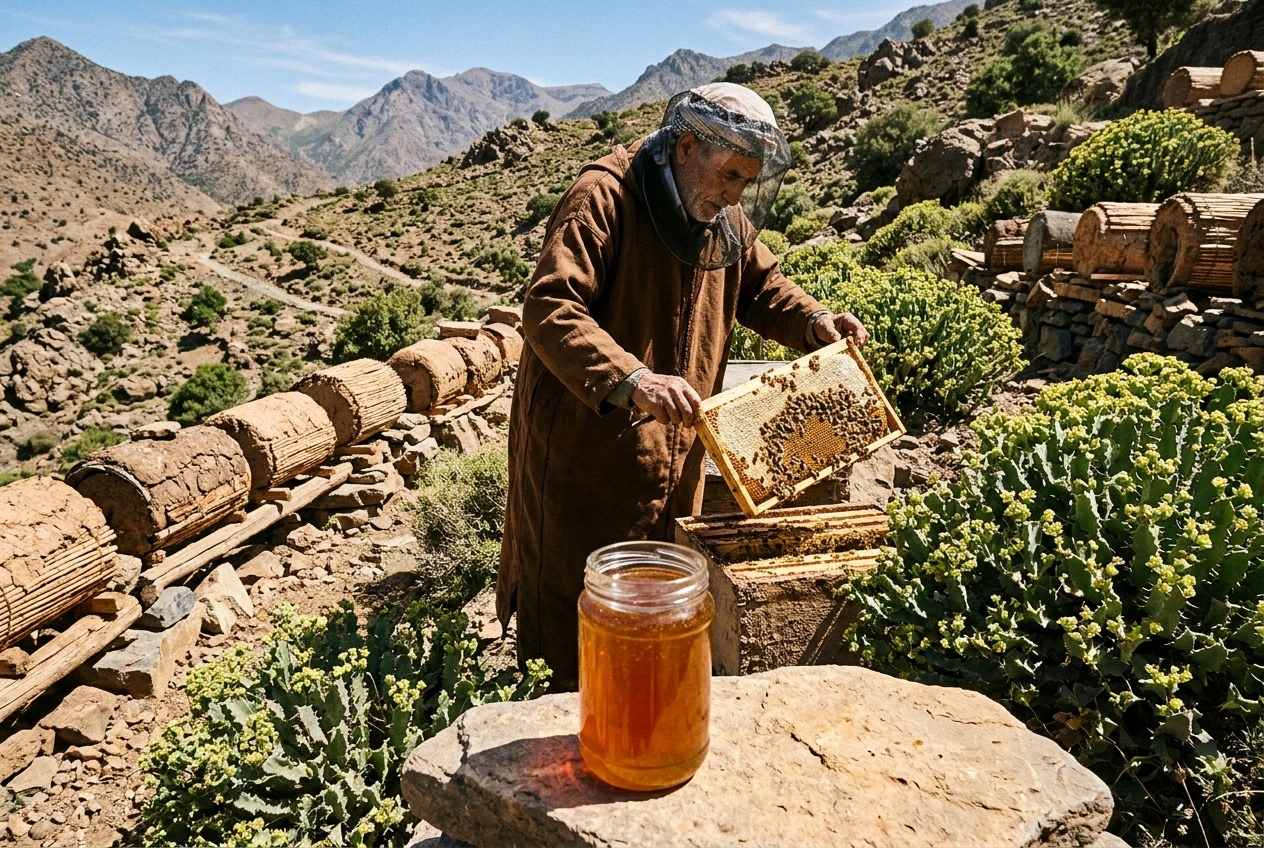
Clinging to the sun-baked, rocky limestone escarpments of the Moroccan Atlas mountains and the arid ravines of the Souss basin grows an ancient, spiny succulent that looks remarkably like a desert cactus: Euphorbia resinifera, known throughout the Maghreb by its indigenous names Daghmouss or Zaggoum.
Endemic exclusively to the Kingdom of Morocco, this hardy desert spurge secretes an intensely caustic white latex when punctured. Yet from its microscopic golden-yellow flowers, resilient local honeybees (Apis mellifera intermissa) gather nectar to produce one of the rarest, most chemically fascinating, and biologically potent honeys on Earth: Zaggoum Euphorbia Honey.
Awarded the prestigious Appellation d’Origine Protégée (AOP Miel d’Euphorbe Tadla-Azilal) and recognized as a primary jewel of Morocco’s protected terroirs, this dark amber nectar possesses a sensory characteristic found in virtually no other commercial honey: an unmistakable, lingering, warm peppery heat that coats the back of the throat seconds after swallowing.
This deep scientific and apicultural report explores the botanical uniqueness of Euphorbia resinifera, official harvest metrics from the Ministry of Agriculture and FIMAP, the biochemical mechanisms behind its thermo-active throat sensation, and its centuries-old role in Moroccan mountain pharmacopeia.
Botanical Terroir: The Endemic Kingdom of Euphorbia Resinifera
Unlike common commercial honeys derived from cultivated crops like clover, sunflower, or canola, authentic Daghmouss honey is an exclusively wild, uncultivated mountain harvest.
- Endemic Moroccan Distribution: Euphorbia resinifera is strictly endemic to Morocco. It thrives in dense, dome-shaped cushions covering rocky limestone hillsides at altitudes between 600 and 1,300 meters, primarily in the provinces of Azilal, Beni Mellal, Chichaoua, Taroudant, and the lower slopes of the Western Rif.
- Extreme Xerophytic Adaptation: Thriving where average annual rainfall drops below 250 millimeters, the plant possesses thick, four-angled fleshy green stems that store moisture for years. The true leaves have evolved into sharp, paired spines that defend the succulent from grazing livestock.
- The Ephemeral May-June Bloom: In late spring, under the blazing pre-summer sun, the tips of the spiny green ribs erupt with thousands of tiny, bright yellow, nectar-bearing flowers (cyathia). For three fleeting weeks, mountain beekeepers transport their hives to remote Atlas gorges to capture this volatile floral nectar.
Official Harvest Statistics & Apicultural Economics (FIMAP & MAPMDREF)
The production and certification of monofloral Euphorbia honey are monitored by the Moroccan Interprofessional Beekeeping Federation (FIMAP), the Ministry of Agriculture (MAPMDREF), and the National Food Safety Office (ONSSA).
The table below compiles verified multi-year audits from official apicultural registries:
| Key Strategic Sector Metric | Official Statistical Value | Regulatory & Institutional Source |
|---|---|---|
| Wild Euphorbia Habitat Area | Over 110,000 Hectares of Spontaneous Natural Formations | High Commission for Waters and Forests |
| Annual Monofloral Honey Output | 380 to 520 Metric Tons (Subject to Spring Rainfall) | MAPMDREF National Livestock Directorate |
| Active Transhumant Beekeepers | Over 3,400 Certified Apiculturists | FIMAP National Beekeeping Registry |
| Certified Geographical Labels | AOP Miel d’Euphorbe Tadla-Azilal & IGP Miel du Souss | Official Bulletin of the Kingdom of Morocco |
| Moisture Content Standard | Strictly < 18.0% (Natural Concentration in Arid Air) | Moroccan Quality Standard NM 08.5.110 |
| Hydroxymethylfurfural (HMF) | < 10 mg/kg at Harvest (Guarantees Unheated Raw Honey) | ONSSA Official Testing Laboratories |
| Diastase Enzyme Activity | > 18 Schade Units (High Natural Enzymatic Potency) | Central Laboratory for Analysis (LOARC) |
| Average Retail Market Value | 350 to 500 MAD/kg ($35-$50/kg, Morocco’s Highest Tier) | Regional Terroir Product Observatories |
Because the flowering season is brief and highly vulnerable to sudden mountain drought or desert winds, pure monofloral Zaggoum honey is a scarce, high-value luxury commodity that commands the highest prices of any honey in North Africa.
The Thermo-Active Sensation: Biochemistry of the “Bite”
The defining signature of authentic Zaggoum honey is its remarkable physical effect:
When you place a spoonful of fresh Daghmouss honey in your mouth, the initial taste is deeply sweet, dark, and floral, with subtle notes of wet river stone and dried prunes. However, within five to ten seconds of swallowing, a distinct, warm, peppery sensation begins to build at the back of the soft palate and upper pharynx. In potent, unadulterated harvests, this warming effect causes a gentle tickle or temporary cough.
The Scientific Mechanism: TRPV1 Receptor Activation
- Trace Terpenoid Compounds: While the raw latex of the spurge contains toxic concentrations of diterpenes, the microscopic floral nectar contains only minute, non-toxic trace botanical metabolites.
- Thermal Heat Perception: These bio-active resinoid molecules bind selectively to human TRPV1 receptors located on sensory nerve endings in the throat, the exact same neuro-receptors activated by capsaicin in chili peppers and piperine in black pepper.
- Vasodilation & Mucous Clearance: The gentle activation of these receptors triggers localized vasodilation (increased capillary blood flow) and stimulates the secretion of natural bronchial fluids, instantly warming the chest and opening restricted airways.
Ancestral Medicine: The Moroccan Mountain Pharmacopeia
For centuries before modern pharmaceutical antibiotics and cough syrups, Berber mountain families in the High Atlas relied on Zaggoum honey as their primary sacred medicine:
- Treatment of Bronchial Infections: Taken neat by the teaspoon or dissolved in warm water with a squeeze of fresh lemon juice, its natural antimicrobial properties (driven by hydrogen peroxide release and low water activity) combine with its throat-warming action to soothe acute bronchitis, stubborn dry coughs, and sore throats.
- Asthma and Respiratory Resistance: In the high mountain hamlets of Azilal where winter blizzards bring freezing damp air, elders consume a daily spoonful of Daghmouss honey mixed with crushed black seeds (Sanouj / Nigella sativa) to reinforce lung capacity and combat chronic wheezing.
- Digestive Tone & Ulcer Relief: Clinical observations in Moroccan university pharmacology departments have demonstrated that raw Euphorbia honey exerts protective effects on gastric mucosa, inhibiting the proliferation of Helicobacter pylori bacteria.
Culinary Art: The Sovereign of the Berber Breakfast
While its medicinal potency is legendary, Zaggoum honey is also deeply cherished by Moroccan gastronomes for its complex, assertive flavor profile:
- The Festive Baghrir Drizzle: The ultimate pairing for Moroccan “thousand-hole” semolina crumpets (Baghrir). The warm crumpet is soaked in a mixture of melted clarified farm butter (Smen Beldi) and raw Daghmouss honey. The spongy honeycomb interior of the bread absorbs the warm elixir, delivering an unforgettable contrast between sweet, buttery richness and the sharp, tingling warmth of the honey.
- Artisanal Herb Cheeses: Poured raw over fresh mountain goat cheese (Jben Beldi), where the spicy heat of the honey cuts through the lactic tang and richness of the goat curd.
- Energy Pastes for Athletes: Blended with stone-ground toasted sesame seeds, almond flour, and a pinch of ground ginger, creating a natural high-calorie endurance paste favored by mountain trekking guides in the Toubkal region.
Frequently Asked Questions (FAQ)
Is the burning sensation in Daghmouss honey dangerous?
Not at all! The throat-warming effect is completely harmless and is the universal scientific fingerprint of authenticity. If a honey labeled as “Daghmouss” tastes mild, sweet, and has zero warming sensation in the throat, it is either adulterated with common sugar syrup or harvested from other flowers like eucalyptus or orange blossom.
Can Daghmouss honey be given to young children?
Like all raw, unfiltered natural honeys, it should never be given to infants under 12 months of age due to the natural risk of infant botulism. For older children, because of the sharp throat-warming sensation, it is best dissolved in warm milk or herbal verbena tea rather than served neat.
Does authentic Euphorbia honey crystallize?
Yes. Pure, unheated raw Daghmouss honey typically crystallizes within 3 to 6 months of harvest into a smooth, fine-grained, butter-like paste with a pale golden-ochre color. Crystallization is natural proof that the honey has not been pasteurized or heat-treated, which would destroy its delicate therapeutic enzymes.
Experience the true heart of Moroccan heritage through its culinary traditions. Join us in preserving and honoring these ancestral recipes.
What People Are Saying
No comments yet. Be the first — we'd love to hear from you.
Houssam Elmrabet
Culturally Verified & Fact-CheckedHoussam Elmrabet is a Moroccan researcher in territorial marketing and cultural heritage preservation. His work documents regional gastronomic identities, local agricultural heritage, and how ancestral culinary traditions define authentic territorial branding across the Kingdom.