Family in Morocco: How Food, Meals, and Hospitality Define Our Most Sacred Relationships
Family in Morocco: How Food, Meals, and Hospitality Define Our Most Sacred Relationships
When I think about what family means in Morocco, I think first not about faces or voices but about smells. The smell of ksbour (fresh coriander) being chopped on a wooden board at five in the morning. The smell of argan oil warming in a small clay dish. The steam rising from a kskkas (couscous steamer) on a Friday at noon, filling the house so completely that you could find your way home blindfolded simply by following it down the street.
Food in Morocco is not how we express family. It is how we are family. Every meal prepared is an act of love addressed to specific people—this tagine made the way my daughter likes it, with more olives; this couscous rolled slightly smaller because my father prefers smaller grains; this harira thinned out because my grandfather likes to drink it from the bowl rather than use a spoon. The precision of Moroccan cooking is inseparable from the precision of Moroccan love.
L’aila (the family, in Darija) is the organizing unit of Moroccan social life in a way that has no equivalent in most Western societies. It is not just the nuclear family—it extends outward through cousins, aunts, uncles, grandparents on both sides, and the informal network of neighbors and family friends who have been so close for so long that the distinction between friend and family has blurred into irrelevance. And all of this extended web is held together, more than by any other force, by shared meals.
The Friday Couscous: The Most Sacred Meal in Morocco
Friday in Morocco is what Sunday is in some Christian cultures, but with a meal more elaborately prepared and more emotionally laden than most Sunday dinners I have encountered anywhere. Friday is yum jemaa (the day of gathering)—the day men go to the mosque for the midday prayer and then come home to their families to eat couscous.
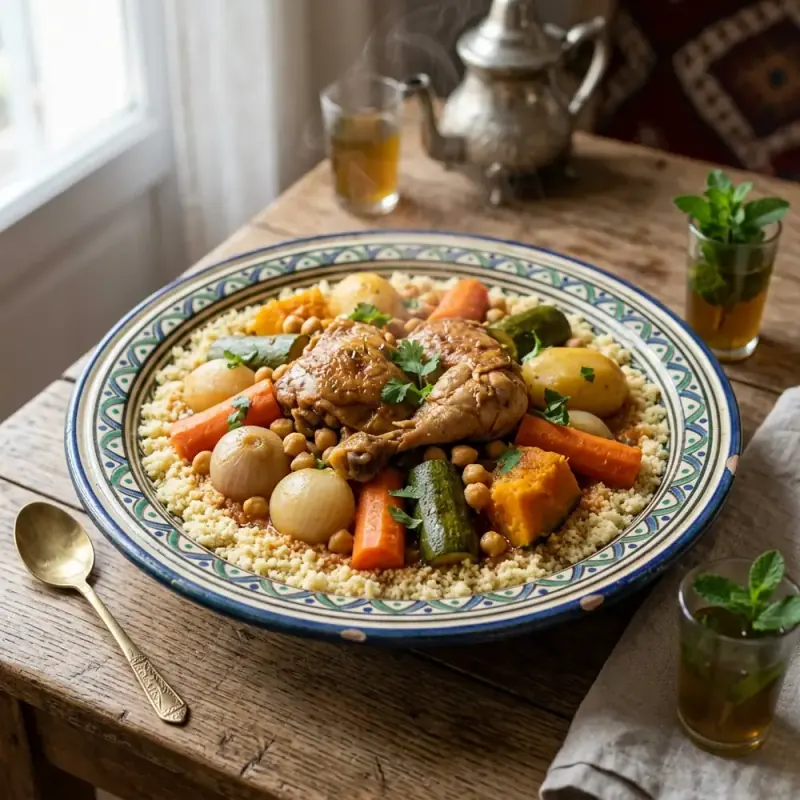
The preparation begins Thursday evening. The dried chickpeas are put to soak. The lamb is purchased from the butcher (l-jazzar) who has been the family’s butcher for twenty years. The vegetables—turnips, carrots, cabbage, courgette, onion—are washed and peeled. Friday morning, the mother wakes early. The smen (aged fermented butter) is measured. The onions start cooking. The couscous is dampened with water and worked with the palms in circular motions until every grain is coated, then poured into the steamer basket.
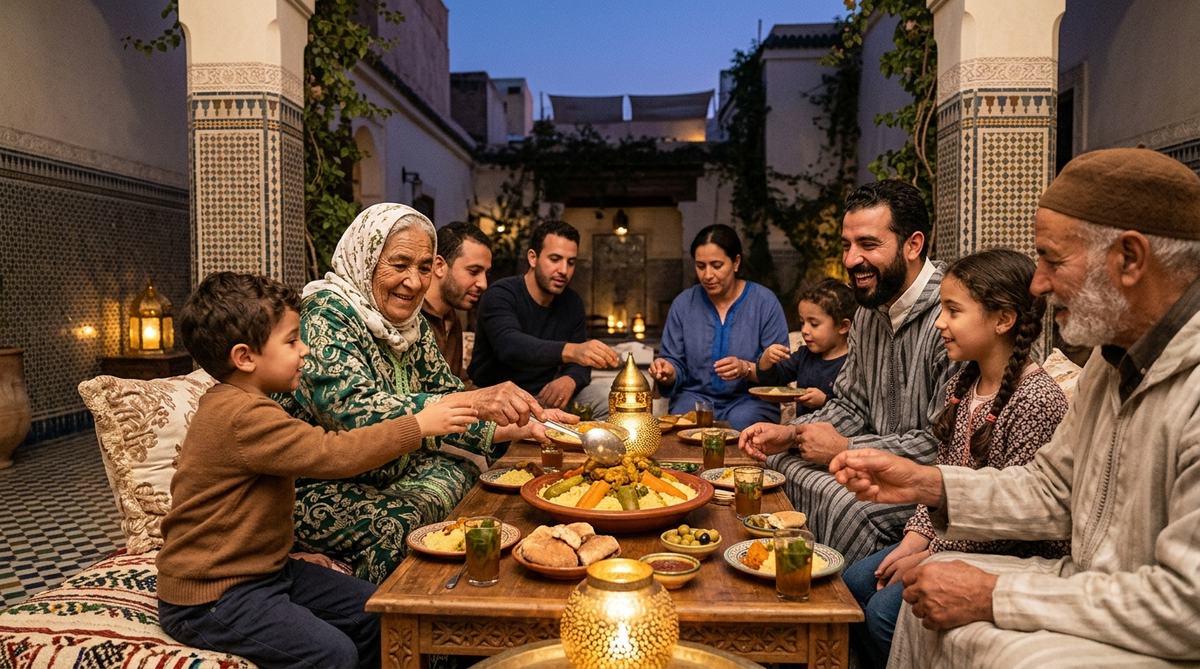
By noon, when the men return from the mosque, the house smells of the accumulated hour of cooking—cinnamon, saffron, caramelized onion. The couscous is mounded high in the gsaa (communal wooden or ceramic platter), the vegetables arranged artfully around the sides, the meat placed at the summit, the cooking broth poured over everything, and the dish brought to the table. Everyone gathers around it.
This is the moment that is so difficult to explain to people who did not grow up with it. The communal bowl is not just a serving style. It is a statement about equality, about trust, about the dissolution of individual boundaries in service of something collective. You eat from your own section of the dish, but you are eating together, and the distinction matters. There are no individual plates. There is no “mine” and “yours.” There is just the gsaa and the family around it.
The Art of Eating with Your Hands
Makla bl-iyd (eating with the hands) is not a primitive lack of cutlery. It is a practice with its own etiquette: always the right hand, always rolling the couscous into a small compressed sphere before lifting it to your mouth, always using just three fingers rather than clutching. Children learn this at the age of three or four, and the learning is part of socialization—you are being taught how to be with your family.
A good jadda (grandmother) can assess your emotional state by watching how you eat. If you are distracted, your couscous balls are imprecise. If you are sad, you eat from the edges rather than the center. If you are nervous about something, you reach too frequently. The communal meal is a daily emotional diagnostic conducted through the language of food.
How Cooking Knowledge Passes Through Generations
There are no Moroccan cookbooks in most Moroccan homes. There never were. Knowledge passes through doing—through standing next to your mother in the kitchen from the age of seven, watching the exact moment she adds the preserved lemon, learning by touch when the dough for msemen is properly rested, understanding by smell alone that the oil is hot enough for maakouda.
This transmission is so intimate and so specific that two women who both say they make “the family tagine” may produce dishes that taste entirely different—because the recipe they each learned was calibrated to a different kitchen, a different grandmother’s preference, a different altitude and clay pot and quality of saffron. There is no standardization. There is only lineage.
The jadda (grandmother) is the apex of this knowledge system. In many families, she is the only one who knows how to make certain dishes correctly—the exact proportion of smen in the couscous, the timing for the third steam, the specific shape of the chebakia pastry that signals it was made by this family. When a grandmother dies without having fully transmitted her knowledge, something is genuinely lost. Moroccan families speak about this openly and with grief.
The M’aallema: The Master Cook of Celebrations
For weddings, circumcisions (khitane), and major family celebrations, many families hire a M’aallema (master female cook—the title means, literally, “the one who knows”). The M’aallema is a professional in the oldest sense: her knowledge is vast, her authority in the kitchen during a celebration is absolute, and her fee reflects both her skill and her social status.
She arrives the day before the wedding feast, assesses the kitchen, directs the younger female relatives as her assistants, and produces dishes at a scale and quality that the family could not achieve alone. She might make pastilla for two hundred, cook three whole lambs in the communal oven, prepare a couscous that feeds four tables simultaneously. The guests who eat well will speak about the M’aallema’s work for years. Her reputation is the family’s reputation.
Ramadan: The Month When Family and Food Become One
Nothing in Moroccan life concentrates the relationship between family and food more completely than Ramadan. For thirty days, the family fasts together—no food, no water from dawn (suhur) until sunset (ftour)—and then breaks the fast together every evening at the sound of the evening call to prayer (adhan).
The ftour table is one of the most specific and beloved images in Moroccan culture: harira in large pots or individual clay bowls, chebakia pastries soaked in honey, sellou (a toasted flour, almond and sesame energy ball), hard-boiled eggs, beghrir (spongy pancakes), dates (tmar), zbaib (raisins), fresh-squeezed orange or pomegranate juice. This table is prepared by the women of the house every single day for thirty days without variation, without complaint. It is an act of devotion to God and to the family simultaneously.
Later in the evening comes the main meal—tagine or lamb or pastilla—and then the suhur (pre-dawn meal before fasting resumes), usually something light: msemen with amlou, harcha with cheese, leftovers from the evening. The family is awake together at 3:00 AM, eating in the dark and the quiet, which creates an intimacy that normal daily life never quite replicates.
Special Ramadan Dishes
Certain foods appear only during Ramadan: trid (paper-thin flatbread layered with chicken and onion sauce), rfissa (shredded msemen with lentils and chicken in a fenugreek-heavy sauce), and in some families, mrouzia (slow-cooked lamb with raisins, honey, and ras el hanout) for Eid celebrations at the end of the month. The seasonality of Ramadan food is absolute—eating chebakia in July, outside of Ramadan, feels slightly odd, like eating hot cross buns in August.
Eid al-Adha: The Family Comes Together Around the Lamb
Eid al-Adha (the Festival of Sacrifice, called Aid l-kbir in Darija—the big celebration) is the year’s most intense family food event. Every family that can afford it sacrifices a lamb—the kbush—in memory of Ibrahim’s willingness to sacrifice his son, and the meat is distributed: one third for the family, one third for neighbors and friends, one third for the poor.
The preparation is total family participation. The men butcher. The women clean and prepare. Children are assigned tasks: holding, fetching, washing. The family eats fresh liver (kibda) grilled with cumin and onion within the first hour—the most prized and immediate reward of the sacrifice. Then throughout the day: tfaya (caramelized onion and raisin sauce), mechui (whole roasted lamb), kofte (spiced ground lamb patties), lamb tripe soup (dchicha). The cooking continues for three days as the family works through their portion of the animal with minimal waste.
Eid al-Adha teaches Moroccan children that meat is not something that comes packaged from a supermarket. It comes from an animal, a life, a sacrifice. The lesson about respect and gratitude is built into the ritual of the day.
Hospitality Customs: Zid Zid and the Art of Welcome
Zid, zid means “more, more” in Darija—it is what the Moroccan host says when your plate looks remotely non-full, when you pause between bites, when you make the mistake of saying “no thank you, I am fine.” In Morocco, the offer to eat more is not polite filler. It is a declaration: I want you to be satisfied in my home. Your comfort is my responsibility.
The mint tea ceremony (atay) marks every arrival and every departure. You do not arrive at a Moroccan home and ask for water. You arrive, you are greeted, you are seated, and the tea appears. This is not optional. A house that fails to offer tea to a guest has failed at something fundamental. The tea is sweet, poured from height to create foam, served in small decorated glasses. You drink it slowly, you compliment the host’s home, you ask about the family. This is the grammar of Moroccan hospitality—the meal comes after the tea, and the tea is itself already the beginning of the meal.
Modern Changes in Moroccan Family Eating
Urban Moroccan life has changed the family meal significantly. In Casablanca, where many families live in apartments rather than houses with large traditional kitchens, the extended family Friday couscous is increasingly replaced by a nuclear family meal, or a restaurant outing. Young Moroccans working long hours sometimes eat lunch outside the home—a sandwich from a grill, not a tagine. The gsaa is less universal in cities than it was a generation ago.
And yet. On Ramadan, every family reconvenes. On Eid, everyone comes home. For weddings, the M’aallema is hired and the traditional dishes are served. The pull of food tradition in Morocco is strong enough to survive urbanization, modernity, and even emigration.
How Expat Moroccans Keep the Tradition Alive
In Paris, Brussels, Montreal, New York—wherever the Moroccan diaspora has settled—the relationship with food is the most direct line back to home. Moroccan women in Paris wake up on Friday morning and start the couscous, importing their preserved lemons and smen from Moroccan grocery stores or making them at home. During Ramadan, expat communities organize communal ftour gatherings where thirty families come together because the fast should not be broken alone.
A Moroccan grandmother in Montreal who has not spoken Arabic in six years will still know, without looking it up, exactly how many grams of saffron go into the wedding chicken. The body remembers what the mind sometimes forgets. And when her grandchildren—born Canadian—eat her couscous, they are eating something that cannot be bought at any grocery store: the specific history of a family, transmitted through food, across an ocean.
Frequently Asked Questions
Why is the Friday couscous tradition so important in Morocco?
Friday is the Islamic day of congregational prayer and communal gathering. The couscous meal that follows it is the religious and social culmination of the week—the moment when all family branches converge, obligations are temporarily suspended, and the family simply exists together. It has been performed in virtually every Muslim Moroccan home for over a millennium.
Is it rude to refuse food when invited to a Moroccan home?
Refusing food is considered impolite, particularly if you are a guest being welcomed for the first time. The correct approach is to eat genuinely and generously, then decline gracefully after you have eaten well, explaining that you are comfortably full (shban). A complete refusal to eat suggests either that you distrust the host’s cooking or that you have been offended in some way—neither impression you want to give.
How does Ramadan change family dynamics in Morocco?
Ramadan is the month when family cohesion is at its most intense. The shared fast, the shared breaking of the fast at sunset, the late-night meals and prayers create a rhythm of collective discipline and collective joy. Families who have grown apart throughout the year reconnect during Ramadan. It is simultaneously the most demanding month and the most beloved.
Do Moroccan families cook differently for guests versus everyday meals?
Absolutely. Everyday family food is simple, economical, and practical: a basic vegetable tagine, bissara soup with bread, kefta with eggs. Guest meals are elaborate productions that may include multiple courses—a bastila starter, a main tagine with preserved lemons and olives, couscous, a sweet pastry dessert. The effort of the guest meal is itself the message of welcome—the family is telling you that your presence is worth this labor.
Experience the true heart of Moroccan heritage through its culinary traditions. Join us in preserving and honoring these ancestral recipes.
What People Are Saying
No comments yet. Be the first — we'd love to hear from you.
The Moroccan Food
Culturally Verified & Fact-CheckedThe Moroccan Food editorial team brings together native culinary researchers, heritage preservationists, and experienced home cooks across Marrakech, Fes, and Casablanca. Every recipe and cultural guide is reviewed against ancestral oral traditions and authentic regional practices.