Fes Leather Tanneries: A Thousand Years of Living Craft

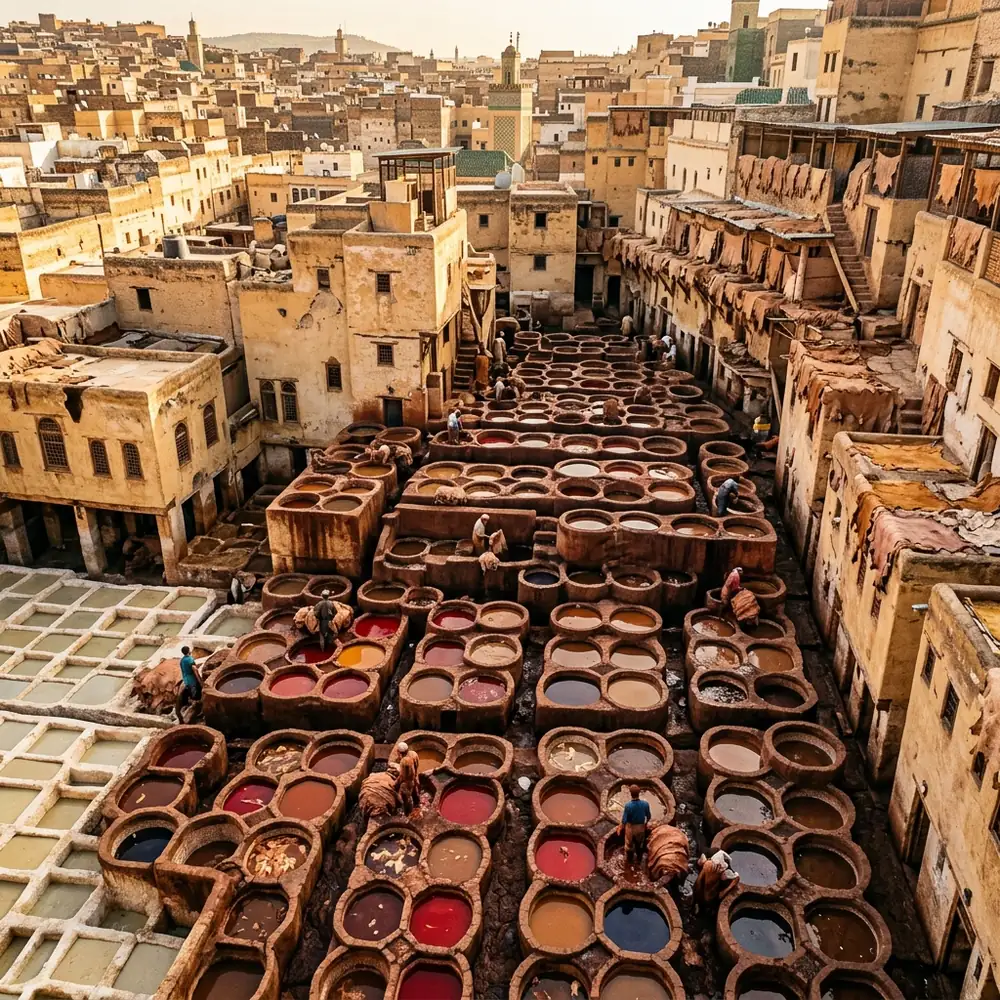
The first thing visitors notice about the Chouara tannery in Fes el-Bali is not its famous geometry of stone vats — it is the smell. Rising from the medina’s leather quarter on most mornings, it is a dense, animal presence: the smell of raw hide, of pigeon dung used in the softening process, of natural dyes fermenting in shallow pools under an open Moroccan sky. It is a smell that connects you, more directly than any museum exhibit could, to the same process that has been carried out on this hillside since the eleventh century. The Chouara tannery is widely cited as one of the oldest continuously operating tanneries in the world, a distinction that makes it simultaneously a working factory, a cultural monument, and one of the most photographed industrial sites on earth.
The craft of Fes leather tanneries did not arrive by accident. The city of Fes, founded in the late eighth century and developed into a major intellectual and commercial capital under the Marinid dynasty, occupied a strategic position on trade routes linking sub-Saharan Africa, the Maghreb, and the Mediterranean. Animal hides — from camels, cattle, sheep, and goats — arrived in quantity from the pastoral hinterland, and the nearby Fes River provided the constant water supply that tanning requires. By the time the Chouara tannery was established in its current location in the eleventh century, the trade had already developed sufficient complexity to support specialised guilds, with separate associations for the tanners themselves, the dyers, and the craftsmen who cut and stitched the finished leather into goods for trade.
The tanning process visible at Chouara today is, in its fundamentals, unchanged from that medieval practice. Freshly received hides are first soaked for several days in large vats of water and salt to remove residual flesh and blood. They then enter a lime and ash bath — in some workshops mixed with pigeon dung, whose high ammonia content softens the collagen fibres of the skin — where they spend several days until the remaining hair loosens and can be scraped away. After rinsing, the hides go into vats of quebracho or mimosa bark solution for the actual tanning, a process that chemically converts the raw hide into stable leather by binding tannin molecules to the collagen. This vegetable tanning produces leather with a distinctive character — firm, dense, with a slight sheen — quite different from the chrome-tanned leather that dominates industrial production globally.
The dyeing stage is where moroccan leather achieves its celebrated palette, and where the craft most clearly reveals its reliance on locally sourced natural materials. Saffron yields a rich golden yellow, used for the classic Moroccan yellow babouche slippers. Poppy petals produce shades ranging from coral to deep red, depending on concentration and mordanting technique. Indigo, sourced from the indigofera plant and historically imported along trans-Saharan trade routes, creates the range of blues that appear in belts and cushion covers. Henna powder, ground from the leaves of Lawsonia inermis and mixed with water, dyes leather a warm orange-brown particularly valued for certain styles of bags. Pomegranate bark, boiled and reduced, yields a tawny, ochre tan used as a base layer or finished colour. The dyers who work in the Chouara vats develop an almost tactile sense for colour development, judging readiness not by measuring instruments but by the colour of the dye liquid against the skin of the hide and the way the leather takes on sheen under the morning light.
The finished leather emerges in sheets that are then sold to the artisans of the medina’s leather-goods market, the Souk Cherratine. Here, in workshops barely two metres wide, master craftsmen cut and stitch babouches fes — the iconic pointed slippers whose shape has remained essentially constant for centuries. The golden babouche, worn by men for formal occasions and religious observance, requires three to four hours of hand-stitching per pair. Ladies’ babouches, often embroidered with silk thread or decorated with metallic wire, can take considerably longer. Beyond slippers, the workshops produce poufs, shoulder bags, belts, notebook covers, and larger luggage pieces — a full range that now serves a global retail market through export intermediaries and, increasingly, direct online sales by individual craftsmen.
The economic data surrounding Fes leather exports tells a story of both importance and ongoing challenge. Morocco’s artisanal leather sector generates approximately 1.4 billion Moroccan dirhams annually in export revenue, with Fes accounting for a significant plurality of that figure (Ministère du Tourisme et de l’Artisanat, 2022). An estimated 8,000 to 10,000 artisans work directly in the leather trades in Fes, from raw tanning through finished goods production (Chambre de l’Artisanat de Fes-Meknès, 2022). These numbers make the leather quarter among the medina’s largest employers. The finished goods flow primarily to France, Spain, Italy, and the United States, with Gulf markets growing as regional tourism to Morocco brings Moroccan craft products to wider Gulf consumer attention.
The survival of the traditional tanning process is not guaranteed, however. Environmental regulation has become an increasing pressure on the Fes tanneries, as the chemical runoff from even vegetable tanning processes contains organic compounds and dye residues that have historically been discharged into the Fes River. Morocco’s Ministry of Environment has worked with the Wilaya of Fes-Meknès and international development partners to fund wastewater treatment infrastructure for the tanning quarter, and a remediation project targeting the most polluted sections of the Oued Fes was launched in phases from 2019 onward (Wilaya de Fes-Meknès, Environmental Progress Report, 2022). Compliance with the new discharge standards is costly for small workshops, and several smaller tannery operators have consolidated or closed during the transition period.
There is also a generational tension within the craft. Young Fassis with university degrees are less likely to enter the tanning pits than their fathers and grandfathers were, and the physically demanding work — standing barefoot in dye vats in all seasons, exposed to chemical vapours and intense sun — commands higher wages than it once did as labour alternatives expand. Craft schools supported by the Ministry of Artisanal Affairs and the European Union have launched programmes to attract and train a new generation of leather artisans, framing the work not simply as industrial labour but as the stewardship of a chouara tannery fes heritage listed among Morocco’s most significant cultural assets.
For the visitor who finds their way to one of the terrace overlooks above Chouara — vendors of leather goods typically invite you up and hand you a sprig of fresh mint to hold under your nose against the smell — the sight of a hundred circular stone vats arranged below, each a different colour, workers moving between them in a choreography shaped by a millennium of practice, is genuinely difficult to process as a contemporary reality. This is not a reconstruction or a museum demonstration. It is Monday morning at a working factory. The leather drying on rooftops above the medina will be cut into babouches by Thursday, sold to a French wholesaler by Friday, and in a shop window in Bordeaux or Lyon within the month. The medieval and the global occupy the same stone vat, and have done so, without interruption, for a thousand years.
Experience the true heart of Moroccan heritage through its culinary traditions. Join us in preserving and honoring these ancestral recipes.
What People Are Saying
No comments yet. Be the first — we'd love to hear from you.
Houssam Elmrabet
Culturally Verified & Fact-CheckedHoussam Elmrabet is a Moroccan researcher in territorial marketing and cultural heritage preservation. His work documents regional gastronomic identities, local agricultural heritage, and how ancestral culinary traditions define authentic territorial branding across the Kingdom.