Fes Medina Culinary Secrets: A Food Lover's Guide to Morocco's Ancient City
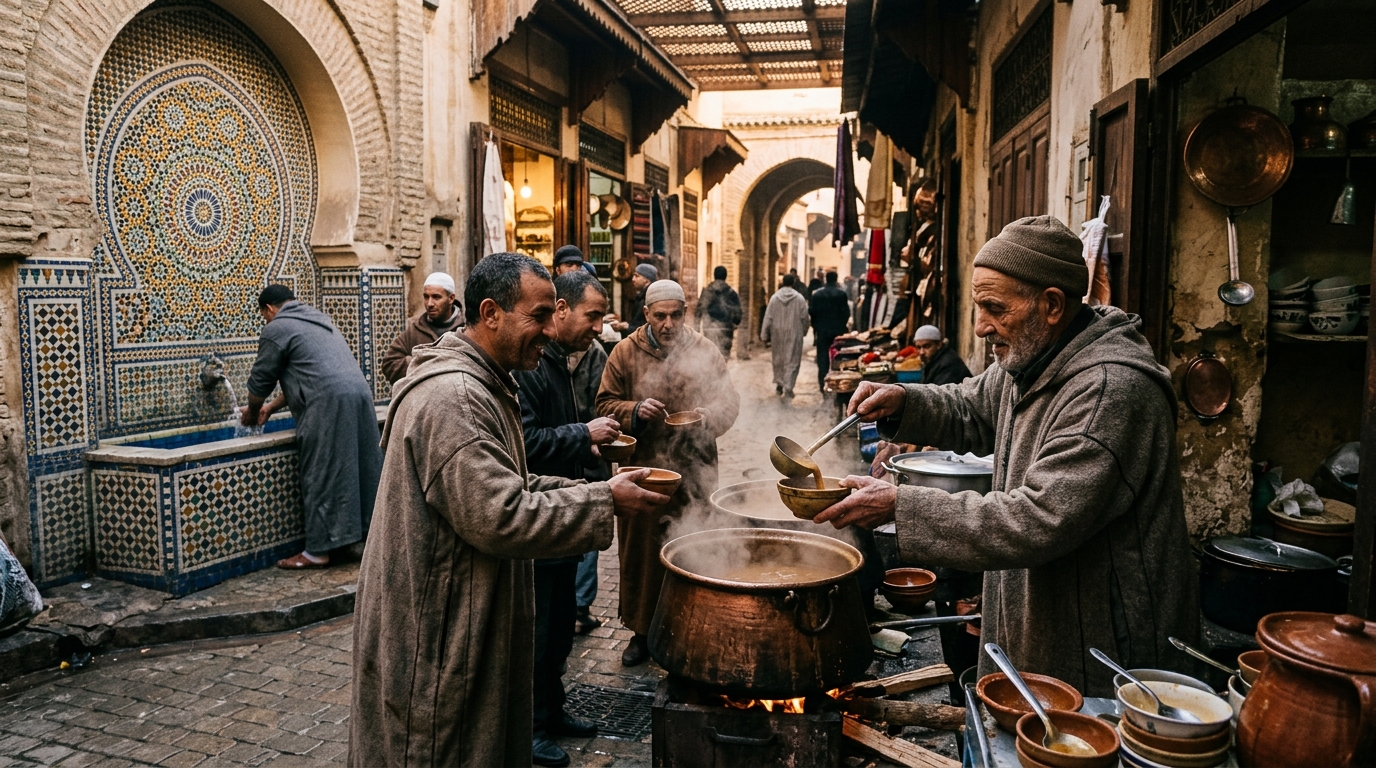
There is a moment, somewhere between the Rcif bridge and the Andalusian quarter, when you stop following the map and start following your nose. That is the moment Fes starts making sense. The city does not reveal itself to tourists who walk with their phones raised. It opens itself to people who are hungry.
Fes el-Bali is the oldest living medieval city on the planet. Its medina has been continuously inhabited for over twelve centuries. In that time, it has developed a cuisine so layered, so specific, and so quietly confident that even many Moroccans from other cities speak of Fassi food with a kind of reverence — the way a musician speaks about a particular chord progression that always works.
Before the City Wakes Up: The Rcif Dawn Scene
Get up early. This is not negotiable.
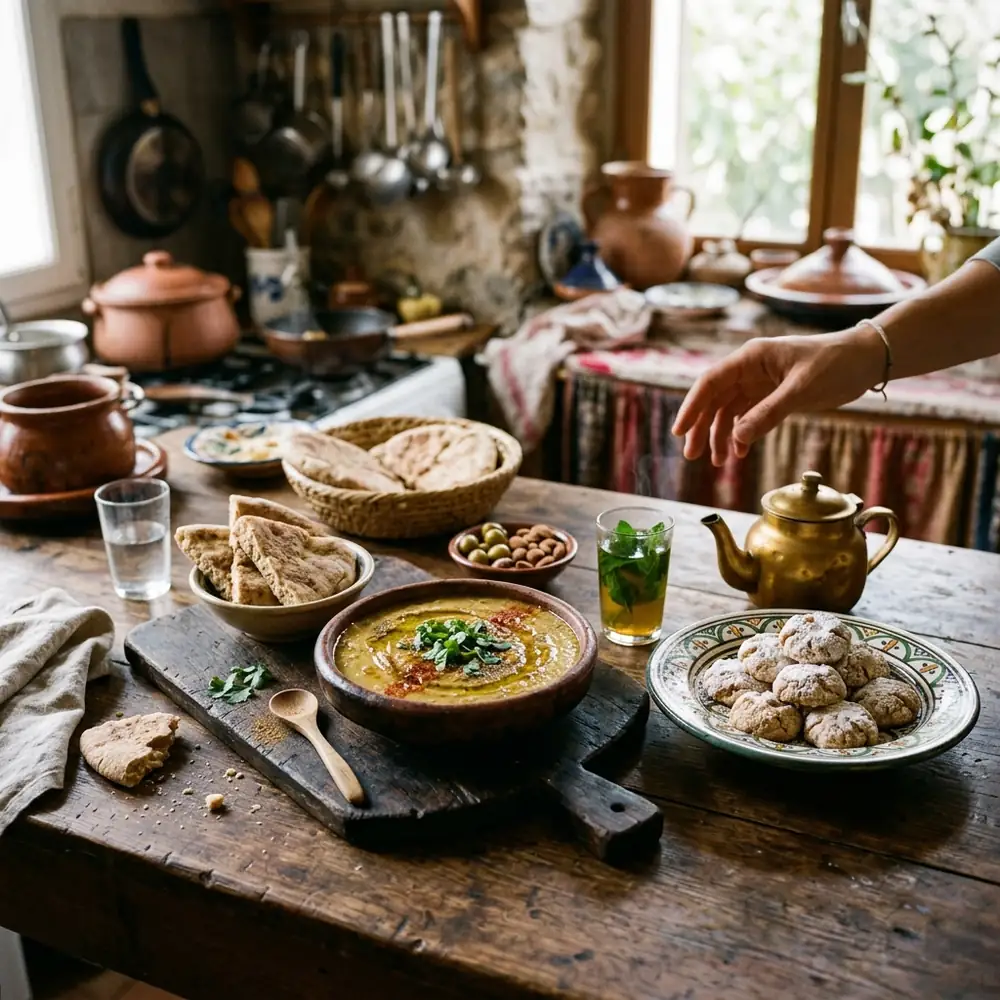
By five-thirty in the morning, the Rcif neighborhood — the low-lying quarter along the Oued Fes river — is already working. The cauldrons of bissara come first. Bissara is a fava bean soup, the color of sage, cooked overnight with garlic, cumin, and olive oil. In Fes, it is not a side dish or a starter. It is breakfast, it is dinner, and for many working men in the medina, it is the meal that makes everything else possible. A bowl costs between five and eight dirhams. Eat it standing up, the way everyone else does, with a piece of khobz torn from the warm round loaf you just bought at the communal ferran oven around the corner.
The ferran — the neighborhood bread oven — is another thing worth seeking out. Families in the medina do not always bake at home. They mix their dough, shape it, press a personal mark into the top, and carry it to the neighborhood oven on a wooden board. By the time they come back thirty minutes later, it is baked. Some families have been using the same ferran for four generations. You can buy a loaf from the bakers waiting to sell the extras. It is the best bread you will eat in Morocco, and it costs almost nothing.
Pastilla: The Fassi Original vs. The Tourist Version
If you only eat one thing in Fes, it must be pastilla. And I mean the real Fassi pastilla, which is made with pigeon.
This is important because most restaurants outside of Fes, and quite a few inside it, now make pastilla with chicken or seafood. These are good. The chicken version is honest and satisfying. But the pigeon version is something else entirely — deeper, darker, slightly gamier, with a sweetness from the cinnamon and powdered sugar that hits against the rich braised meat in a way that still surprises you even when you know it is coming.
The authentic Fassi pastilla uses warqa pastry, which is thinner than filo and requires a technique passed down through years of practice. A skilled cook makes warqa by dabbing a ball of wet dough against a hot pan in overlapping circles, building up the paper-thin sheet layer by layer. When you find a restaurant where the pastilla has that translucent, almost lacey crust on the outside — not the thick, doughy version — you are eating the real thing.
Ask specifically for bestila bel hmam (pigeon pastilla). Dar Tajine near Bab Guissa does a fine version. So does a small place on Derb Miter that does not have a sign but always has a queue.
Rfissa: The Dish Fes Keeps to Itself
Ask a Fassi what food they are most proud of and they might say pastilla. Ask what food they actually make for their family when someone has a baby, recovers from illness, or comes home after a long time away, and they will say rfissa.
Rfissa is not on many restaurant menus. It is a home dish — the kind of thing you eat at a family table, not at a tourist spot. It involves a bed of shredded msemen (layered pan-fried flatbread), topped with a stewed chicken in a sauce thick with fenugreek, smen (aged fermented butter), and lemon. The fenugreek gives it a slightly bitter, nutty background that is completely unique. The whole thing is warming in a way that feels almost medicinal — because it is. Fenugreek is traditionally believed to support recovery and new mothers’ strength.
Your best shot at eating rfissa in Fes is to book a cooking class with a Fassi family, or to ask at a small neighborhood restaurant if they make it on special days. Some women’s cooperative restaurants in the medina serve it on Fridays. Keep asking.
Hergma: The Dish That Separates Regulars from Tourists
Hergma is cow’s trotters, slow-cooked with chickpeas, onion, cumin, and black pepper until the collagen has collapsed into a thick, glossy, entirely indulgent stew. It is sold from large copper pots in the souks, usually in the morning, usually to men who eat it with bread and nothing else.
It is one of the most Fassi things you can eat. It is also one of the things that tourists routinely skip because the presentation — a grey-beige stew scooped into a bowl from a communal pot — does not photograph well for Instagram. This is your gain. The line at the hergma cart near Seffarine Square on a cold morning is not for tourists. Get in it.
Boujeloud Square vs. the Hidden Places
Boujeloud Square, near the famous blue-tiled gate of Bab Bou Jeloud, is where most visitors end up eating. The restaurants along the strip are not bad. Some of them are perfectly decent. But they are also priced for people who just stepped off a tour bus and did not know where else to go, and the food — while usually fine — is adjusted for international palates.
The better places require fifteen more minutes of walking. Follow the main medina artery past Talaa Kebira, turn into the narrower lanes of the Quartier des Andalous, and look for places that have plastic chairs instead of carved cedar ones, where the chalkboard menu is in darija (Moroccan Arabic) rather than English. These spots serve the food that locals actually eat on their lunch break. The price difference is stark — a full meal at a tourist-facing Boujeloud restaurant might cost 80 to 120 dirhams. The same volume of food at a neighborhood place costs 25 to 40.
The Chouara Tannery Tea Houses
You will go to the Chouara tannery. Everyone does. The leather workers have been dyeing hides in those stone vats since the twelfth century, and the view from the surrounding balconies is genuinely extraordinary.
What most visitors miss is that the tea houses and small cafés on the rooftops above the tannery are not just for looking — they also serve food. Mint tea, obviously. But also Fassi cookies: ghoriba (crumbly shortbreads made with sesame or coconut), chebakia (fried pastry soaked in honey and sprinkled with sesame), and briouat (crispy pastry cigars filled with almond paste or minced meat). Sit long enough, and you stop noticing the smell of the tannery, which is considerable, and start noticing the light on the old city rooftops, which is extraordinary.
Navigating the Medina by Smell and Sound
Here is the most practical food advice I can give you about Fes: stop using your map to find food.
The medina is 9,000 narrow lanes. No app has mapped all of them correctly. What does work is your senses. Follow the smell of cumin and you find the spice souk. Follow the smell of frying oil and you find kefta or merguez being cooked. Follow the sound of metal on metal and you are near the Seffarine (coppersmith) Square. Follow the smoke and you are near a mechoui oven where whole sheep are roasted in underground pits.
Get lost on purpose. The medina’s food geography is intuitive once you stop fighting it. The worst that happens is you find a dead end and a cat. The best that happens is you find a woman selling Fassi msemen from a cart that no guidebook has ever mentioned.
The Medina Cooking Class: What to Look For
If you want to cook Fassi food properly, a cooking class inside the medina is worth every dirham. Not a demonstration class where you watch a chef and then eat. An actual hands-on class, ideally starting at the souk so you understand where the ingredients come from.
Good classes in Fes take you to the Rcif market at 7am, where you choose the vegetables, smell the spices, and argue (gently) over which chicken looks best. Then you go back to a riad kitchen and make something with what you bought. The best classes focus on three dishes maximum. Breadth is the enemy of depth. If a class promises to teach you ten Moroccan dishes in three hours, find a different one.
Fes is the right place to learn Moroccan cooking because the cuisine here is the most elaborate and technically demanding in the country. What you learn here transfers everywhere else.
FAQ
Is it safe to eat street food in Fes medina? Yes, with basic common sense. Avoid food that has been sitting out in the heat for hours. Look for stalls with high turnover — the bissara carts and hergma pots that empty and refill regularly are always the safest. Hot food served immediately is almost always fine.
What is the best time of day to eat in the Fes medina? Early morning (before 8am) for bissara and fresh bread. Lunchtime (12pm to 2pm) for cooked dishes at neighborhood restaurants. Evening (after 7pm) for the more atmospheric, sit-down Fassi meals. Avoid the mid-afternoon lull — many small places close between 3 and 6pm.
Can I find vegetarian food easily in Fes medina? More easily than you might expect. Bissara is naturally vegan. Many couscous dishes are served with only vegetables. Zaalouk (roasted eggplant salad) and taktouka (pepper and tomato salad) are staples everywhere. Just communicate clearly — some dishes use chicken broth even when the protein is not visible.
How much should I budget for food in the Fes medina per day? If you eat the way locals eat — street breakfast, neighborhood lunch, market snacks — you can eat extraordinarily well for 80 to 120 dirhams per day ($8–12 USD). Add a nice dinner at a riad restaurant and that number goes to 250 to 350 dirhams. The medina rewards people who eat where the locals eat.
Experience the true heart of Moroccan heritage through its traditions. Join us in preserving these ancestral rituals.
What People Are Saying
No comments yet. Be the first — we'd love to hear from you.
The Moroccan Food
A Moroccan cultural writer dedicated to documenting the authentic voice, history, and heritage of the Kingdom. Writing from within — to share what truly makes Morocco extraordinary.
Our Mission →