The Fes Tanneries: How Moroccan Leather Has Been Made the Same Way for 900 Years
The Fes Tanneries: What Is Actually Happening in Those Stone Vats
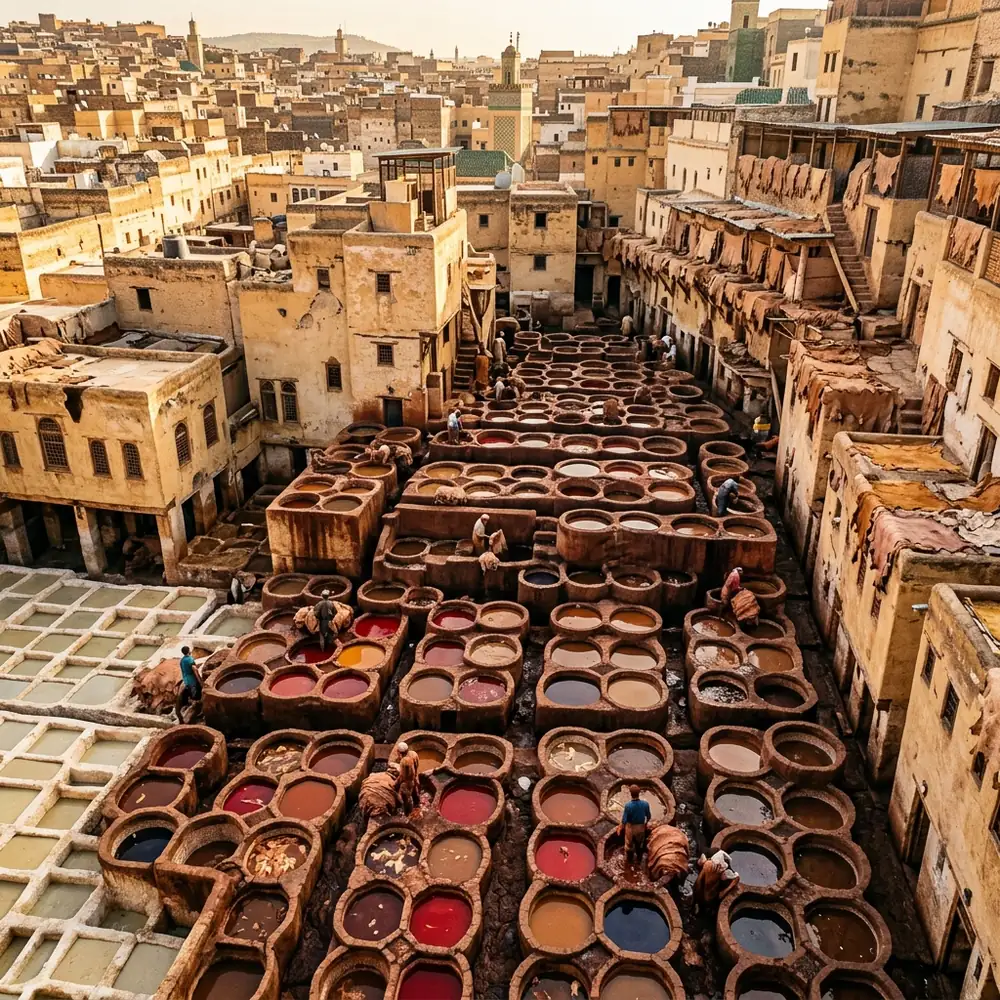
The photograph everyone takes — the aerial shot looking down over the Chouara tannery in Fes, with its circular stone vats filled in yellow and brown and red, the workers moving between them against the backdrop of the medina rising on the surrounding hills — is one of the most reproduced images in Moroccan tourism photography. It is also, in a specific way, slightly deceptive, because it aestheticizes what is from the inside a physically demanding, olfactorily overwhelming, and technically complex industrial process that has been operating on this site continuously since approximately the 11th century.
The photography platforms — balconies of leather goods shops surrounding the tannery, where visitors are directed upstairs with a sprig of mint pressed into their hands to hold under their noses — are constructed specifically so you can see the beautiful overhead view. They are not constructed to give you any sense of what the work is like from below, at the level of the vats, which is where the craft actually happens. Let me tell you what is happening at that level.
What Is in the Tannery Vats and What Does Each One Do?
The traditional tanning process at Chouara — still used today with minimal modification — involves a sequence of chemical treatments that transform raw animal hide into finished leather. The vats contain different solutions at different stages of this process.
The first stage is the liming vats: a mixture of water, quicklime, and ash that removes hair and outer skin layers from the raw hide and begins breaking down the hide's protein structure. Hides soak in liming solution for several days. The chemical action of the lime is visible as the hides swell and change texture. Workers wearing no protective equipment waded into these vats historically, and still largely do, because the protective equipment that would be specified by any contemporary occupational safety regulation would make the physical manipulation of the hides significantly more difficult.
The second stage, after liming, is the pigeon dung vats. This is the detail that appears in every description of the Chouara tannery and that visitors find most arresting. The softening vats contain a solution of water and dried pigeon excrement — collected from the pigeon houses maintained on rooftops throughout the medina specifically for this purpose — which is rich in ammonia and enzymes that further break down and soften the hide, making it pliable rather than stiff. Pigeon dung has been used for this purpose in Moroccan tanning since the process was established. Synthetic chemical equivalents exist and are used in industrial tanning facilities. They are not used at Chouara because the traditional process produces specific qualities in the finished leather that the synthetic process does not fully replicate.
The dyeing vats come after the softening. The traditional dye colors — poppy red, saffron yellow, cobalt blue, green from mint, brown from cedar bark, indigo — are all natural plant-based dyes prepared in large containers and maintained at specific concentrations. Hides are worked through the dye by the tanners standing in the vat, trampling the leather repeatedly to force the dye into the fiber uniformly. The physical labor of a Chouara tanner — standing in dye up to the knee or thigh for hours, constantly moving and manipulating heavy wet leather — is considerable, and the physical cost accumulated over a working lifetime is visible in the bodies of older tanners.
What Makes Fes Leather Different From Other Moroccan Leather?
The answer is partly the process — the traditional natural dye and pigeon-softening method — and partly the specific hide quality and the craft tradition of finishing that follows the tanning. Leather that has been softened with pigeon dung and dyed with natural plant dyes has a specific hand quality — the way it feels when you handle it, its flexibility, its response to use over time — that is different from chrome-tanned and synthetic-dyed leather. It also ages differently: natural-dyed Fes leather darkens and develops a patina with use rather than fading or cracking.
The finishing — the stretching, drying, hammering, and polishing of the tanned hide that produces the smooth, even surface of the finished leather goods — is carried out by different craftsmen from the tanners, specialists whose skill is in transforming the tanned hide into a material that a leather worker can then cut and stitch. The division of labor within the leather trade in Fes is extremely fine: tanners, finishers, cutters, stitchers, and sellers are all separate specialties, often organized by family and neighborhood within the Fes medina's guild structure.
The goods that are made from Fes leather — the traditional balgha (the pointed-toe leather slipper), bags, belts, jackets, book bindings, cushion covers — are widely sold throughout Morocco and exported internationally. The balgha specifically is considered one of the definitive Moroccan craft objects: a pointed slipper in natural tan or yellow that is the standard indoor footwear in traditional Moroccan households and that is still worn daily by a significant percentage of the Moroccan male population, particularly those of the older generation.
Is the Tannery Sustainable and What Is Its Future?
The honest answer is: uncertain. The traditional tannery process produces effluent — the runoff from liming, softening, and dyeing vats — that is environmentally problematic. The Oued Fes, into which the tannery effluent has historically discharged, shows chemical and biological impacts of this discharge. Regulatory pressure to modernize the effluent treatment has been building for years.
The tanners themselves are in a complicated position: adopting industrial methods would reduce their environmental impact but would also change the quality of their product and potentially eliminate the craft tradition that gives Fes leather its value and its market. The boutique leather goods market — which is where the premium value of Fes tannery leather is captured — depends on the traditional process being genuinely traditional, not just marketed as such.
There are ongoing discussions within the Fes artisan community and with the Moroccan Ministry of Handicrafts about how to modernize effluent treatment without disrupting the craft process itself. These discussions have been ongoing for two decades without complete resolution, which tells you something about the difficulty of the problem.
The Invisible Invitation
Go to the tannery in the morning, before ten, when the light falls directly into the vats and the workers are most active. Accept the mint that the shop offers — not as a courtesy, because it is functionally necessary. Stand on the terrace for twenty minutes rather than five, long enough for the initial assault of the smell to settle into a background condition and for you to actually see what is happening in the vats rather than reacting to the smell. Watch a tanner work the leather through a dye vat. Count how many times he steps across the same vat in five minutes. Calculate what that motion repeated across a working day, across a working week, across twenty years looks like in a person's body. The leather goods in the shop downstairs are the result of that. Something about them looks different after this calculation.
SEO Meta Description: How are the Fes tanneries made and why do they still use ancient methods? The pigeon dung vats, natural dyes, Chouara tannery process, and the sustainability challenge facing Morocco's oldest craft.
Experience the true heart of Moroccan heritage through its culinary traditions. Join us in preserving and honoring these ancestral recipes.
What People Are Saying
No comments yet. Be the first — we'd love to hear from you.
Youssef Amazigh
Culturally Verified & Fact-CheckedThe Moroccan Food editorial team brings together native culinary researchers, heritage preservationists, and experienced home cooks across Marrakech, Fes, and Casablanca. Every recipe and cultural guide is reviewed against ancestral oral traditions and authentic regional practices.