The Gnawa: Morocco's Sub-Saharan African Spiritual Brotherhood and Why Their Music Heals
The Gnawa: What Their Music Is Actually For and Why the Festival Version Misses the Point
I need to say something at the beginning about the Gnawa World Music Festival in Essaouira — not to dismiss it, but to be clear about what it is and what it is not.
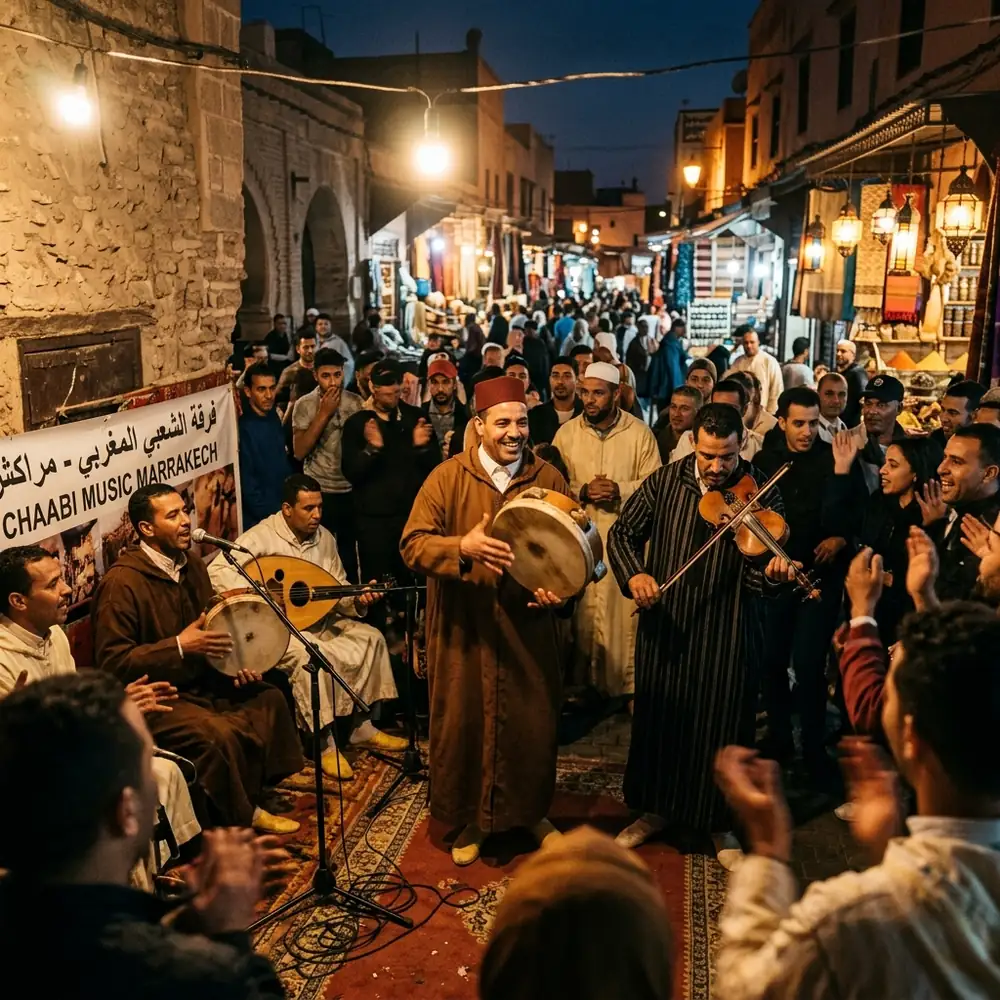
The festival is a celebration and a promotion of Gnawa music in the context of world music exchange. It is legitimate, it supports Gnawa musicians financially, and it has introduced Gnawa music to millions of people who would not otherwise have encountered it. These are real and significant achievements.
What the festival is not is a Gnawa healing ceremony. The performances at the festival — large outdoor stages, amplified sound, mixed international and Moroccan audiences — are presentations of Gnawa musical tradition in a concert context. They are separated from the function for which that musical tradition was developed and in which it still operates: the lila, the healing ceremony, which takes place in private homes, in front of an invited community, for the specific therapeutic purpose of treating a person who is suffering — spiritually, psychologically, or physically — through ritual engagement with the Gnawa’s spirit world.
These are two different things. The music is the same. The purpose is completely different. Understanding the difference is understanding the Gnawa.
Who Are the Gnawa and Where Did They Come From?
The Gnawa — also written Gnaoua, Gnawa, Koyo depending on transliteration convention — are a brotherhood of Moroccan Muslims of sub-Saharan African descent, primarily from West and Central Africa, whose ancestors arrived in Morocco primarily through the trans-Saharan slave trade between the 14th and 19th centuries. This history is important and has not always been acknowledged fully in Moroccan public discourse — the recognition that a significant element of Morocco’s cultural landscape was built by enslaved people is a historical truth that contemporary Moroccan society is still working through.
The Gnawa maintained, across centuries of transplantation and forced integration into Moroccan Muslim society, a parallel spiritual tradition rooted in West African religious practice — specifically in the spirit pantheon of the vodun/bori traditions of the West African Sahel — that was adapted into a framework compatible with Islamic practice. The Gnawa formally converted to Islam and are Muslims. Their spiritual practice overlays Islamic practice with a pre-Islamic spirit world that survived the conversion and the displacement and the centuries.
This kind of syncretic preservation — maintaining an older spiritual practice within an officially Islamic framework — is not unique to the Gnawa. It occurs across the Islamic world at the intersection of conversion and local spiritual tradition. But the Gnawa’s version of it is particularly well-documented, particularly musically rich, and particularly alive.
What Is a Lila and What Happens During It?
A lila is a Gnawa healing ceremony conducted by a Maâlem (master musician and spiritual practitioner) with his troupe of musicians and assistants, on behalf of a person who is seeking healing from a specific affliction — which might be diagnosed as physical illness, psychological distress, possession by a malevolent spirit, or some combination of these in a framework that does not separate them the way Western medicine does.
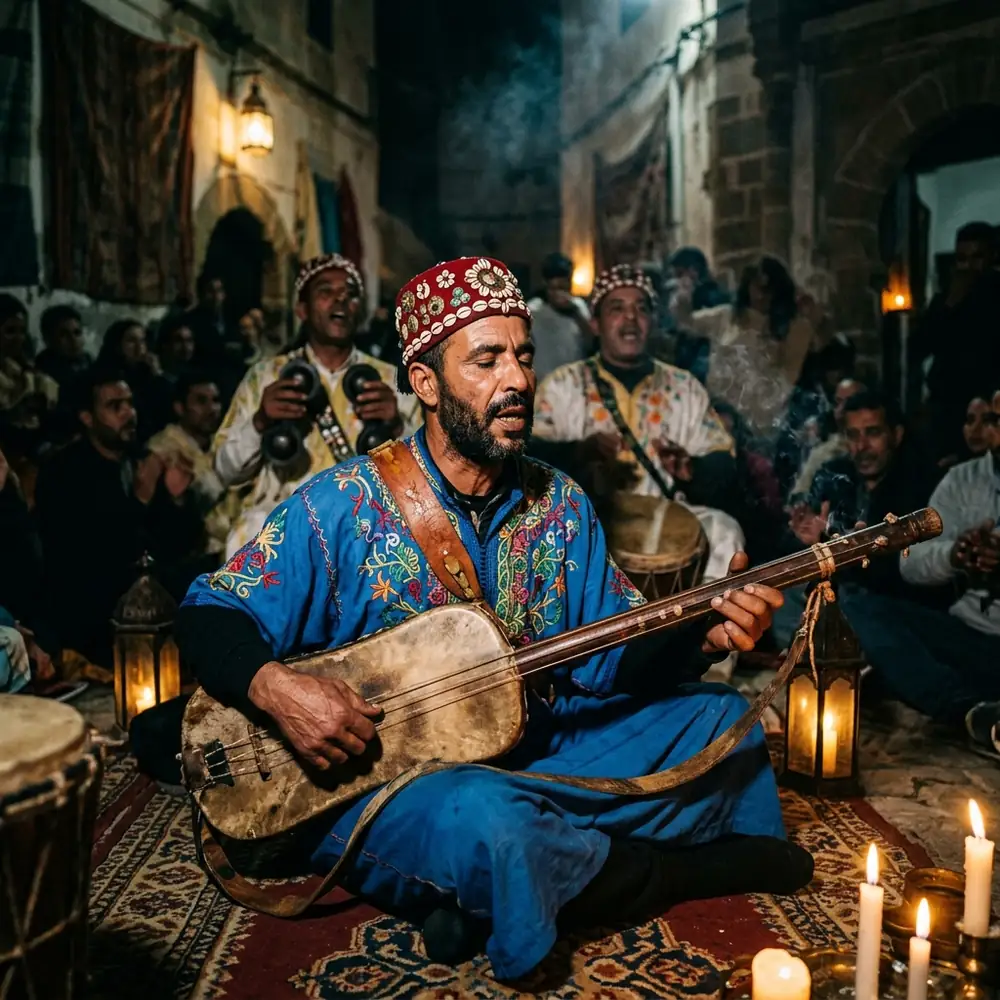
The ceremony begins in the evening and runs through the night, typically ending at dawn. The Maâlem plays the guembri — the three-stringed bass lute, with a resonating skin over a wooden boat-shaped body, with a characteristic buzzing quality produced by sympathetic strings across the bridge — while his assistants play the qaraqeb (large iron castanets, held in pairs in each hand and clacked together in complex rhythmic patterns) and sing. The music is organized into a series of discrete sections called mluk (spirits), each associated with a specific color, specific incense, specific foods and offerings, and a specific set of spirits from the Gnawa pantheon.
Each mluk section begins slowly and builds in tempo and intensity over thirty to sixty minutes. The person being healed — who has been prepared for the ceremony through specific ritual procedures in the days before — responds to specific mluk sections with physical movement that ranges from gentle swaying to full trance states involving loss of voluntary motor control. The music’s tempo and the Maâlem’s attention to the patient guides the trance, and the community of experienced Gnawa practitioners and initiated women who are present at the ceremony form a container that manages the trance state safely.
This is not theater. The people involved in a lila are not performing for an audience. The patient’s trance is not voluntary. The Maâlem’s skill in navigating the patient through the mluk sequence toward resolution is clinical knowledge — empirically developed across generations of practice — as well as musical skill.
What Is the Guembri and Why Is It Central to Gnawa Identity?
The guembri (also sintir or hajhuj) is the foundational instrument of Gnawa music, and its construction and playing technique are as important to the tradition as its musical role.
The body is a wooden, boat-shaped resonating box — traditionally made from a single piece of cedar or walnut, hollowed out — covered on the playing face with a skin membrane, typically camel skin in the traditional construction. Three strings are attached from a leather tail piece at the base to tuning pegs at the head. A thin buzzing metal wire runs across the bridge and contacts the strings, producing the characteristic buzz that is inseparable from the guembri’s sound and that serves both a musical function (adding overtone complexity) and a ritual function (the buzz is considered the voice of the spirit world).
The Maâlem plays the guembri by plucking the strings with the fingers — the thumb providing the bass pulse, the index finger playing melodic lines — while simultaneously using the instrument’s wooden body as a percussion instrument, slapping it with the left hand’s heel. A good Maâlem plays rhythm, bass, and melody simultaneously and conducts the ceremony through the instrument: tempo changes, transitions between mluk sections, cues to the qaraqeb players and the vocalists, all communicated through variations in playing that the initiated musicians read and respond to.
Learning the guembri at the level required for a practicing Maâlem is a multi-year process that occurs within the Gnawa brotherhood’s internal transmission system — father to son, Maâlem to apprentice. It is not taught in music schools. It is not in any curriculum. It is passed person to person, in the context of actual ceremonial practice.
The Invisible Invitation
The lila has been going for four hours when the mluk of the Blue spirits begins. The incense changes — something sweeter, heavier. The music’s tempo drops and then rebuilds from a new baseline. One of the women who has been sitting quietly at the edge of the room for the past four hours begins to move. The movement is involuntary in its quality — not dancing, not convulsing, but responding, in the way a body responds to a force it didn’t produce. The Maâlem plays directly toward her. The qaraqeb keep the rhythm. The room is watching with complete attention and complete calm, because everyone in the room has seen this before and knows what it is. You are at the edge, a guest who was brought by someone known to the family. Watch. Do not photograph. Do not speak. This is their work, not your experience. Understand the difference and you will be welcome to watch.
SEO Meta Description: Who are the Gnawa of Morocco and what is a lila ceremony? The sub-Saharan African heritage, guembri instrument, trance healing ritual, and why the Essaouira festival is not the full tradition.
Experience the true heart of Moroccan heritage through its culinary traditions. Join us in preserving and honoring these ancestral recipes.
What People Are Saying
No comments yet. Be the first — we'd love to hear from you.
Youssef Amazigh
Culturally Verified & Fact-CheckedThe Moroccan Food editorial team brings together native culinary researchers, heritage preservationists, and experienced home cooks across Marrakech, Fes, and Casablanca. Every recipe and cultural guide is reviewed against ancestral oral traditions and authentic regional practices.