Casablanca: More Than Just the Airport
Almost every international visitor to Morocco passes through Mohammed V International Airport outside Casablanca. And yet, nine out of ten travelers grab their luggage, jump straight onto a southbound train to Marrakech, and never spend a single night in the Kingdom’s largest city.
For decades, casual travel guides have dismissed Casablanca (Dar el-Baida in Arabic, or colloquially Casa) as an unromantic, sprawling industrial concrete jungle with nothing to see except a single famous mosque.
As a researcher in territorial marketing and urban heritage, I can tell you that this dismissal misses the true heartbeat of modern Morocco.
If Fes represents Morocco’s medieval soul and Marrakech represents its festive desert theater, Casablanca is the living, breathing engine of the twenty-first century Kingdom. It is a cosmopolitan coastal metropolis of nearly four million people, the financial capital of North and West Africa, an open-air museum of early twentieth-century Art Deco architecture, and home to the most daring architectural achievement in modern Islamic history.
Here is an authentic territorial guide to looking beyond the Hollywood myths, exploring Casablanca’s historic quarters, and experiencing the culinary vitality of Morocco’s great Atlantic port.
The Hollywood Myth vs. The Living Metropolis
Before setting foot in Casablanca, one cultural misconception must be cleared away: the iconic 1942 Hollywood movie Casablanca, starring Humphrey Bogart and Ingrid Bergman, was not filmed in Morocco.
Not a single frame was shot on African soil. The entire film was produced on Soundstage 19 at the Warner Bros. lot in Burbank, California. There was no real “Rick’s Café Américain” in 1942. (An enterprising former American diplomat named Kathy Kriger eventually opened a real-life Rick’s Café in 2004 inside a restored 1930s riad near the port walls, meticulously recreating the movie’s brass chandeliers, grand piano, and palm-shaded bar for nostalgic travelers).
The real Casablanca is infinitely more fascinating than a black-and-white Hollywood fantasy. Originally settled by indigenous Amazigh fishermen as the ancient port of Anfa, the city was rebuilt in the late eighteenth century by the Alaouite Sultan Sidi Mohammed ben Abdallah following a devastating earthquake.
In the early twentieth century, under the guidance of French urbanist Henri Prost and Resident-General Hubert Lyautey, Casablanca was transformed from a modest walled harbor into one of the most daring testing grounds for modern urban architecture in the world.
The Architectural Wonder: Hassan II Mosque
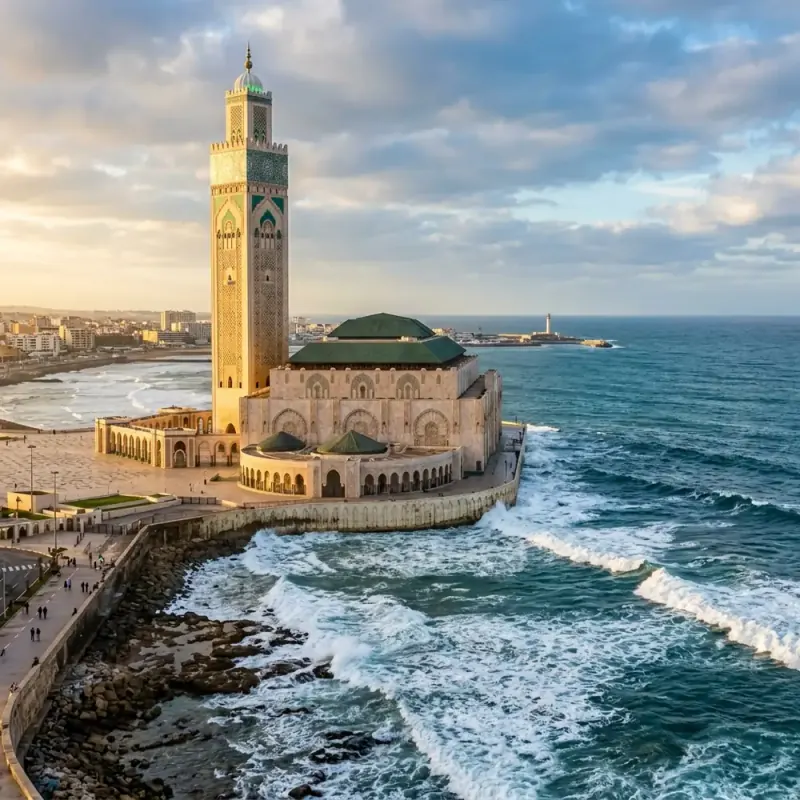
Standing on a rocky promontory jutting boldly out into the crashing Atlantic surf, the Hassan II Mosque (Mosquée Hassan II) is an engineering triumph that takes your breath away.
Commissioned by the late King Hassan II and completed in 1993 after seven years of continuous construction by over 10,000 Moroccan master artisans (maâlems), the mosque was inspired directly by the Quranic verse: “And His throne was upon the water.”
To understand its staggering scale:
- The Minaret: Rises 210 meters (689 feet) into the Atlantic sky, making it one of the tallest religious minarets on earth. At night, a laser beam shoots thirty kilometers from its peak, pointing directly east toward Mecca.
- The Capacity: The central prayer hall accommodates 25,000 worshippers, while the vast outdoor marble esplanade holds an additional 80,000 people during Friday and Eid prayers.
- Master Craftsmanship: Every square centimeter showcases ancestral Moroccan decorative arts: hand-carved cedar wood ceilings from the Middle Atlas, intricately chiseled white stucco (tadelakt), and massive mosaic tile panels (zellige) laid in complex mathematical geometries.
- High-Tech Engineering: A retractable titanium roof weighing 1,100 tons slides open in just three minutes, flooding the prayer hall with Atlantic sunshine and fresh sea air, while heated marble floors keep worshippers comfortable during damp winter mornings.
Unlike most active mosques in Morocco, which are closed to non-Muslims, the Hassan II Mosque offers comprehensive, multilingual guided tours outside of prayer times. Stepping barefoot onto its polished marble floors while watching the Atlantic waves crash against the glass foundations beneath you is an essential Moroccan experience.
Downtown Art Deco: The World’s Great Open-Air Museum
While architecture lovers travel to Miami or Havana for Art Deco, Casablanca possesses one of the richest and most complete collections of 1920s and 1930s Mauresque architecture anywhere on the planet.
During the interwar period, visionary European architects were given free rein to experiment with concrete, elevators, and curved corner facades, blending French Beaux-Arts and Art Deco geometry with traditional Moroccan architectural elements (such as carved plaster cornices, horseshoe archways, and green ceramic roof tiles).
Take a walking tour through downtown:
- Boulevard Mohammed V: Once the glamorous retail artery of French North Africa, lined with towering 1930s residential palaces featuring curved balconies resembling the prows of ocean liners, wrought-iron elevator cages, and grand shaded arcades.
- Place des Nations Unies and Place Mohammed V: The monumental administrative center of the city, framed by the majestic Palais de Justice (Courthouse) with its grand colonnade, the Wilaya (Administrative Palace) with its clock tower, and the restored 1920s central post office.
- Villa des Arts: A stunning 1934 Art Deco villa surrounded by quiet gardens, now operating as a contemporary art center showcasing modern Moroccan painters and sculptors.
The Habous: A 20th-Century Ideal Medina
If the ancient medieval medina of Casablanca (located near the port) is modest in size, the city boasts a second, remarkable historic district known as the Quartier des Habous (or the Nouvelle Médina).
Constructed in the 1920s by French architects to solve a housing crisis for rural migrants arriving from the provinces, the Habous was designed as an idealized version of an imperial Moroccan medina. The architects followed traditional Moroccan spatial hierarchy: narrow winding lanes, stone archways, shaded courtyards, and communal ovens, but widened the passages to allow natural light and fresh ventilation.
Today, the Habous is a peaceful, tree-lined sanctuary famous for two cultural anchors:
- The Royal Olive Market (Souq des Olives): An open courtyard filled with dozens of traditional wooden barrels brimming with cured Moroccan olives: cracked green olives marinated with wild thyme and preserved lemon, jet-black wrinkled salt-cured olives (zitoun akhal), and fiery red olives tossed in harissa.
- Pâtisserie Bennis Habous (Established 1930): Hidden down a quiet tiled alleyway, this legendary family-run bakery is regarded by many food connoisseurs as the greatest traditional pastry shop in Morocco. Watch the bakers slide wooden paddles loaded with fresh almond cornes de gazelle, honey-soaked briouates, and orange-scented pastillas into centuries-old wood-fired brick ovens.
Coastal Energy and Gastronomy: How Casablanca Eats
Casablanca is a port town at heart, and its culinary scene revolves around the freshest catch landed daily along the Atlantic shelf:
1. The Central Market Fish Feast (Marché Central)
Built in 1917, the historic Marché Central on Boulevard Mohammed V is an essential midday food stop. Stroll past stalls displaying wild Atlantic sea bass, red sea bream, giant squid, and piles of live oysters from Oualidia.
Choose your fresh fish directly from the fishmonger, pay by the weight, and carry your newspaper-wrapped parcel across the aisle to one of the small, busy open-air fry kitchens. For a few dirhams, the cooks will dredge your catch in seasoned cornmeal and fry it golden-crisp to order, served alongside hot flatbread, spicy tomato dip, and cold soda.
2. La Corniche (Aïn Diab)
As the late afternoon sun dips toward the ocean, Casablanca’s residents flock to La Corniche, a wide pedestrian promenade hugging the Atlantic coast in the upscale neighborhood of Aïn Diab. Here, modern beach clubs, grand seafood brasseries, and outdoor cafes look out over the crashing breakers.
Order a traditional Moroccan afternoon snack: a hot, crispy sugar-dusted doughnut (sfenj) straight from the fryer, or a tall glass of jus d’avocat, a rich, velvety smoothie made from ripe avocados, cold milk, a splash of orange blossom water, and crushed almonds.
Practical Advice for Navigating Casablanca
- Getting Around: Casablanca is vast. For downtown travel between the train station, the central market, and the Habous, use the modern, air-conditioned Casablanca Tramway (Lines T1 and T2). For trips to the Hassan II Mosque or La Corniche, hail a red Petit Taxi (always ensure the driver activates the digital meter, le compteur).
- Casa-Port vs. Casa-Voyageurs: The city has two primary train stations. Casa-Port is situated directly downtown near the port and medina, ideal for coastal trains to Rabat. Casa-Voyageurs is located slightly east of center and serves long-distance routes, including the Al Boraq high-speed train to Tangier and southern trains to Marrakech.
- Recommended Stay: Spend one full day and one night in Casablanca before heading to the interior. Explore the Hassan II Mosque in the morning, walk through the Art Deco downtown and Marché Central for lunch, visit the Habous in the afternoon, and watch the Atlantic sunset from La Corniche.
Casablanca is where the future of Morocco is actively being built. It is big, confident, stylish, and deeply authentic.
Frequently Asked Questions
Is Casablanca worth visiting for tourists?
Yes. While it does not have the sprawling medieval atmosphere of Marrakech or Fes, Casablanca offers a captivating look at modern, cosmopolitan Morocco. The Hassan II Mosque alone, one of the few grand mosques in the Islamic world open to non-Muslims on guided tours, makes a day trip or overnight stay completely worthwhile.
How do you get from Mohammed V Airport to downtown Casablanca?
The easiest, most reliable, and cheapest option is the official ONCF airport train, located directly on the lowest level of Terminal 1. Trains depart every hour directly to Casa-Voyageurs and Casa-Port stations in downtown Casablanca, taking approximately 35 minutes for less than 50 dirhams ($5). Official white airport taxis are also available 24/7 for a fixed flat rate.
Is Rick’s Café in Casablanca authentic?
The original 1942 film Casablanca was shot entirely in California, meaning the Rick’s Café of the movie never physically existed in Morocco during World War II. However, the modern Rick’s Café in Casablanca, established in 2004 inside a restored 1930s coastal mansion, is a beautifully executed tribute that faithfully recreates the movie’s decor, music, and cocktail atmosphere. Reservations are essential for dinner.
Is Casablanca safe for walking around?
Like any metropolis of four million residents, Casablanca requires sensible urban awareness. Downtown avenues, the Habous quarter, La Corniche, and the Hassan II Mosque esplanade are safe, well-patrolled, and active with families. Keep expensive cameras and phones secure in crowded commercial areas, and avoid walking alone along unlit port alleys late at night.
Experience the true heart of Moroccan heritage through its culinary traditions. Join us in preserving and honoring these ancestral recipes.
What People Are Saying
No comments yet. Be the first — we'd love to hear from you.
Houssam Elmrabet
Culturally Verified & Fact-CheckedHoussam Elmrabet is a Moroccan researcher in territorial marketing and cultural heritage preservation. His work documents regional gastronomic identities, local agricultural heritage, and how ancestral culinary traditions define authentic territorial branding across the Kingdom.