Chefchaouen: The Blue Pearl (And Yes, It Really Looks Like That)
When travelers catch their first glimpse of Chefchaouen, rising like a pale indigo mirage against the sheer limestone cliffs of the Rif Mountains, the immediate reaction is disbelief. Travelers often assume the blue alleys circulating on digital platforms must be the work of heavy saturation filters.
Having conducted field research across northern Morocco’s rural and urban territories, I can assure you: the reality is even more striking than the photographs. Every stone doorstep, archway, courtyard wall, and cobblestone incline in the medina is bathed in varying shades of cobalt, sky blue, periwinkle, and pale chalk wash.
Yet to treat Chefchaouen merely as an outdoor photo backdrop is to overlook one of North Africa’s most resilient territorial identities. Founded in the late fifteenth century as a secluded mountain stronghold, Chefchaouen served for centuries as a sanctuary for Muslim and Sephardic Jewish refugees fleeing the Spanish Reconquista. Their combined heritage created a distinct Andalusian-Moroccan mountain culture that survives intact today in its dialect, its stone architecture, its wool-weaving craft, and its UNESCO-recognized culinary traditions.
Here is an authentic territorial guide to understanding the Blue Pearl, navigating its labyrinthine alleys, and experiencing the mountain foodways that make this valley one of Morocco’s most enduring cultural jewels.
The Fortress in the Horns: Strategic Mountain Geography
To understand why Chefchaouen looks and feels unlike any other Moroccan city, you must look up at the mountain ridges that loom directly overhead. The city takes its name from the Amazigh (Berber) phrase Ichawen, meaning “the horns”, referring to the twin peaks of Jbel Tisouka (2,050 meters) and Jbel Meggou (1,616 meters) that frame the settlement like the upright horns of a mountain goat.
In 1471, a holy warrior named Moulay Ali Ben Rachid established a fortified compound (qasba) at the foot of these peaks. His goal was straightforward: create a defensive bastion to block the Portuguese army, which had seized the Atlantic port of Asilah and the Mediterranean port of Ceuta, from pushing deeper into the Moroccan interior.
Tucked into a steep, spring-fed ravine with only narrow passes entering the valley, the settlement was virtually impenetrable. For more than four centuries, Chefchaouen remained closed to foreign travelers. When the Spanish colonial administration entered the town in 1920, they discovered an isolated community speaking an archaic, fifteenth-century dialect of Andalusian Castilian, preserving urban customs and culinary practices that had disappeared from mainland Spain centuries earlier.
The True Origin of the Blue Wash
Every visitor asks the same question: why is Chefchaouen blue?
Tour guides offer competing theories. Some claim the blue paint mimics the color of the sea, while others insist it was introduced by the Spanish in the 1970s to attract modern tourism. The historical truth is multifaceted and deeply tied to territorial memory:
- The Sephardic Jewish Tradition of Tekhelet: In 1492, following the Alhambra Decree, thousands of Sephardic Jews expelled from Andalusia sought refuge across northern Morocco. A significant community settled in Chefchaouen’s Mellah (Jewish quarter). In Jewish tradition, the sacred dye tekhelet, a blue hue reminiscent of the clear sky, serves as a constant spiritual reminder of heaven and the divine presence. The residents began washing their inner courtyards and doorways with blue-tinted slaked lime (el-jir).
- Thermal Regulation and Insect Deterrence: In Mediterranean mountain climates, slaked lime is a natural antiseptic and thermal barrier. The chalky mineral wash reflects intense summer sun, keeping the thick stone interiors cool during July and August. In addition, mountain elders will tell you that the chalk-blue pigment naturally repels mosquitoes and flies, which tend to avoid blue surfaces mimicking running water.
- The Communal Spring Cleansing: Maintaining the blue hue is an active civic ritual. Twice a year, most notably before the sacred month of Ramadan and during the spring festival, families mix bags of natural powdered lime with mineral water and blue dye in large plastic buckets. Using long-handled coarse brushes, mothers and daughters repaint the facades of their homes up to eye level, washing away mountain soot and winter dampness.
The UNESCO Mediterranean Diet: Mountain Gastronomy
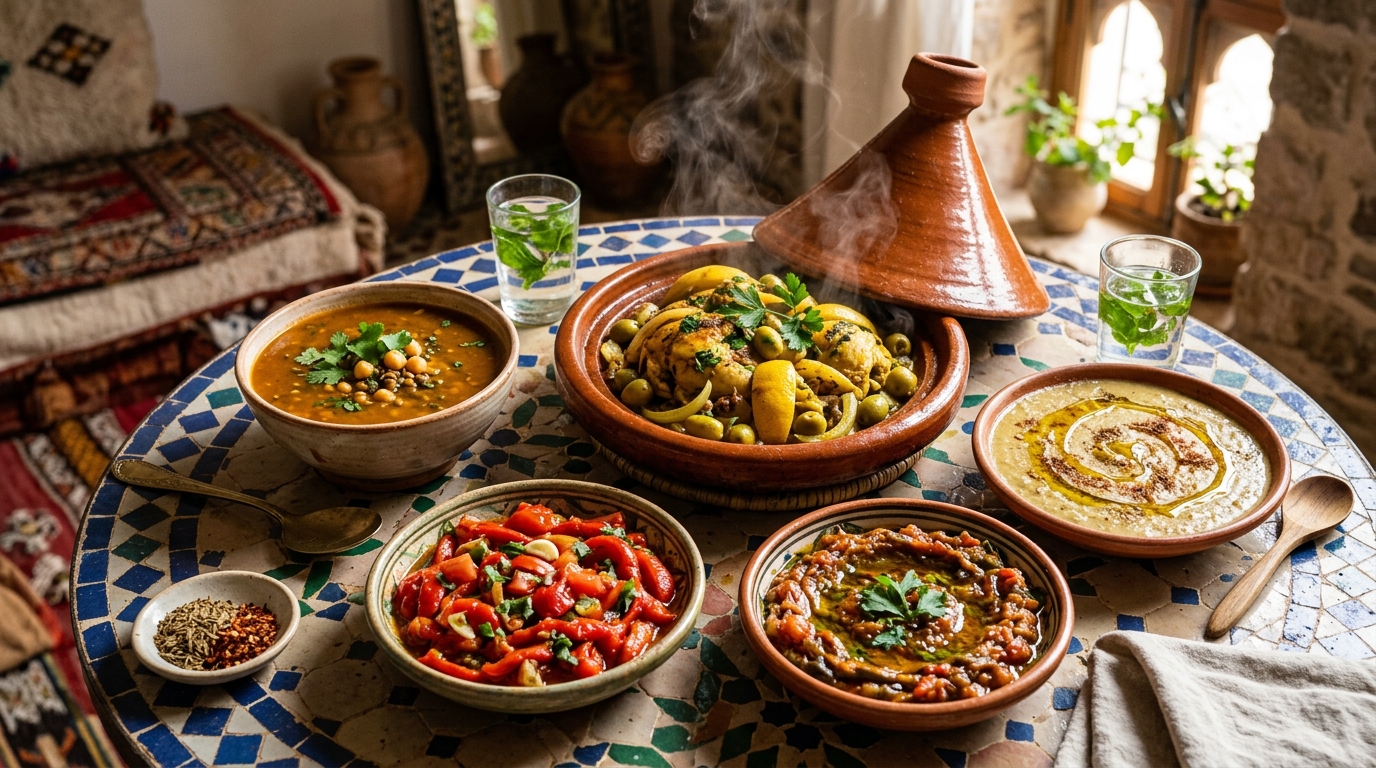
While imperial cities like Fes and Marrakech are famous for elaborate court dishes loaded with expensive dried fruits and warm spices, Chefchaouen’s culinary identity is grounded in the soil of the Rif. In 2010, Chefchaouen was chosen to represent Morocco in the UNESCO Intangible Cultural Heritage inscription of the Mediterranean Diet, alongside communities in Greece, Italy, and Spain.
When eating in the blue medina, look for these hyper-local specialties:
Jben Jebli (Fresh Mountain Goat Cheese)
The limestone hills surrounding Chefchaouen are grazing territory for thousands of native mountain goats. Local women gather early every morning along the edge of the central market, selling rounds of Jben Jebli wrapped in dried palm leaves (doum). Lightly salted, creamy, and faintly herbaceous, this fresh cheese is traditionally drizzled with wild mountain olive oil and scooped with warm semolina flatbread for breakfast.
Bissara with Mountain Olive Oil
Unlike the smooth, yellow fava bean purees of central Morocco, Chefchaouen’s winter staple is dense, hearty, and often blended with green split peas. Served in deep earthenware bowls at unassuming local lunch counters, it is dusted with cumin seeds harvested from the eastern hills and flooded with unfiltered, dark green olive oil cold-pressed from ancestral groves in nearby Ouezzane.
Tagine with Wild Thyme and Mountain Figs
In late summer, the city’s home cooks prepare slow-simmered lamb and goat tagines sweetened with sun-dried mountain figs and perfumed with wild mountain thyme (za’atar) gathered from the rocky slopes of Talassemtane.
Navigating the Blue Medina: Key Quarters
The medina of Chefchaouen is built on a steep incline. Walking its alleys requires sturdy footwear, as smooth river stones and worn lime steps can be slick beneath leather soles.
1. Plaza Outa el-Hammam
The public heart of the town. This wide, tree-shaded stone square is dominated by the red-clay walls of the fifteenth-century Kasbah and the striking octagonal minaret of the Grand Mosque. While the cafes lining the square perimeter are pleasant for people-watching with a pot of fresh mint tea (atay), locals rarely eat dinner here. Step twenty meters into the side alleys to find authentic family kitchens.
2. The Kasbah Gardens and Museum
Inside the fortress walls built by Moulay Ali Ben Rachid lies a serene, Andalusian-style courtyard garden planted with towering palms, fig trees, and climbing bougainvillea. The small ethnographic museum housed inside the fortress cells displays antique Rifian pottery, handwoven wool mendils (the red-and-white striped wrap skirts worn by mountain peasant women), and centuries-old flintlock muskets.
3. Ras el-Maa: The Mountain Spring
At the northeastern edge of the medina, stone alleys open onto the rushing waters of Ras el-Maa (“the head of the water”). Here, ice-cold mountain streams burst from the limestone cliff face. For centuries, this spring has provided Chefchaouen with fresh drinking water, powered stone flour mills, and filled the public outdoor wash-basins where local women still gather to wash wool rugs and blankets while catching up on neighborhood news.
4. The Sunset Walk to the Spanish Mosque (Bouzafar)
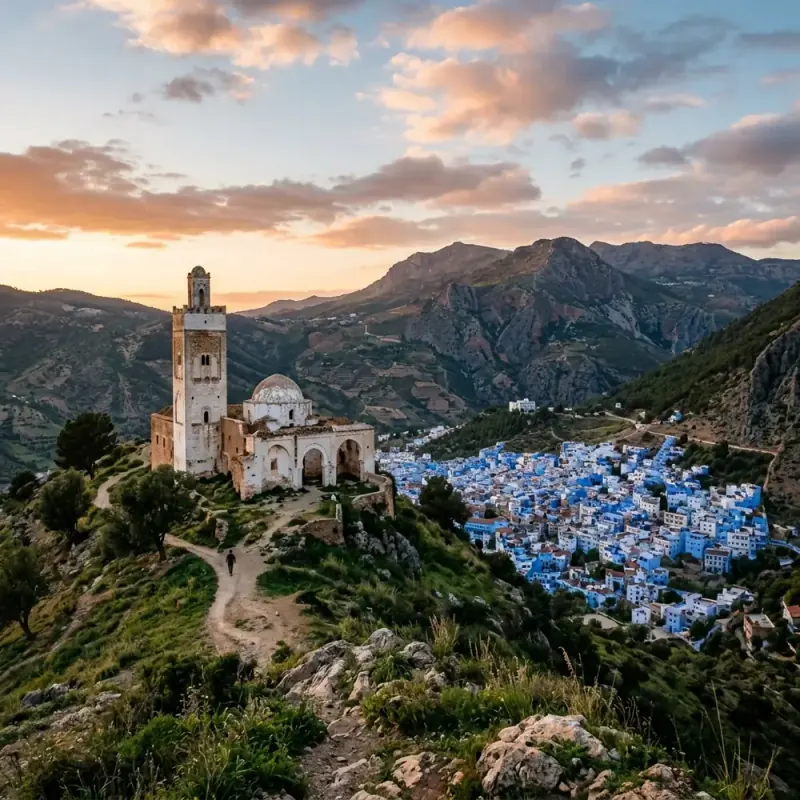
From the bridges of Ras el-Maa, a well-trodden dirt path winds up the opposite mountain slope through ancient olive terraces. A twenty-minute gentle climb brings you to the abandoned Spanish Mosque (Jamaa Bouzafar), erected by the Spanish military in the late 1920s.
From this high promontory at golden hour, you look across the entire valley. As the sun sinks behind the Rif peaks, the blue town below catches the fading amber light, glowing in surreal contrast against the dark mountain stone, while the call to prayer echoes out from half a dozen minarets simultaneously.
Practical Territorial Advice for Responsible Travel
To experience Chefchaouen with respect and ease, keep these practical points in mind:
- Photography Etiquette: Because Chefchaouen’s residential alleys are home to working families, treat doorways and courtyards as private domestic spaces. Always ask permission (“Mumkin soura?” in Darija) before photographing local residents, particularly elderly women in traditional mountain dress. Respect private homes that display “No Photos” signs.
- Timing Your Visit: Avoid arriving during mid-August midday heat or peak holiday weekends when domestic and European tour buses crowd the narrow alleys. The ideal seasons are April to May (when wild mountain iris and almond blossoms cover the valley) and October to November (crisp autumn weather and olive harvest season).
- Day Trip into Talassemtane National Park: If you stay for more than two days, hire a licensed mountain guide in town to hike the Akchour gorge. A two-hour trail along a mountain river leads to the dramatic natural rock arch known as the Bridge of God (Pont de Dieu) and cascading wilderness waterfalls shaded by rare Spanish fir trees (Abies pinsapo).
Chefchaouen is proof that a city can captivate modern global travelers while maintaining fierce loyalty to its mountain roots, its Andalusian memories, and its peaceful communal rhythm.
Frequently Asked Questions
How many days are needed to visit Chefchaouen?
Two full days (two nights) is the ideal duration. This allows you to explore the medina at a relaxed pace early in the morning before day-trippers arrive, walk up to the Spanish Mosque for sunset, sample local mountain goat cheese and tagines, and spend a full day hiking in the nearby Akchour waterfalls and Talassemtane National Park.
Is Chefchaouen safe for solo and female travelers?
Chefchaouen is widely recognized as one of the safest and most relaxed towns in Morocco. The small-scale mountain community is conservative yet gentle, with significantly less aggressive merchant haggling than in larger imperial medinas like Marrakech or Fes. Normal travel awareness and modest dress covering shoulders and knees are recommended.
How do you get to Chefchaouen from Tangier or Fes?
Chefchaouen has no airport or train station due to its mountain topography. The most reliable public transport is the official CTM coach bus: it takes approximately 2.5 hours from Tangier and about 4 hours from Fes. Private grand taxis and pre-booked transfers are also readily available from Tangier Ibn Battouta Airport.
Can you buy alcohol in Chefchaouen?
Because Chefchaouen was founded as a sacred holy city by the descendants of the Prophet Muhammad, alcohol is not sold within the historic medina walls. Only one or two licensed international hotels situated outside the medina perimeter offer licensed bars. Visitors embrace the town’s fresh mountain spring water, freshly squeezed orange juice, and hot mint tea.
Experience the true heart of Moroccan heritage through its culinary traditions. Join us in preserving and honoring these ancestral recipes.
What People Are Saying
No comments yet. Be the first — we'd love to hear from you.
Houssam Elmrabet
Culturally Verified & Fact-CheckedHoussam Elmrabet is a Moroccan researcher in territorial marketing and cultural heritage preservation. His work documents regional gastronomic identities, local agricultural heritage, and how ancestral culinary traditions define authentic territorial branding across the Kingdom.