Essaouira: The Ultimate Chill Coastal Town
After several days of navigating the dizzying, high-energy market corridors of Marrakech, visitors often feel sensory fatigue. The constant hum of mopeds, the dense desert heat, and the intense merchant haggling can leave even seasoned travelers craving stillness.
The antidote sits exactly three hours west along the Atlantic coastline: Essaouira (pronounced es-swee-rah).
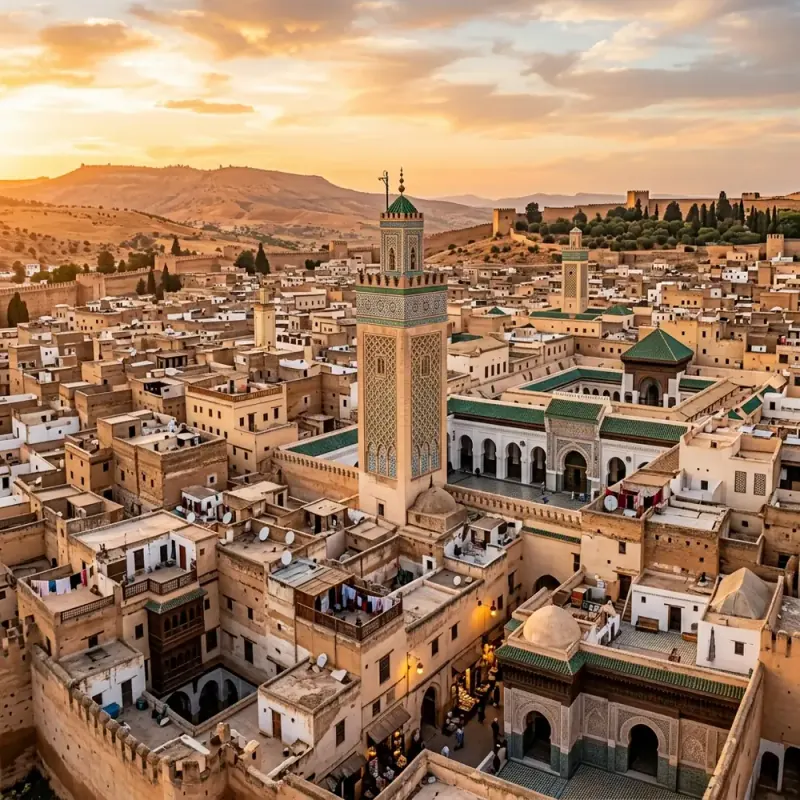
The moment you step through its sea-facing stone gates, the atmosphere shifts completely. The dry desert air is replaced by cool, salty ocean breezes. Seagulls wheel and cry above white-plastered houses with blue wooden shutters. The rhythmic roar of the Atlantic breakers echoes against eighteenth-century granite ramparts.
Unlike the tangled, maze-like layout of most Moroccan medinas, Essaouira’s alleys are surprisingly wide, straight, and laid out on an orderly, pedestrian-friendly grid. Local shopkeepers sit peacefully on low stools carving fragrant thuya wood, rarely bothering to interrupt your stroll with aggressive sales pitches.
As a researcher in territorial marketing and cultural heritage, I consider Essaouira one of Morocco’s most fascinating historical experiments: a city specifically drafted by European military engineers for an enlightened Moroccan sultan, which later blossomed into the international spiritual home of Gnawa music and bohemian creativity.
Here is an authentic territorial guide to understanding the historic port of Mogador, exploring its artisan quarters, and savoring the freshest seafood in the Atlantic basin.
The Architecture of “The Well-Designed”: 1765
To understand why Essaouira feels so open and harmonious, you must look to its Arabic name: Al-Sawira (الصويرة), which translates literally as “the beautifully designed” or “the well-drawn.”
For centuries, this natural Atlantic bay was known to European navigators as Mogador (derived from the local Amazigh patron saint, Sidi Megdoul). Ancient Phoenicians and Romans established dye-manufacturing outposts here on the offshore Purpuraire Islands, harvesting purple murex sea snails to dye the imperial robes of Roman emperors.
In the 1760s, the visionary Alaouite Sultan Sidi Mohammed ben Abdallah decided to create a modern, fortified international trading port to capture foreign maritime commerce and assert Moroccan commercial independence. He hired a French military architect named Théodore Cornut (a disciple of the famous French fortress engineer Vauban).
Cornut designed an unprecedented hybrid city: European-style stone bastions, military artillery platforms, and a straight-angled street grid, entirely executed in native Moroccan sandstone and integrated with traditional Moroccan minarets, mosques, and covered souks. When completed in 1765, it was christened Al-Sawira in honor of its precise geometric drafting.
The Sea Ramparts: Skala de la Ville
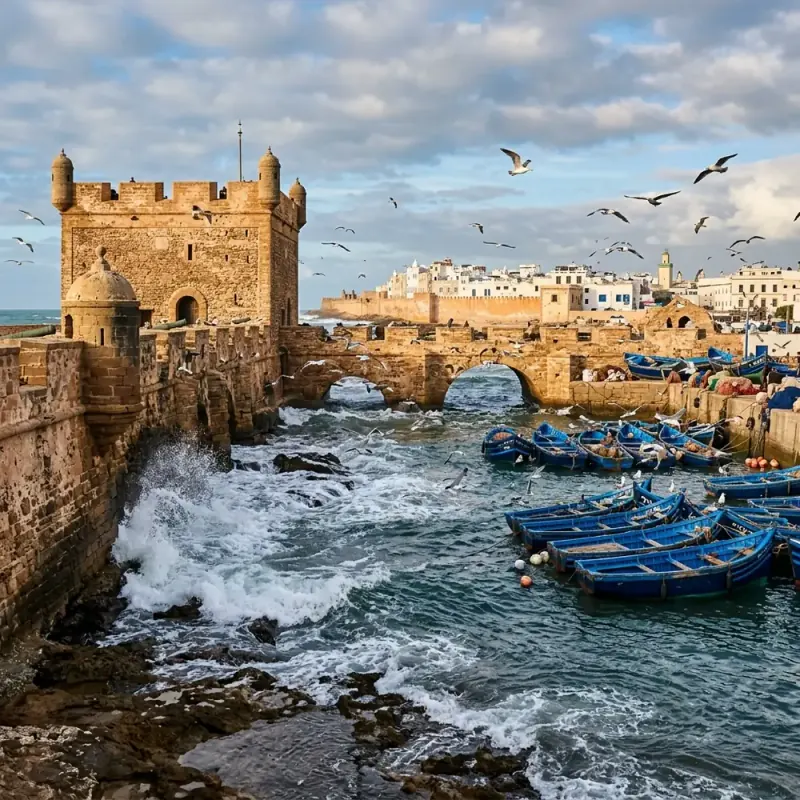
The most dramatic landmark in Essaouira is the Skala de la Ville, the monumental stone defensive wall that protects the northwestern flank of the medina from Atlantic storms and naval invasion.
Climb the broad stone ramp up to the battlements, and you find yourself standing before a row of nineteen heavy, green-patinated bronze naval cannons cast in Barcelona and Seville in the mid-eighteenth century. Below the ramparts, massive ocean rollers explode against the jagged black sea rocks, sending plumes of salt spray high into the coastal breeze.
Film lovers will immediately recognize these dramatic stone bastions:
- Orson Welles filmed the opening funeral sequence of his classic 1951 film adaptation of Shakespeare’s Othello on these ramparts.
- More recently, television audiences know these stone battlements as the fictional slave city of Astapor in Game of Thrones, where Daenerys Targaryen acquires her Unsullied army.
Beneath the battlements, inside the cavernous vaulted stone arches where ammunition and horses were once stored, lies a tranquil street of woodworking workshops. Here, master craftsmen carve and polish Thuya wood (Tetraclinis articulata), a rare, resin-scented hardwood native to the coastal Atlas hills. The wood’s intricate, swirling burl grain is inlaid by hand with mother-of-pearl, lemonwood, and silver wire into jewelry boxes, chess sets, and furniture.
A Legacy of Harmony: The Sultan’s Merchants
Unlike most Moroccan cities where Jewish populations were segregated into small peripheral Mellahs, Essaouira has a profound Jewish history that defined its golden age.
To turn Mogador into a world-class trading hub, Sultan Sidi Mohammed invited prominent Sephardic Jewish merchant families from across Morocco and Europe, granting them special commercial privileges, tax exemptions, and title as Toujjar al-Sultan (the Merchants of the Sultan).
By the mid-nineteenth century, Essaouira was the only city in the Islamic world with an overwhelming Jewish majority (over 60% of the urban population). Jewish merchants managed Morocco’s diplomatic and trading ties with London, Amsterdam, Livorno, and Genoa, exporting Moroccan almonds, gum arabic, beeswax, and ostrich feathers while importing English tea, sugar, and textiles.
Today, this rich cross-cultural memory is preserved at Bayt Dakira (the House of Memory), a beautifully restored museum and research center in the old Jewish quarter that celebrates the historic Judeo-Muslim brotherhood of Essaouira, alongside the restored Simon Attias Synagogue.
The Capital of Gnawa Trance and Soul
In the 1960s and 1970s, Essaouira became a gathering point for international musicians, including Jimi Hendrix, Cat Stevens, and Frank Zappa, who were drawn to the city’s easy-going coastal pace and spiritual resonance.
Above all, Essaouira is the spiritual global capital of Gnawa culture.
Originating from enslaved sub-Saharan Africans brought across the Sahara to Morocco centuries ago, the Gnawa brotherhood preserved their ancestral spiritual rituals, fusing them with Moroccan Sufi Islamic mysticism.
Their music is hypnotic, rhythmic, and deeply therapeutic: driven by the deep, resonant thrum of the guembri (a three-stringed acoustic bass lute carved from a single hollowed trunk of mahogany or walnut and covered in camel neck skin) and the clashing metallic rhythm of qraqeb (heavy iron hand castanets).
Every June, the city hosts the internationally renowned Gnaoua World Music Festival, transforming the medina squares and oceanfront stages into a massive gathering where traditional Moroccan Gnawa master musicians (maâlems) collaborate with global jazz, blues, and reggae icons before hundreds of thousands of listeners under the night sky.
Ocean Gastronomy: How to Eat in Essaouira
Because the cold Canary Current sweeps along this stretch of the Atlantic shelf, Essaouira is blessed with some of the richest fishing waters on the continent:
1. The Port Grilling Feast (Le Port de Pêche)
The historic fishing port, crowded with hundreds of traditional, hand-built wooden boats painted in signature cobalt blue, is an essential morning visit. Watch fishermen untangle longlines and haul wooden crates of sea bass, red mullet, turbot, and Atlantic crabs onto the stone docks.
Just outside the port gates sits a row of open-air wooden stalls with charcoal grills. Select your fish directly from the ice counter: plump fresh sardines, sea bream, and giant calamari. The cook throws the seasoned fish directly over glowing coals, flipping it with wire tongs and serving it within minutes on a paper-lined metal tray alongside sea salt, cumin, half a fresh lemon, and a warm crusty flatbread. It is simple, affordable, and extraordinarily fresh.
2. Atlantic Fish Tagine with Charmoula and Preserved Lemon
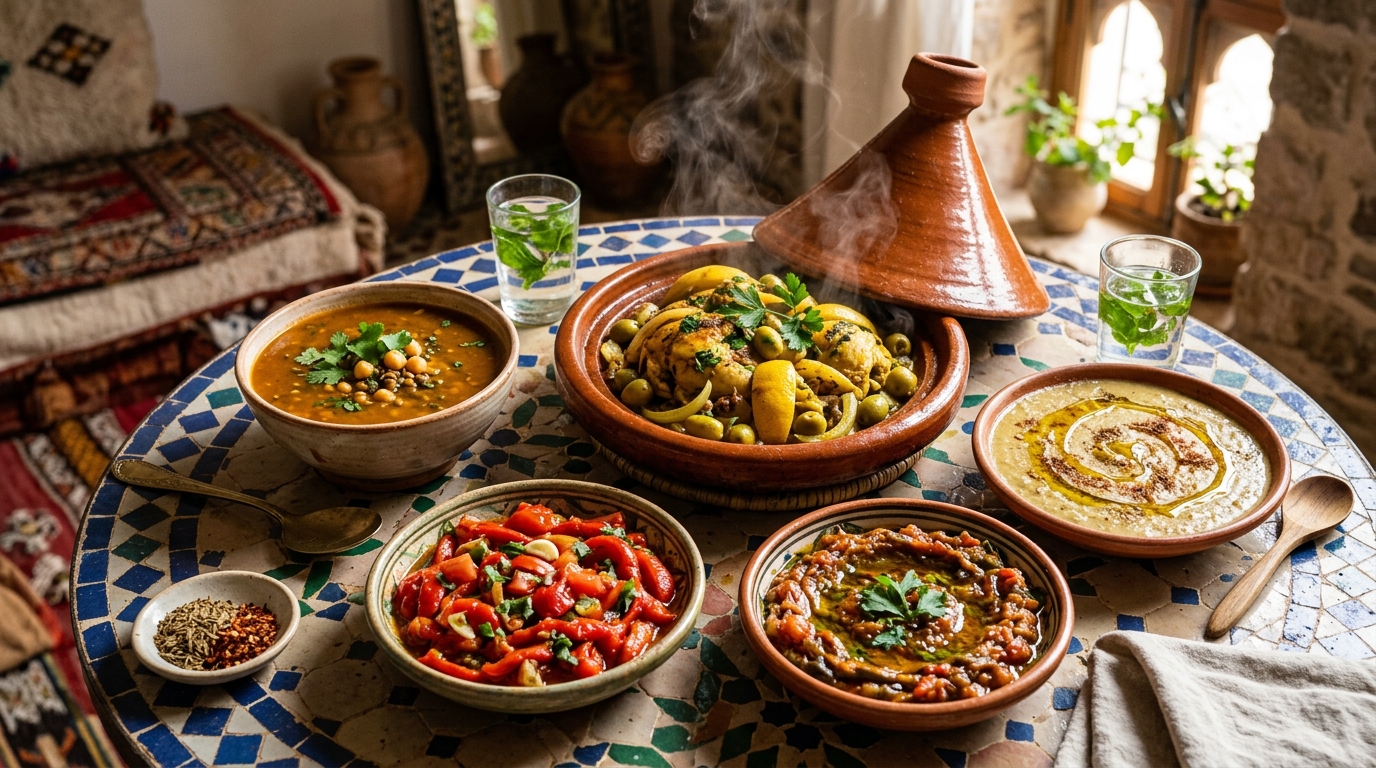
In traditional riad kitchens, the catch of the day (often firm Atlantic conger eel, sea bass, or swordfish) is marinated in a pungent herb paste (chermoula) made from fresh cilantro, crushed garlic, cumin, sweet paprika, and cold-pressed olive oil. The fish is slow-simmered in a clay tagine over a base of sliced potatoes, sweet carrots, and sweet bell peppers, crowned with cured green olives and translucent ribbons of preserved lemon peel.
3. Argan Oil and Amlou
Essaouira sits on the northern edge of the UNESCO-protected argan biosphere. The countryside surrounding the town is filled with gnarled argan trees where local goats famously climb into the branches to eat the fleshy fruit.
Stop at rural women’s agricultural cooperatives outside town to purchase genuine, cold-pressed culinary argan oil, golden, fragrant, and tasting of roasted hazelnuts, and jars of authentic Amlou, the decadent Moroccan spread made by stone-grinding roasted sweet almonds with culinary argan oil and pure wildflower honey.
Practical Advice for Traveling to Essaouira
- Beware the Alizé Trade Winds: Essaouira is known across the world as the “Wind City of Africa” (La Ville du Vent). The powerful Atlantic trade winds (Alizés) blow consistently from May through September. While this makes Essaouira a global paradise for kitesurfing and windsurfing, it means the main town beach can be uncomfortably windy for casual sunbathing in midsummer. Always carry a windbreaker or light woolen sweater, even in July.
- Getting There: Essaouira is located approximately 175 kilometers (108 miles) west of Marrakech. Comfortable, air-conditioned CTM and Supratours coach buses run multiple daily routes between Marrakech and Essaouira, taking roughly 2.5 to 3 hours for about 100 dirhams ($10).
- Ideal Stay: Spend two full nights in Essaouira. This gives you time to wander the medina at an unhurried pace, tour the ramparts, visit the artisan woodshops, enjoy a long seafood lunch at the port, and take a sunset horseback or camel ride along the wild dunes of nearby Diabat.
Essaouira is a town that breathes peace. It reminds travelers that the best journeys in Morocco are not about checking off monuments in a rush, but about slowing down and listening to the ocean wind.
Frequently Asked Questions
Can you swim at the beach in Essaouira?
Yes, but with caveats. The main town beach has gentle, gradual sands and is safe for wading and paddling. However, the Atlantic water is chilly year-round due to the Canary Current (typically 17°C to 20°C / 62°F to 68°F), and the persistent afternoon trade winds can create choppy waves and blowing sand. For calmer swimming and surfing, travelers head twenty minutes south to the sheltered bay of Sidi Kaouki.
Did Jimi Hendrix really live in Essaouira?
Jimi Hendrix visited Morocco for eleven days in July 1969, staying briefly in Essaouira and the nearby coastal village of Diabat. While local folklore playfully claims his song Castles Made of Sand was inspired by the ruined Dar Sultan palace submerged in the sand dunes of Diabat, the song was actually recorded two years before he ever visited Morocco! Nevertheless, his visit cemented Essaouira’s reputation as a haven for music and freedom.
Is Essaouira cheaper than Marrakech?
Yes, significantly. Because Essaouira operates at a much more relaxed community pace, restaurant meals, riad accommodations, and artisanal handicrafts (like leather, rugs, and woodcraft) are generally 25% to 40% less expensive than in Marrakech, with far less aggressive price negotiation required.
What is the best month to visit Essaouira?
The best months to visit are September to November and April to May. During late autumn and early spring, the summer trade winds die down, leaving sunny, warm, calm days with temperatures around 23°C to 25°C (73°F to 77°F), ideal for exploring the historic ramparts and enjoying open-air dining.
Experience the true heart of Moroccan heritage through its culinary traditions. Join us in preserving and honoring these ancestral recipes.
What People Are Saying
No comments yet. Be the first — we'd love to hear from you.
Houssam Elmrabet
Culturally Verified & Fact-CheckedHoussam Elmrabet is a Moroccan researcher in territorial marketing and cultural heritage preservation. His work documents regional gastronomic identities, local agricultural heritage, and how ancestral culinary traditions define authentic territorial branding across the Kingdom.