Fes: Time Travel is Real, and It's Located in Morocco
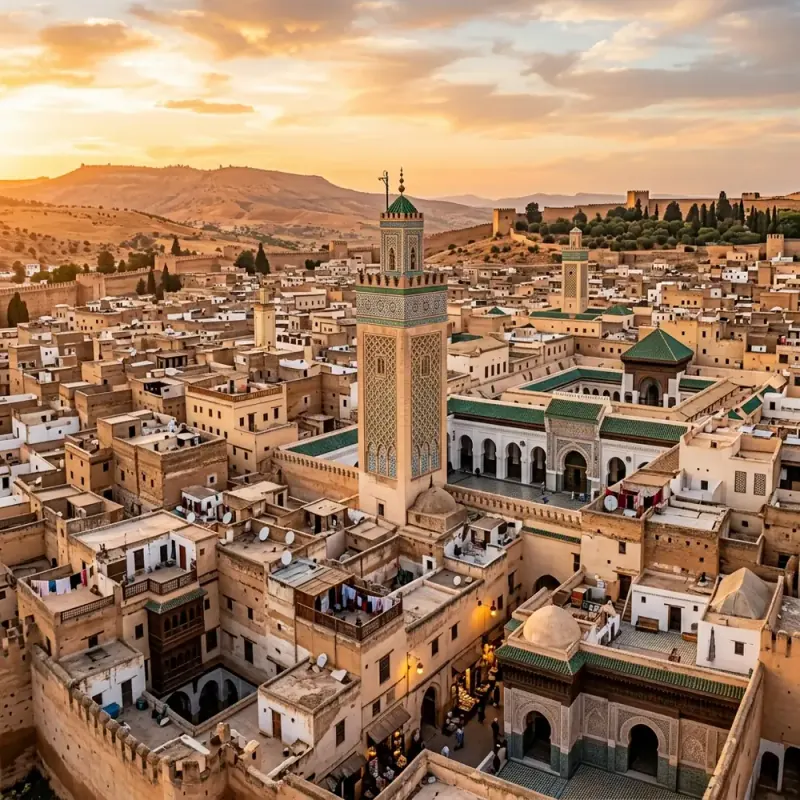
Step through the majestic horseshoe arch of Bab Bou Jeloud (the Blue Gate) on an early morning, and modern twenty-first-century life evaporates within ten paces. The hum of motor scooters, traffic lights, and glass storefronts vanishes. In their place is the clopping of iron horseshoes on worn river stones, the rhythmic metallic clinking of coppersmiths hammering brass trays, the scent of crushed spearmint and smoldering cedar wood shavings, and the urgent cry of a donkey driver shouting: “Balak! Balak!” (Make way! Clear the road!).
This is Fes el-Bali (Old Fes). It is not an open-air museum staged for tourists. It is a living, working, medieval urban metropolis home to nearly 150,000 residents, completely enclosed within eighth-century ramparts.
Covering over 540 acres with more than 9,000 winding, interlocking alleys and dead-end residential passages, Fes el-Bali is officially recognized by UNESCO as the largest contiguous car-free urban zone on the planet.
As a researcher in territorial marketing and Moroccan urban history, I consider Fes the irreplaceable spiritual, intellectual, and culinary anchor of the Kingdom. While other dynasties rose in Marrakech, Rabat, or Meknes, Fes remained the intellectual heart where royal court recipes were refined over twelve centuries, and where Islamic theology, science, and jurisprudence flourished.
Here is an authentic territorial guide to navigating the great labyrinth of Fes, understanding its ancient institutions, and tasting the aristocratic culinary heritage of the imperial medina.
The Foundation of a Nation: 789 AD
To understand the sacred stature of Fes in the Moroccan consciousness, one must trace its origins to the birth of the Moroccan state itself. In 789 AD, Moulay Idriss I, a direct descendant of the Prophet Muhammad who escaped Abbasid persecution in Arabia, arrived in the Saïss plain and established a small fortified settlement on the right bank of the Jawhar River.
Following his assassination, his son, Moulay Idriss II, expanded the city in 808 AD, declaring Fes the first capital of an independent, sovereign Islamic Moroccan empire.
Two massive migration waves quickly transformed Fes from a modest mountain town into the leading intellectual center of the medieval Mediterranean:
- The Andalusian Quarter (Adwat al-Andalus): In 818 AD, hundreds of aristocratic, highly educated Muslim families fleeing religious turmoil in the Umayyad capital of Córdoba settled on the eastern bank of the river, bringing sophisticated Andalusian garden design, silk weaving, and courtly culinary arts.
- The Kairouan Quarter (Adwat al-Qarawiyyin): In 825 AD, several hundred wealthy merchant families expelled from Kairouan (in modern-day Tunisia) settled on the western bank, bringing trans-Saharan trading connections, leather tanning guilds, and vast mercantile capital.
For centuries, these two rival riverbanks competed in architecture, scholarship, and culinary refinement, eventually merging into the single, unified cultural capital that stands today.
The Intellectual Wonder: University of Al-Qarawiyyin
Tucked deep within the dense market labyrinth of the medina lies the University of Al-Qarawiyyin (Jami’at al-Qarawiyyin).
Founded in 859 AD by a devout, wealthy immigrant woman named Fatima al-Fihri, who used her entire inherited fortune to establish a center of religious learning for her community, Al-Qarawiyyin is officially recognized by both UNESCO and the Guinness Book of World Records as the oldest continually operating institution of higher learning in the world, predating the University of Bologna by more than two centuries and the University of Oxford by nearly three.
For over a millennium, Al-Qarawiyyin was the intellectual powerhouse of the Mediterranean world. In its vast arcaded courtyard, cooled by marble fountains and paved in turquoise zellige, scholars did not study religion alone.
It was a center for higher mathematics, astronomy, cartography, grammar, and medicine. Celebrated historical figures studied and taught here, including the Jewish philosopher Moses Maimonides, the pioneering sociologist Ibn Khaldun, the traveler Leo Africanus, and even the Christian scholar Gerbert of Aurillac (who later became Pope Sylvester II and introduced Arabic numerals and the concept of zero to medieval Western Europe).
While the central prayer hall is reserved for Muslim worshippers, non-Muslim visitors can gaze through the monumental cedar archways into the marble courtyard, and explore the newly restored Al-Qarawiyyin Library, home to precious illuminated manuscripts on gazelle parchment dating back to the ninth century.
The Chouara Tanneries: An 11th-Century Industry
No visit to Fes is complete without witnessing the famous Chouara Tanneries (Dar Dbagh Chouara), which have operated continuously since the eleventh century along the riverbed.
Climb to the rooftop viewing terrace of any surrounding leather shop (where a vendor will hand you a sprig of fresh spearmint to hold against your nose to mask the pungent odor), and look down into the courtyard below. The scene looks completely untouched by the modern industrial revolution:
Dozens of workers, clad only in shorts, stand thigh-deep in hundreds of round stone vats filled with natural liquids:
- The Cleaning Vats: Raw sheep, goat, cow, and camel hides are soaked for days in mixtures of water, limestone, and pigeon droppings. The high ammonia content in pigeon droppings naturally softens the tough animal fibers without artificial chemicals.
- The Natural Dyeing Vats: The cured hides are transferred into giant stone vats bubbling with natural vegetable dyes that have colored Moroccan leather for a thousand years:
- Yellow: Crushed mountain saffron and pomegranate skins (qshour ruman).
- Red: Crushed poppy petals (aker fassi).
- Blue: Natural indigo stone.
- Brown: Boiled cedar wood bark and mimosa.
- Green: Wild garden mint.
Workers stomp the skins barefoot for hours under the hot sun to force the natural dye deep into the leather grain. The resulting butter-soft leather is dried on nearby medina rooftops and stitched by hand into traditional babouche slippers, travel bags, and book bindings.
Imperial Fassi Gastronomy: The Aristocracy of the Table
In Morocco, there is an undisputed consensus: the cooking of Fes is the height of the national culinary art. Long-established Fassi families pride themselves on recipes that balance sweet, savory, and floral notes with mathematical precision:
1. Pastilla au Pigeon (Bstilla)
The crowning achievement of Moroccan gastronomy. Originating from Moorish Andalusia, authentic Fassi pastilla is a massive, circular pie made of dozens of paper-thin, translucent pastry sheets (warqa) brushed with melted butter.
Inside lies a rich filling of tender pigeon or chicken braised with onions, saffron, ginger, and nutmeg, folded with a velvety scrambled egg custard, and layered with sweet, coarse-ground toasted almonds scented with orange blossom water and cinnamon. Baked until golden-crisp, the pie is heavily dusted with powdered sugar and crisscrossed with ground cinnamon lines. The combination of hot savory meat, rich eggs, crunchy sweet almonds, and crisp pastry is an extraordinary sensory experience.
2. Khlii (Ancestral Preserved Beef Confit)
Invented centuries ago by Fassi trading families to preserve meat for trans-Saharan caravan expeditions across the desert, Khlii is cured beef seasoned with garlic, ground coriander seeds, and cumin, sun-dried on medina rooftops, and then slow-braised for hours in melted beef tallow and olive oil until tender.
Today, Fassis eat Khlii for breakfast, warmed in a small clay dish with fresh eggs fried in its seasoned fat, scooped with crusty round bread.
3. Mrouzia (The Medieval Honey Tagine)
Prepared during the festival of Eid al-Adha, Mrouzia is an ancient, sweet-and-savory tagine of tender lamb shank or neck slow-simmered with honey, golden raisins, toasted almonds, and a complex 35-spice Ras El Hanout blend. When cooked properly, the sauce reduces into a thick, glossy dark mahogany syrup that coats the spoon like caramel.
How to Navigate the 9,000 Alleys of Fes el-Bali
Because Fes el-Bali has no street signs, no vehicle access, and tall blank exterior walls designed for residential privacy, it is easy for first-time visitors to feel completely lost.
Here are the practical navigation secrets:
- Understand the Two Downhill Arteries: The medina is built in a natural river bowl. Two primary commercial streets run downhill from Bab Bou Jeloud (the Blue Gate) toward the river and Al-Qarawiyyin: Tala’a Kebira (“the Great Incline”) on the high ridge, and Tala’a Seghira (“the Small Incline”) lower down. As long as you know whether you are walking downhill (toward the tanneries and university) or uphill (toward the Blue Gate and car access), you cannot stay lost for long.
- Hiring a Licensed Guide for Day One: For your first morning, hire an officially accredited cultural guide through your riad or the official tourist office (ensure they wear the official brass national tourist badge). A knowledgeable local guide will navigate the labyrinth effortlessly, reveal hidden residential medersas, explain architectural zellige symbolism, and shield you from aggressive carpet shop pressure.
- Get Lost on Day Two: On your second day, put away your phone map and wander intentionally. Explore the quiet residential quarters where children play with wooden spinning tops beneath archways, women carry metal trays of unbaked bread dough to neighborhood wood-fired ovens (ferran), and cats sun themselves on ancient mosaic thresholds.
Fes is not a city that yields its secrets immediately. It demands that you slow down, listen to its quiet rhythms, and allow its twelve centuries of living history to envelop your senses.
Frequently Asked Questions
How many days should you spend in Fes?
To appreciate Fes properly, plan for at least two full days (three nights). Spend the first day exploring the medina landmarks (Al-Qarawiyyin, Chouara Tanneries, Bou Inania Medersa, and the Mellah Jewish Quarter). Spend the second day exploring the artisanal ceramic workshops outside the walls, walking the Merenid Tombs at sunset, and taking an evening cooking class in a traditional riad.
Is Fes safe to walk around at night?
The main arteries of the medina, such as Tala’a Kebira and Talaa Seghira, remain active, well-lit, and populated until around 9:30 PM. However, after shops shutter their wooden doors, the deep residential side alleys can become completely dark and confusing to navigate. It is best to arrange for a staff member from your riad to meet you at a major landmark or restaurant if walking back late in the evening.
What is the difference between Fes el-Bali, Fes el-Jdid, and the Ville Nouvelle?
Fes consists of three distinct historical layers:
- Fes el-Bali (Old Fes): The original eighth-century medieval walled medina with 9,000 car-free alleys.
- Fes el-Jdid (New Fes): Founded in the thirteenth century by the Marinid dynasty, housing the Royal Palace (Dar el-Makhzen) and the historic Jewish Mellah.
- The Ville Nouvelle: The modern twentieth-century French colonial quarter featuring wide avenues, banks, modern restaurants, and the train station.
Can you visit the University of Al-Qarawiyyin if you are not Muslim?
Non-Muslim visitors cannot enter the active prayer hall of the Qarawiyyin Mosque. However, you can walk through the open entrance vestibules and look directly into the breathtaking marble courtyard, and you can visit the beautifully restored fourteenth-century library and neighboring medersas (such as the Medersa el-Attarine and Bou Inania), which welcome all visitors to admire their masterwork plaster and tile craftsmanship.
Experience the true heart of Moroccan heritage through its culinary traditions. Join us in preserving and honoring these ancestral recipes.
What People Are Saying
No comments yet. Be the first — we'd love to hear from you.
Houssam Elmrabet
Culturally Verified & Fact-CheckedHoussam Elmrabet is a Moroccan researcher in territorial marketing and cultural heritage preservation. His work documents regional gastronomic identities, local agricultural heritage, and how ancestral culinary traditions define authentic territorial branding across the Kingdom.