Moroccan Sahara Expedition Guide: Erg Chebbi, Erg Chigaga, and Nomadic Trans-Saharan Heritage
archived: false
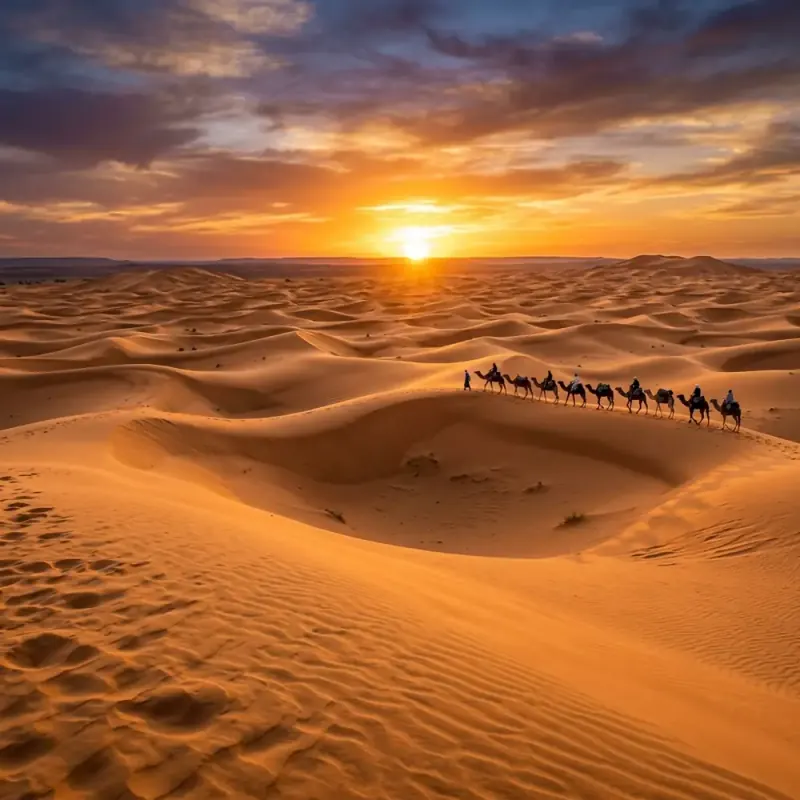
The Moroccan Sahara is one of the most evocative desert landscapes on earth, spanning golden sand dune seas (Ergs), vast stony plains (Regs), deep palm oases, and ancient dried riverbeds (Wadis). For centuries, these desert expanses served as the vital economic highways of the Maghreb, where trans-Saharan camel caravans carried gold, salt, dates, and handmade manuscripts between West Africa and the imperial capitals of Morocco.
Understanding the Moroccan Sahara requires distinguishing between its geographical zones, its nomadic Amazigh and Sahrawi heritage, and the logistical realities of crossing extreme environments with comfort and safety.
Choosing Your Desert Route: Erg Chebbi vs. Erg Chigaga
Travelers planning an expedition to the Moroccan desert must make a foundational geographical decision between the two primary dune seas: Erg Chebbi near Merzouga and Erg Chigaga near M’Hamid El Ghizlane.
| Feature | Erg Chebbi (Merzouga) | Erg Chigaga (M’Hamid El Ghizlane) | | : - | : - | : - | | Dune Height | Reaches up to 150 meters; towering, steep golden barchans. | Waves of continuous dunes up to 60 meters high spanning 40 km. | | Access | Paved asphalt highway runs directly to the dune base. | Requires 3 to 4 hours of off-road 4x4 desert driving over sand and rock. | | Atmosphere | Accessible, dynamic infrastructure; numerous camps and hotels nearby. | Remote, wild, raw wilderness; completely isolated from civilization. | | Travel Time | 9 hours drive from Marrakech or 8 hours drive from Fes. | 9 hours drive from Marrakech through the Draa Valley and Zagora. | | Best For | First-time visitors, families, and those with tighter schedules. | Adventure travelers seeking true isolation, silence, and wilderness. |
The Erg Chebbi Experience
Erg Chebbi forms a dramatic orange sand island twenty-two kilometers long and five kilometers wide, rising sharply out of a black limestone plain. Because paved roads reach the desert town of Merzouga, visitors can arrive smoothly and transition into camel treks or 4x4 transfers to their desert camps. High-end fixed camps here provide running water, private solar electricity, and plush bedding beneath Berber wool rugs.
The Erg Chigaga Expedition
Erg Chigaga is the wild frontier. Located south of Zagora, the paved road ends at the outpost of M’Hamid El Ghizlane. From there, heavily equipped 4x4 vehicles navigate sixty kilometers of gravel desert, dry salt flats of Lake Iriki, and rolling dunes. With zero artificial light pollution for fifty miles in any direction, Erg Chigaga offers an overwhelming sense of solitude and planetary silence.
The Trans-Saharan Caravan Heritage: Sijilmassa and Rissani
Before entering the sands of Merzouga, travelers pass through Rissani, a historic oasis settlement of supreme territorial significance. In the eighth century, this oasis was the legendary city-state of Sijilmassa, the northern terminal of the trans-Saharan gold trade route that linked Morocco with Timbuktu and the ancient Ghana Empire.
Caravans comprising thousands of camels spent up to two months crossing the desert sands to reach Sijilmassa, where desert merchants traded West African gold and ivory for Atlas mountain silver, Fassi glazed ceramics, and Mediterranean dates. Today, Rissani preserves this legacy in its historic traditional market:
- The Donkey Parking Lot: On souk days (Tuesday, Thursday, Sunday), hundreds of desert farmers tie their pack animals in an expansive courtyard before trading produce.
- The Spice and Date Souk: Showcasing dozens of indigenous Saharan date varieties, including the prized Majhoul, Feggous, and Boufeggous.
- The Ancestral Ksar: Walled adobe fortified villages (Ksour) constructed with defensive watchtowers and subterranean shaded corridors designed to temper desert heat.
Saharan Gastronomy: The Desert Bread and Nomadic Cooking
Cooking in the Sahara evolved around strict environmental constraints: scarce firewood, absence of refrigeration, and the necessity of high-calorie, long-lasting sustenance.
Medfouna: The Berber Stuffed Bread
Often called the “Berber Pizza” by travelers, Medfouna is an ancient culinary triumph native to the Tafilalet oasis. Local bakers roll a round disc of leavened wheat semolina dough and fill it generously with finely minced beef or camel meat, sweet onions, rendered suet (Chehma), blanched almonds, hard-boiled eggs, and a complex spice blend featuring cumin, paprika, coriander, and ginger.
Traditionally, nomadic shepherds baked Medfouna directly in clean desert sand covered by glowing embers of acacia wood. Today, local bakers bake it inside traditional wood-fired stone ovens. Slicing into a fresh Medfouna releases fragrant spiced steam, offering a comforting, savory meal paired with piping hot mint tea.
Camel Stew and Preserved Meats
Nomadic camps also prepare hearty tagines made with camel meat stewed with wild desert herbs like wormwood (Shih) and wild mountain thyme (Zaitra), served alongside dates and hand-rolled whole-wheat couscous.
Desert Astronomy and Night Sky Orientation
Because the Sahara ranks among the least light-polluted regions on earth, the night sky transforms into an astonishing celestial amphitheater. Nomadic camel drivers historically navigated vast dune seas at night using stellar navigation (Al-Hidayah bil-Nujum), tracking the North Star (Al-Jady) and lunar phases to travel during cool night hours.
Sitting beside a desert campfire in Erg Chebbi or Erg Chigaga, the Milky Way arches across the sky with photographic clarity. Satellites drift visibly overhead, shooting stars streak across the atmosphere every few minutes, and constellations appear with breathtaking definition. Modern mobile star-mapping apps complement traditional nomadic guidance, creating an unforgettable astronomy experience.
Practical Advice for Desert Travelers
Crossing into the Sahara requires respecting desert safety protocols:
- Hydration is Critical: The desert air is dry enough to evaporate perspiration instantaneously. Drink at least three liters of clean mineral water daily, even if you do not feel thirsty. Avoid excessive soda or alcohol consumption in desert heat.
- Dress for Dramatic Temperature Shifts: Desert sand does not retain heat. While midday temperatures in spring and autumn can reach 32°C, the temperature drops rapidly once the sun sets, plummeting to 8°C or lower at night. Pack thermal base layers, a wool hat, and a warm fleece alongside lightweight linen shirts and cotton pants.
- Protect Your Electronics: Fine Saharan sand (Chergui dust) penetrates unsealed zippers and camera lenses. Keep smartphones and camera bodies inside zip-lock plastic bags when riding camels or walking across dunes during windy afternoons.
- The Cheche (Desert Turban): Purchase a genuine four-meter indigo cotton turban (Cheche) in Rissani or Zagora. Learn from your driver how to wrap it securely around your head and mouth; it remains the most effective defense against sun, heat, and blowing sand.
Frequently Asked Questions
Is it better to travel to Merzouga or Zagora from Marrakech?
If you have only two days, Zagora is closer, but note that the dunes near Zagora are low and rocky rather than deep sand. For towering, iconic golden sand dunes, you need at least three days (two nights) to travel comfortably to Erg Chebbi in Merzouga or Erg Chigaga in M’Hamid El Ghizlane, stopping along the Dades and Draa valleys along the journey.
Can travelers visit the Sahara during the summer months (July and August)?
Summer in the Moroccan Sahara is intensely hot, with afternoon temperatures routinely exceeding 45°C. Most luxury desert camps close during July and August due to the extreme heat. The ideal window for desert expeditions spans October through April, when daytime temperatures are pleasant and nights are comfortably crisp.
What should I pack for an overnight stay in a desert camp?
Pack warm night clothes (fleece jacket, thermal leggings, wool socks), comfortable walking shoes or closed sandals, sunglasses with UV400 protection, high-SPF sunscreen, lip balm with sunscreen, a headlamp with a red-light mode for walking between camp tents at night, and a portable power bank for recharging devices.
How are the camels treated in Moroccan desert camps?
Responsible desert camps prioritize the welfare of their dromedaries. Camels should be well-fed, hydrated, and carry humane saddles without sores. They walk at an easy, unhurried pace across designated dune trails for forty-five minutes to an hour during sunset and sunrise. If you prefer not to ride a camel, camps readily provide comfortable 4x4 dune transport instead.
Experience the true heart of Moroccan heritage through its culinary traditions. Join us in preserving and honoring these ancestral recipes.
What People Are Saying
No comments yet. Be the first — we'd love to hear from you.
Houssam Elmrabet
Culturally Verified & Fact-CheckedHoussam Elmrabet is a Moroccan researcher in territorial marketing and cultural heritage preservation. His work documents regional gastronomic identities, local agricultural heritage, and how ancestral culinary traditions define authentic territorial branding across the Kingdom.