The Hammam: Morocco's special Steam Bath Ritual
The Hammam: What Nobody Tells You About Morocco’s Ancient Steam Bath
Let me be direct with you before we go any further: if you visit Morocco and you do not go to a traditional neighborhood hammam — not a hotel spa, not a riad that has installed a private steam room and called it a hammam — then you have not really arrived in our country yet. You have been standing outside the door.
The hammam (the word itself comes from the Arabic for “spreader of warmth”) has been the functional heart of Moroccan social life since the 9th century. Every medina — Fes, Marrakech, Tétouan, Meknes — was built around three non-negotiable structures: the mosque, the market, and the hammam. Remove any one of those three and the neighborhood stops functioning as a neighborhood. It just becomes a collection of buildings.
What Actually Happens Inside a Moroccan Hammam?
Most foreign visitors imagine the hammam as a kind of beautiful, exotic spa. Gentle music, dim candlelight, someone politely scrubbing their shoulders. This is not wrong exactly. But it is like describing a Friday couscous as “a meal with grain.” Technically accurate. Completely inadequate.
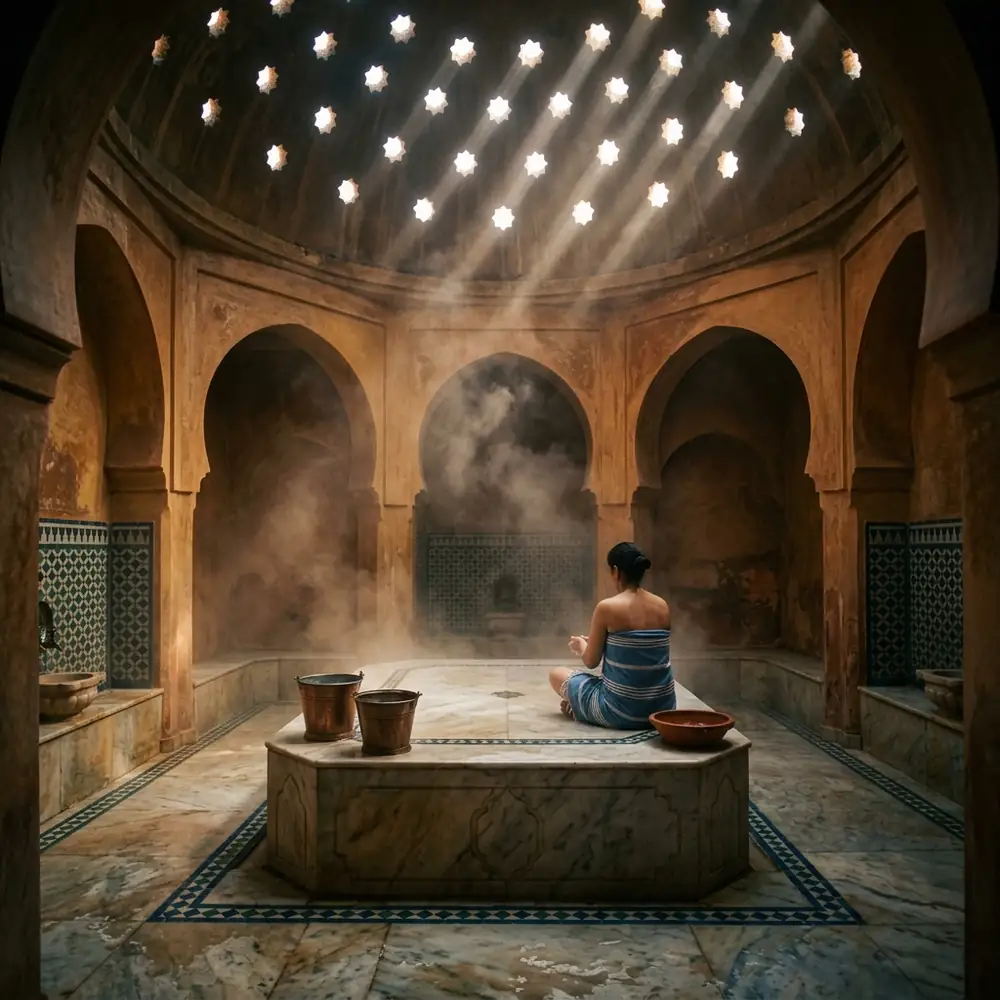
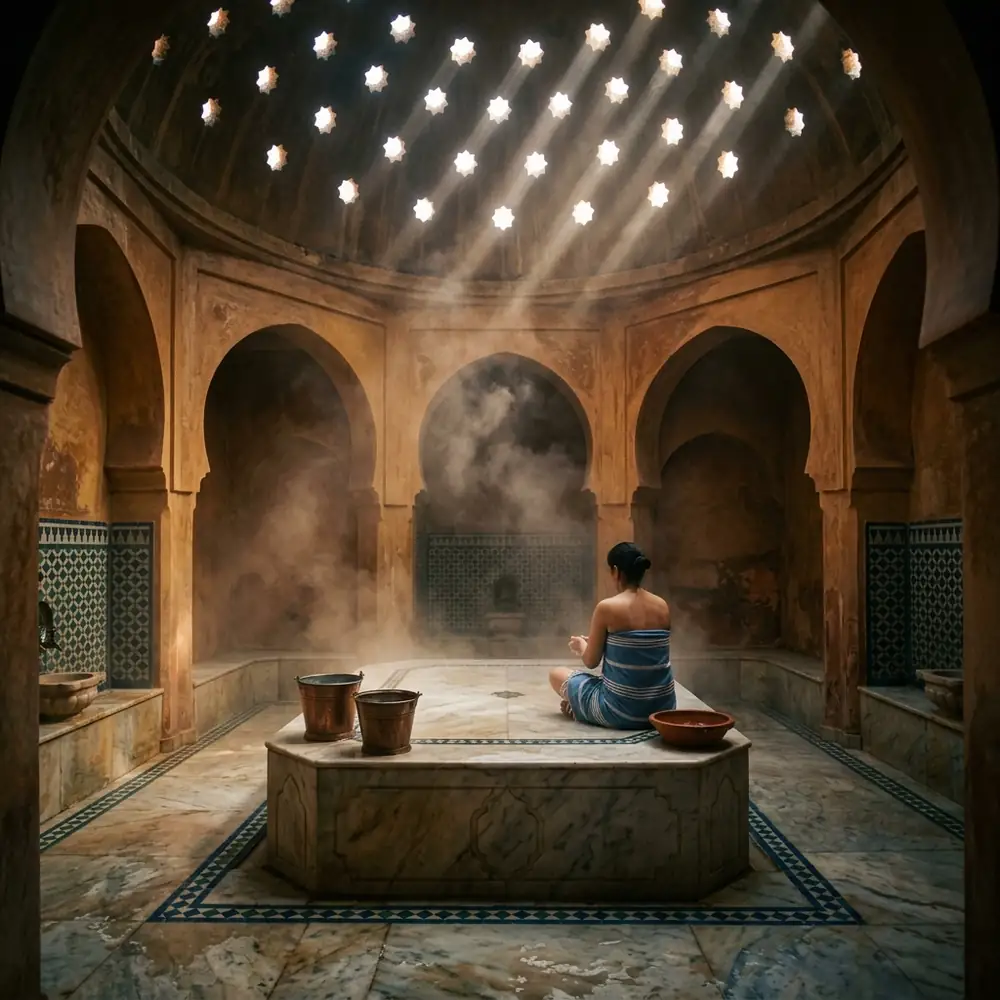
The architecture of a classic Moroccan hammam follows a thermal logic that hasn’t changed in a thousand years. You move through three rooms — cool, warm, hot — in sequence, and each room does something specific to your body before you’re ready for the next one.
The cool room, the bayt al-barrani, is where you undress, leave your things in a wooden cubicle, and mentally transition. It’s where people sit and talk between sessions. It gets loud in here. You’ll hear everything — gossip about the neighborhood, arguments about football, someone’s aunt asking someone else’s mother why her son hasn’t married yet.
The middle room, the bayt al-wastani, is where most of the real social life happens. This is the room at moderate heat where friends sit on the tiled floor with buckets of hot water and talk for what can honestly be hours. Do not rush this room. Our grandmothers certainly didn’t.
And then the inner room. The bayt al-sajun. The hottest, steamiest, most disorienting space — where the wooden ceiling is almost invisible through the vapor and the stone benches are so warm you feel them through the towel. This is where you submit.
What Are Kessa and Savon Beldi — and Why Do They Matter?
Here is the part that nobody forgets. After you have spent 20 minutes letting the steam do its work — opening your pores, softening everything — the kessala (the bath attendant) arrives with two things: the kessa and the savon beldi.
The kessa is a rough-woven exfoliating mitt that looks completely harmless. It is not harmless. When drawn firmly across steam-softened skin in long circular strokes, it pulls up what can honestly only be described as a shocking amount of dead skin — grey, rolled-up ribbons of it — revealing the new layer underneath. The first time this happens to you, you will be simultaneously horrified and delighted. Both reactions are correct.
Savon beldi is something else entirely. It is not a bar of soap. It is a thick, almost gelatinous dark paste — the color of strong espresso — made from cold-pressed olive oil and potassium. It smells green, raw, a little bitter. Slathered on after the steam and before the kessa, it does something to the skin that I have genuinely never been able to replicate with any product sold in a pharmacy.
The combination of steam, beldi soap, and a thorough kessa treatment leaves you with the skin of someone twenty years younger. I am not exaggerating. Our grandmothers’ skin at seventy was something other cultures marvel at. The hammam is why.
Why Is the Hammam More Than a Bath?
Because it always has been. The public hammam was the one space in the medieval Moroccan city where the vertical hierarchies of daily life temporarily dissolved. The wealthy merchant and the leather worker from the tannery sat in the same steam room with nothing separating them except the tiles. Shared nakedness is an extraordinary social equalizer.
For women especially — and the women’s hammam has always had its own hours or its own separate space — the hammam was the primary venue for female society. Marriages were arranged there. Engagements were announced. New brides were inspected — affectionately, critically — by the older women of the family. Remedies for difficult pregnancies were whispered from one generation to the next in the steam.
And it still works this way. Go to any working-class neighborhood hammam in Casablanca or Salé on a Thursday morning — the traditional preparation day before Friday prayers — and you will see exactly the same social mechanics functioning as they did in the 14th century. Just with more mobile phones visible in the cool room.
The Invisible Invitation
There’s a hammam I know in the Fes medina — I won’t tell you the name because it hasn’t changed a thing about itself in response to tourism and I’d like to keep it that way — where the tiles are original 15th century Zellige and the steam comes from a wood-fired furnace that the owner feeds himself every morning at six. On cold January mornings, half the neighborhood is already inside by seven. The smell hits you at the door: eucalyptus, olive oil soap, and something ancient underneath it all — the warm, mineral smell of old stone that has held heat for five centuries. Bring a towel. Leave everything else behind.
SEO Meta Description: What is a Moroccan hammam really like? A local guide to the steam bath ritual, Kessa scrub, Savon Beldi, and the social tradition behind this ancient Moroccan institution.
Experience the true heart of Moroccan heritage through its culinary traditions. Join us in preserving and honoring these ancestral recipes.
What People Are Saying
No comments yet. Be the first — we'd love to hear from you.
Youssef Amazigh
Culturally Verified & Fact-CheckedThe Moroccan Food editorial team brings together native culinary researchers, heritage preservationists, and experienced home cooks across Marrakech, Fes, and Casablanca. Every recipe and cultural guide is reviewed against ancestral oral traditions and authentic regional practices.