Harira: The Soup That Breaks Every Ramadan Fast and Why Nothing Else Would Do
Harira: What the Soup Is, What It Does, and Why the Smell at Iftar Time Is Unlike Anything Else
If you have ever been in a Moroccan city during Ramadan at the moment the fast breaks, you know the smell I am about to describe without my needing to describe it. It is harira — the particular combination of tomato and celery and lemon and coriander and saffron, all cooked together for two hours and arriving at every door and every window at exactly the same moment — and it is, together with the sound of the cannon or the call to prayer that signals iftar, one of the most instantly recognizable sensory experiences Morocco produces.
I am not a romantic about food. But I will admit that the smell of harira in a Moroccan medina street at the exact moment when the fast breaks produces in me something that is not purely sensory. It is the smell of an entire country stopping simultaneously and sitting down together, and the smallness of that description does not convey the size of what it actually feels like to be in it.
Let me tell you how to make it first, and then I’ll come back to the feeling.
What Is Harira Made Of and What Is Its Structure?
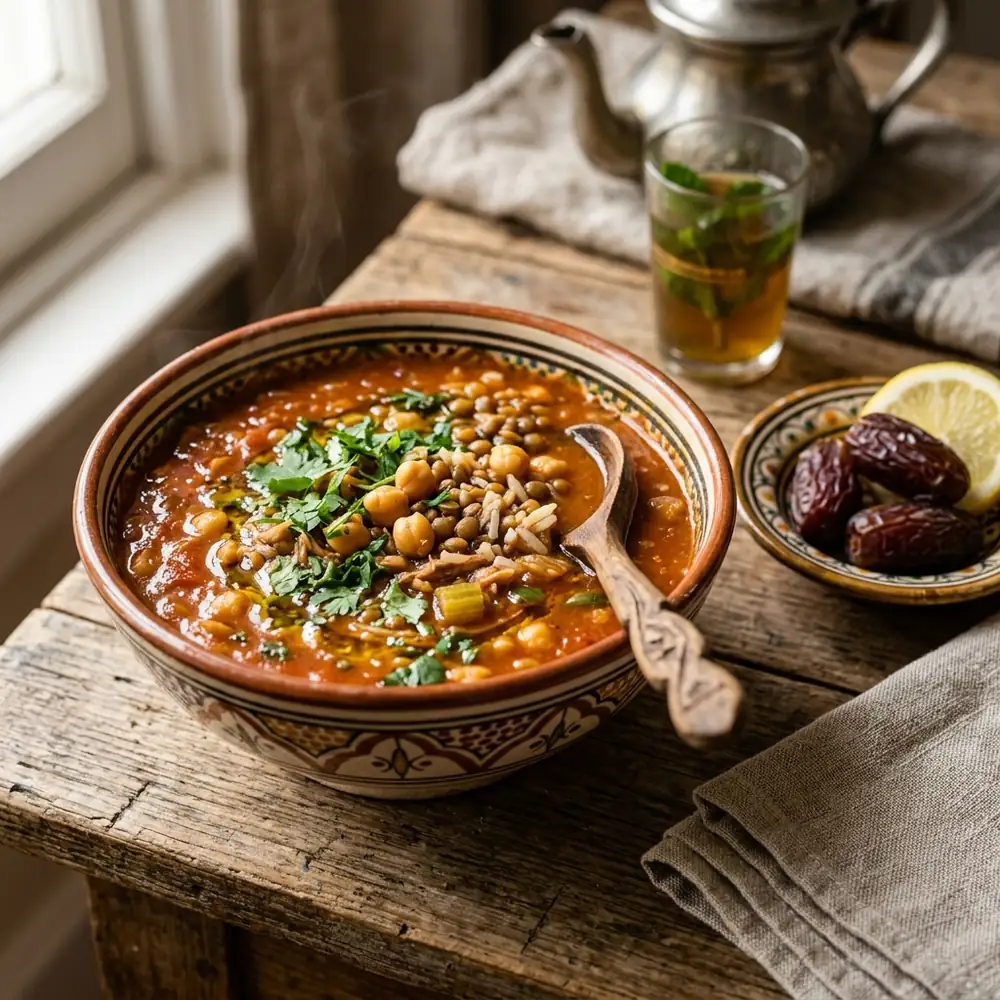
Harira is a thick, lightly spiced tomato and legume soup with a characteristic texture produced by two thickening agents used simultaneously: flour dissolved in water (la tadouira) and beaten egg added just before serving. The combination of these two thickeners produces a soup that is not clear-broth thin but not cream-soup thick — a middle texture with body and slightly viscous consistency that coats the back of a spoon and holds its warmth longer than a light broth.
The core ingredients: tomatoes (fresh or tinned, though fresh in-season tomatoes produce a significantly better result), celery (the entire stalk including leaves, which contribute a herbal bitterness that is part of harira’s character), onion, dried chickpeas (soaked overnight) and dried lentils, fresh coriander and flat-leaf parsley in considerable quantity, ginger, black pepper, turmeric, a little cinnamon, saffron, and lemon juice added at the end.
The fat is traditionally smen — the aged clarified butter that contributes a savory depth that vegetable oil doesn’t provide. This is the one element most modern recipes substitute most readily, and it is the substitution that most changes the final flavor. If you have access to smen, use it.
Meat is optional in the strict sense but expected in most families’ versions: lamb on the bone, or chicken pieces, or beef shin — all work, all contribute body to the broth, all are traditional in different family and regional variations. A strictly vegetarian harira is entirely valid and common in households where meat is expensive or simply not the preference. But the meat version has a richness that the vegetarian version reaches toward and doesn’t quite achieve.
What Is the Tadouira and Why Is It Made Separately?
The tadouira — the flour-water slurry that is one of harira’s two thickeners — is made separately and added at a specific moment rather than mixed directly into the soup. The reason is control: flour added directly to a hot liquid lumps unpredictably. Flour pre-dissolved in cool water and then poured slowly into the simmering soup while stirring disperses evenly and produces the desired smooth, consistent thickness.
The ratio is roughly one tablespoon of plain flour per serving, dissolved in enough cold water to make a thin, flowing liquid. It is added in the last twenty minutes of cooking, poured in a thin stream with the soup stirring constantly. From this moment, the soup must be stirred or at minimum checked every few minutes — the flour content makes scorching at the bottom of the pot a real risk, and scorched harira has a bitter undertone that no amount of additional lemon juice corrects.
The beaten egg — a whole egg beaten lightly, poured in a thin stream from a height in the last five minutes — adds richness, further thickens, and produces the slightly silky quality in the finished soup’s texture that distinguishes harira from other tomato legume soups. It is added off direct heat or over the lowest possible flame, stirred in immediately, and the soup is served within five minutes of the egg addition.
How Is Harira Served at Iftar and What Accompanies It?
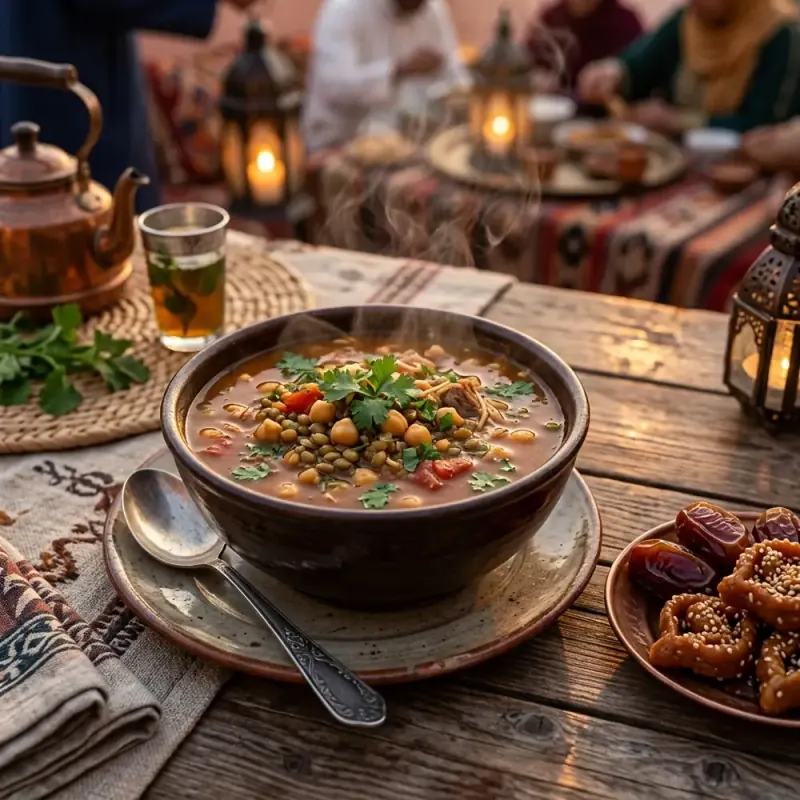
The timing is not flexible. Harira is served at the exact moment of iftar — the moment the fast breaks, announced by cannon in Moroccan cities and by the call to prayer — in a bowl that should be hot enough to sustain steam for the duration of the first ten minutes of eating.
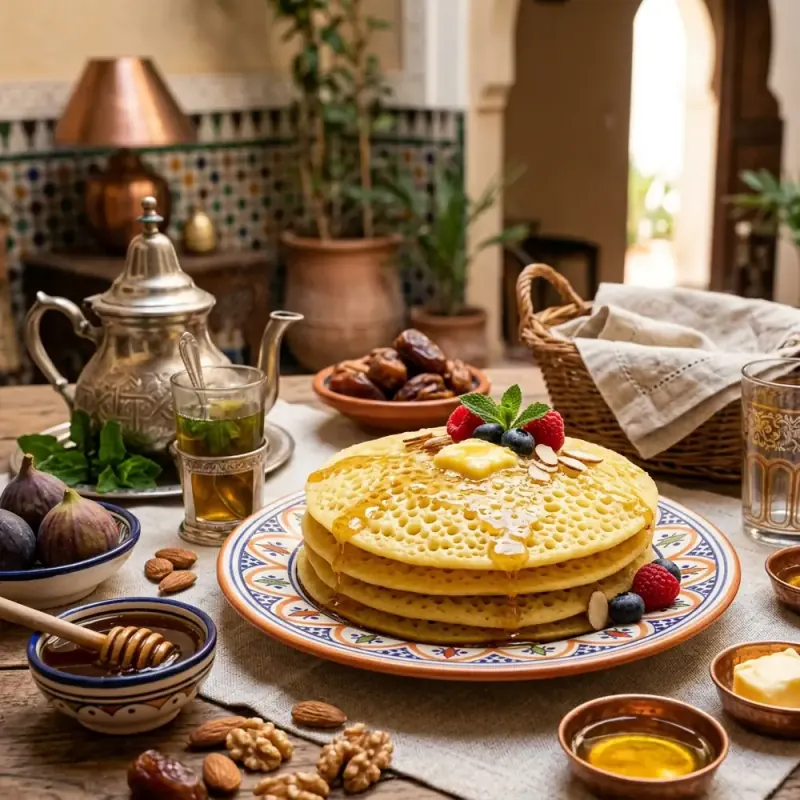
The accompaniments are traditional and consistent: dates are eaten first, immediately at the break of the fast, before the soup (this is both religious practice and physiological wisdom — the date’s simple sugars reach the bloodstream immediately after a day of fasting, preventing the lightheadedness that can accompany too-rapid eating after prolonged abstention). Bread — khobz or baghrir or sometimes meloui, depending on the family — for dipping. Lemon wedges on the side of the soup bowl, because some people want more acidity. A handful of chebakia or sellou on the table, for the sweetness that is also part of the traditional iftar spread.
The first bowl of harira after a day of fasting is drunk rather than eaten with a spoon by many Moroccan families — the bowl held in both hands, the soup sipped directly, the warmth moving from the mouth through the chest and the stomach with a specificity that I can only inadequately describe. It is the physical opposite of fasting. It is warm where fasting is cold, full where fasting is empty, present where fasting — in its best manifestation — is an intentional absence.
The Invisible Invitation
It is one minute before the cannon. The harira has been on the stove since four in the afternoon and the apartment smells of it completely — celery and coriander and tomato and the faint warm note of saffron that always comes through last. The dates are on the table, the bread is warm, the bowls are out. Everyone is sitting down. The television is on in the other room with the iftar broadcast. The cannon fires. The spoon goes in. Nobody speaks for the first thirty seconds because the soup is what matters right now, and everything else can wait until the first bowl is finished. Ramadan karim.
SEO Meta Description: What is Moroccan harira and how is it made? The Ramadan soup’s ingredients, tadouira thickening technique, egg finish, and what the iftar moment smells and feels like in a Moroccan city.
Experience the true heart of Moroccan heritage through its culinary traditions. Join us in preserving and honoring these ancestral recipes.
What People Are Saying
No comments yet. Be the first — we'd love to hear from you.
Khadija Tahiri
Culturally Verified & Fact-CheckedThe Moroccan Food editorial team brings together native culinary researchers, heritage preservationists, and experienced home cooks across Marrakech, Fes, and Casablanca. Every recipe and cultural guide is reviewed against ancestral oral traditions and authentic regional practices.