Harmal: The Ancient Seed of Mystery and Smudging in Moroccan Folklore
archived: false
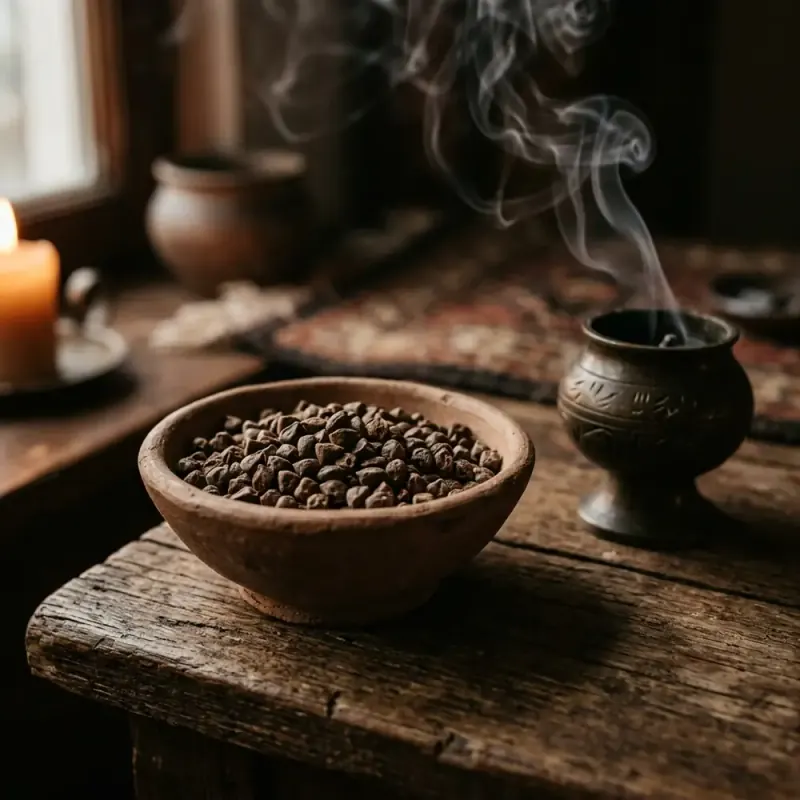
In the deepest recesses of the Moroccan apothecary souk, stored in rustic burlap sacks away from culinary spices, sits a collection of tiny, triangular, matte-brown seeds that command enormous cultural respect and a distinct whisper of caution. In Moroccan Darija, these seeds are known as Harmal (Peganum harmala, known in English as Syrian Rue or Wild Rue).
Unlike sweet-scented Serghina or luxurious Oud, Harmal is never burned for pleasant perfumery. When thrown onto glowing charcoal embers, its smoke is harsh, pungent, acrid, and violently bitter. Across Moroccan folklore and traditional medicine, Harmal occupies an extraordinary cultural space: the ultimate spiritual fumigant for neutralizing the evil eye (Al-Ayn), dispelling negative energies, and safeguarding newborn infants and wedding homes from spiritual disturbance.
Botanical Identity and Chemical Power
Peganum harmala is an exceptionally hardy, perennial succulent shrub belonging to the Nitrariaceae family:
- The Desert Survivor: It thrives on degraded, arid, overgrazed pastures from the pre-Saharan plains of Ouarzazate and Errachidia to the stony plateaus of the Oriental. Its thick, deeply penetrating taproot allows it to survive in regions where virtually no other vegetation can persist.
- The Seeds: The shrub produces solitary white flowers followed by three-chambered spherical capsules packed with dozens of dark brown, angular seeds.
- The Beta-Carboline Chemistry: What makes Harmal biologically potent is its exceptionally high concentration of beta-carboline alkaloids, specifically harmine, harmaline, and tetrahydroharmine. These natural compounds are potent, reversible inhibitors of monoamine oxidase A (MAO-A), giving the plant documented psychoactive, sedative, and central nervous system effects.
The Smudging Ritual: Neutralizing the Evil Eye (Al-Bkhour)
In Moroccan popular belief, negative energy, jealousy, and spiritual afflictions are felt as heavy atmospheric burdens that settle into the corners of a home.
The ritual burning of Harmal follows specific communal codes:
- The Charcoal Casting: On Tuesday or Friday afternoons, or when a family member experiences sudden unexplainable fatigue, headache, or misfortune attributed to the evil eye, a grandmother takes a small handful of whole Harmal seeds.
- The Popping Seeds: The seeds are cast directly onto glowing coals inside a clay brazier (Majmar). As the seeds heat, they pop like microscopic kernels of popcorn, releasing their characteristic sharp, acrid smoke.
- The Fumigation Walk: The censer is carried into every room of the house, held low to the floor and into dark room corners where negative energies are believed to linger.
- The Protective Recitation: As smoke billows, the elder recites protective Quranic verses (Surah Al-Falaq and Surah An-Nas) and traditional oral invocations, asking for divine peace, protection, and harmony within the household.
Medicinal Respect and Toxicological Reality
While European and North American wellness circles occasionally discuss Harmal in experimental ethnobotanical contexts, Moroccan grandmothers treat the internal ingestion of Harmal with extreme caution:
- Never for Internal Culinary Use: Unlike nigella, cumin, or aniseed, Harmal is never consumed as a culinary seasoning. In high oral doses, its beta-carboline alkaloids cause dizziness, tremors, hallucinations, severe nausea, and cardiovascular depression.
- Uterine Toxicity Warning: In traditional folklore, Harmal was known as a powerful emmenagogue and abortifacient. Internal ingestion can induce violent uterine contractions and toxic physiological reactions.
- Safe Topical and Fumigant Use: Moroccan traditional herbalists (Aattarine) restrict its use almost exclusively to external smudging smoke, or boiling the seeds in olive oil to prepare topical rubs for soothing severe joint rheumatism, sciatic nerve pain, and scalp parasites.
Frequently Asked Questions
Is burning Harmal smoke safe to inhale?
Inhaling small amounts of smudging smoke in a well-ventilated room for a minute or two during a traditional space-clearing ritual is standard practice across Morocco. However, do not burn Harmal in tightly sealed, unventilated rooms, and avoid inhaling dense smoke directly, as its acrid smoke can irritate respiratory mucous membranes.
Can Harmal seeds be planted in home gardens?
While Peganum harmala is a drought-tolerant plant, it is considered an aggressive, invasive noxious weed in many agricultural regions outside its native habitat because livestock avoid grazing it due to its bitter alkaloids, allowing it to crowd out native pasture grasses.
Why do Harmal seeds pop on hot charcoal?
Harmal seeds possess a hard, dense outer seed coat enclosing moisture and volatile oils. When dropped onto searing hot coals, internal moisture instantly turns to steam, building internal pressure until the seed hull fractures with a distinctive sharp snapping sound.
Is Harmal related to true common garden rue?
No. Common garden rue (Ruta graveolens) belongs to the Rutaceae (citrus) family and produces yellow flowers with distinct furanocoumarins. Peganum harmala belongs to the Nitrariaceae family and contains completely different beta-carboline alkaloids, although both share the colloquial name “rue” due to their strong bitter aroma.
Why is Harmal exclusively used for external fumigation rather than internal tea?
Traditional Moroccan attarin (herbalists) strictly caution that Harmal contains potent beta-carboline alkaloids like harmine and harmaline, which can be toxic if ingested. Consequently, its centuries-old role in Moroccan ethnobotany is confined to burning seeds on glowing charcoal (bakhour) to purify domestic spaces and dispel heavy energies.
How do families combine Harmal with other protective resins during fumigation?
Harmal seeds are frequently blended with gum ammoniac (Fassoukh), benzoin resin (Jawi), and dried coriander seeds on a ceramic clay censer (Mijmar). The dense, fragrant smoke is waved through doorways, corners of the home, and around family members during life transitions.
Experience the true heart of Moroccan heritage through its culinary traditions. Join us in preserving and honoring these ancestral recipes.
What People Are Saying
No comments yet. Be the first — we'd love to hear from you.
Samira
Culturally Verified & Fact-CheckedSamira researches rural foodways and wild mountain herbs across the High Atlas and Rif, championing local farmers and small-scale cooperatives.