Hassan II Mosque: What Most Visitors Don't Know About Africa's Largest Mosque
The Hassan II Mosque: Thirty-Five Thousand Craftsmen, Nine Years, and One Laser Pointed at Mecca
I want to be direct about something before we begin, because I think it shapes everything that follows: the Hassan II Mosque is a genuinely controversial building, and the controversy is worth engaging with honestly rather than pretending it doesn’t exist.
The mosque was commissioned by King Hassan II in 1980, designed by the French architect Michel Pinseau, and completed in 1993. Its construction cost, estimated at approximately 585 million US dollars at the time, was funded entirely by a national subscription — meaning that Moroccan citizens, from the wealthy to the modestly employed, were essentially solicited for contributions. Whether “solicited” is the right word, or whether a stronger word is more accurate, is a question Moroccans themselves continue to debate.
At the same time, it is genuinely one of the most extraordinary pieces of 20th-century religious architecture in the world. And it was built almost entirely by Moroccan hands, by craftsmen from across Morocco working in three rotating shifts around the clock for nine years. Whatever complicated feelings you might have about the commissioning — and I have them, and so do many Moroccans — the craftsmanship is indisputable.
What Makes the Hassan II Mosque’s Architecture Technically Remarkable?
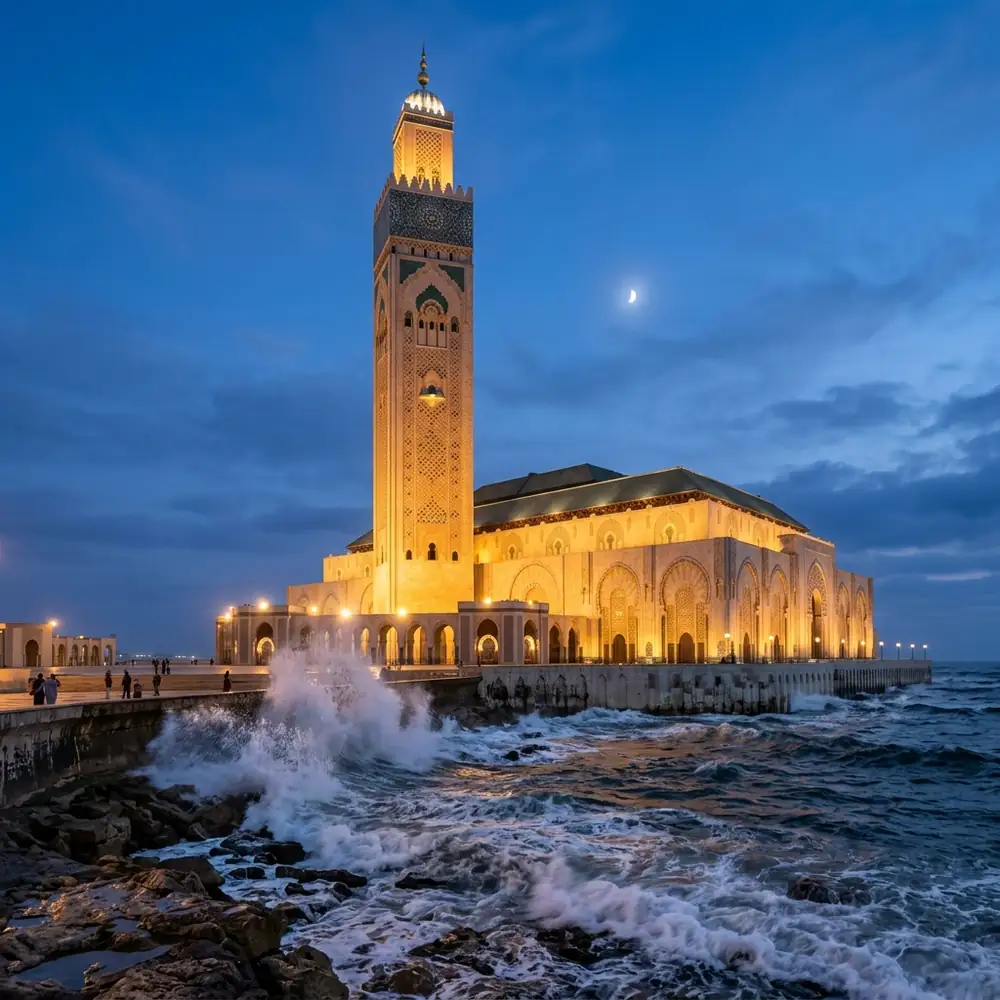
Start with the location, because it is where the whole statement begins. Hassan II wanted his mosque to be built over the sea — a reference to a Quranic verse that he particularly loved: “The Throne of God was built on water.” The site chosen is on the Casablanca corniche, extending into the Atlantic Ocean on a reclaimed land platform. When you stand inside the mosque and look through the glass floor panels in certain sections, you are looking directly down at the sea. The Atlantic waves are visible beneath your feet as you pray.
The retractable roof — an enormous hydraulic mechanism that can open the entire main prayer hall ceiling to the sky in approximately five minutes — is an engineering achievement that required considerable innovation. A mosque of this size, in a coastal Atlantic climate with significant wind and salt air exposure, requires a roof system that can open for warm months and close reliably against North Atlantic storms. The mechanism has operated, reportedly without significant mechanical failure, for over thirty years.
The minaret. It is 210 meters tall. This makes it the tallest minaret in the world and the tallest religious structure in Africa. It took the kind of structural engineering calculation usually reserved for skyscrapers, because a minaret of that height in an Atlantic coastal environment faces wind loads and seismic risk that a conventional mosque minaret does not. The structural frame is reinforced concrete clad in Moroccan craftsmanship — hand-carved zellige, plaster arabesque, and carved cedar — which means that the outside of a skyscraper-scale structure was finished by craftsmen working from scaffolding in essentially traditional ways. The scale of what was asked of them is difficult to fully imagine.
The laser at the summit points toward Mecca. Every night. I have seen it from the sea approaching Casablanca by boat, and from the motorway approaching the city, and from various terraces across Casablanca over the years. The green beam is visible for kilometers and is unmistakably, completely specific to this place. I do not know how to describe what it does to your sense of orientation when you see it from far away — it makes the city feel anchored to something directional and permanent. Which is, presumably, the intention.
What Did 35,000 Moroccan Craftsmen Actually Do to Build This Mosque?
Everything that isn’t structural concrete. And that is the majority of what you see when you walk inside.
The zellige tilework covering the lower walls of the interior — floor to approximately shoulder height throughout the prayer hall, the hammam, the ablution rooms, the corridors — represents approximately 400,000 square meters of hand-cut tile. Not machine-cut. Hand-cut, by craftsmen from the zellige workshops of Fes and Meknes working in temporary workshops set up on-site during the construction period. The scale of this production effort, within nine years, required a simultaneous expansion of the traditional craft sector that effectively trained a new generation of zellige cutters. The construction of the mosque is, among other things, the reason that the zellige craft survived the late 20th century with its traditional methods intact.
The carved plaster — the dense arabesque panels covering the upper walls — was executed by naqshbandi (plaster carvers) working by hand using traditional tools: the small, sharp chisel for detail work, the scraper for surface preparation, the eye and the accumulated understanding of geometric proportion for the composition. The plaster in a traditional Moroccan building is applied wet and carved while it is still slightly soft — this limits the working time available and requires skill that cannot be adequately described but only demonstrated. Multiplied across the interior surface area of the world’s third-largest mosque.
The cedar work — carved ceiling panels, mashrabiya screens, decorative door surrounds — came from workshops in the Middle Atlas. The brass chandeliers were made in Marrakech. The marble came from the Agouim quarries in the High Atlas.
Is the Hassan II Mosque Open to Non-Muslims?
Yes, which is relatively unusual among major mosques in Morocco. Non-Muslim visitors can tour the interior on guided visits that run daily except on Friday mornings and during prayer times. The visit includes the main prayer hall, the hammam (which is operational), and the ablution rooms — all of which are completed to the same level of craftsmanship as the areas visible to worshippers.
The experience of standing inside the main prayer hall — which can accommodate 25,000 worshippers inside and an additional 80,000 on the exterior esplanade — is genuinely affecting regardless of your religious background. The scale is physically disorienting in the way that genuinely large interior spaces always are: the eye struggles to find reference points at the distances involved, and the carved plaster ceiling, which in photographs looks like a flat surface, reveals itself in person as a three-dimensional landscape of receding arabesque detail that you could study for an hour without seeing all of it.
The Invisible Invitation
Go at dusk. Arrive at the corniche esplanade as the sun is going down over the Atlantic and the call to prayer is beginning — you will hear it from the minaret above you and from mosques across Casablanca simultaneously, the voices layering into each other across the city. The exterior lighting comes on. The laser appears at the top of the minaret and points toward Mecca through the evening sky. Behind you, the Atlantic is doing whatever the Atlantic does in Casablanca in whatever month it is when you visit. Stand there for a while. The building is many things and they are all happening at once.
SEO Meta Description: What is the Hassan II Mosque in Casablanca? The architecture, 35,000 craftsmen, retractable roof, ocean location, and Mecca laser of Africa’s largest mosque explained.
Experience the true heart of Moroccan heritage through its culinary traditions. Join us in preserving and honoring these ancestral recipes.
What People Are Saying
No comments yet. Be the first — we'd love to hear from you.
Omar Idrissi
Culturally Verified & Fact-CheckedThe Moroccan Food editorial team brings together native culinary researchers, heritage preservationists, and experienced home cooks across Marrakech, Fes, and Casablanca. Every recipe and cultural guide is reviewed against ancestral oral traditions and authentic regional practices.