The Henna Ritual: Symbolism and Art on Moroccan Skin
The Henna Ritual: Symbolism and Art on Moroccan Skin
In Morocco, henna is never just decoration — it is a living prayer drawn on the skin. Every bride, every newborn, every woman stepping into a special moment wears it as a shield of love and a whisper to God. When you smell the deep, earthy scent of freshly applied henna in our medinas, you are breathing twelve centuries of blessing into your lungs.
What does henna symbolize in Moroccan culture?
Henna is a symbol of protection, fertility, joy, and the sealing of special bonds between a woman and her new life.
- Protection: The khamsa (hand of Fatima) motif embedded in henna patterns is believed to ward off the evil eye (el-ain).
- Fertility: Floral and vine patterns represent growth, abundance, and the promise of new life.
- Transition: Henna marks every major crossing — births, circumcisions, weddings, and religious celebrations like Eid.
- Community: The night of henna (Laylat al-Henna) before a wedding is a women-only ceremony, a final gathering of the bride's girlhood circle.
What happens during a traditional Moroccan henna night?
The Laylat al-Henna is one of the most intimate rituals our Kingdom preserves.
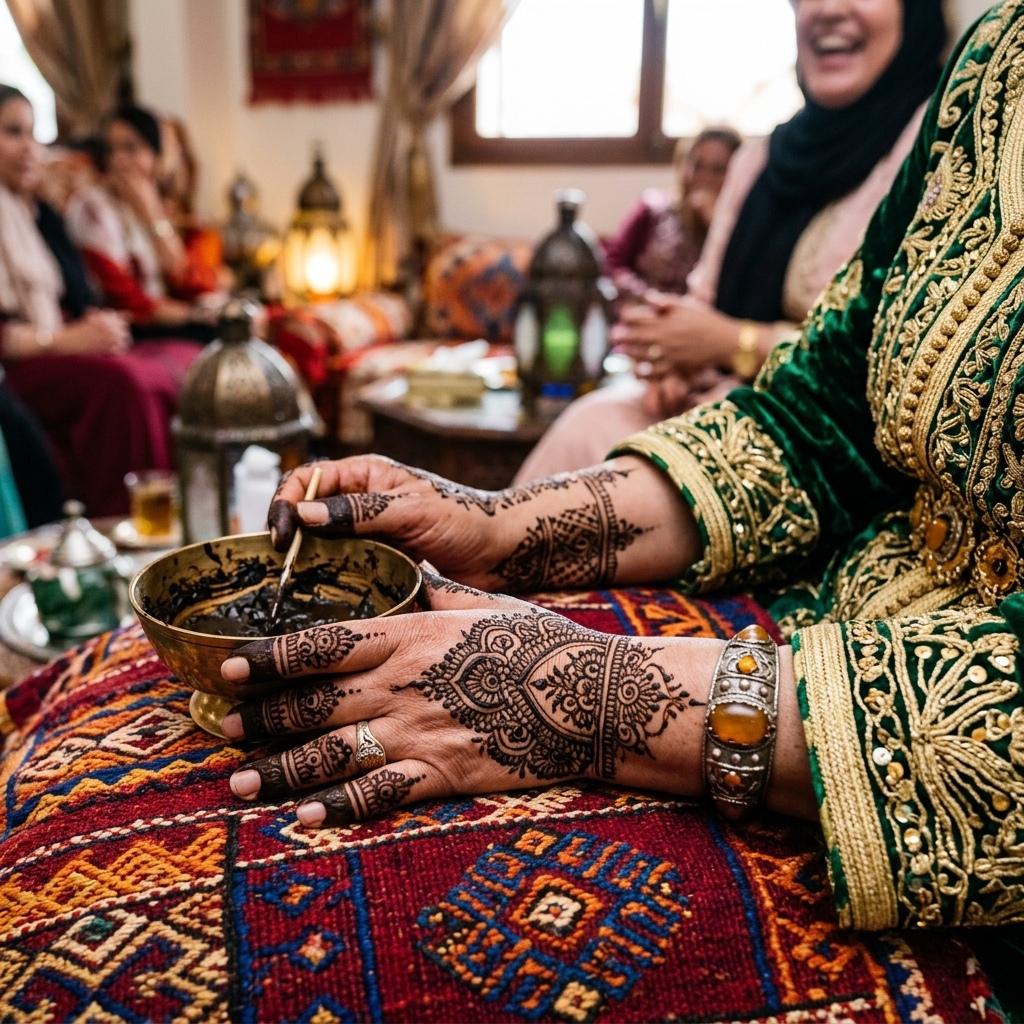
It unfolds on the eve of the wedding, when the women of both families gather in candlelit rooms scented with jawi (benzoin incense) and orange blossom water. A professional henna artist — called a Nqqasha — arrives with her tools: a cone of freshly ground henna paste, essential oils of eucalyptus or clove, and centuries of geometric knowledge in her fingertips.
The bride sits at the center, her hands and feet extended. The Nqqasha begins the slow, deliberate work — spirals, dots, geometric diamonds, and flowing vines that can take three to five hours to complete. Songs fill the air. Taghdiwt — traditional wedding chants — are sung by the elder women, their voices rising and falling like smoke above candles.
After the paste dries and is removed, the henna leaves a rich auburn-to-burgundy stain that deepens for up to 48 hours. My grandmother used to say: "The darker the henna, the deeper the love of the mother-in-law." A piece of folk wisdom, yes — but one that still makes every new bride hold her breath and wait.
How is authentic Moroccan henna paste made?
Real Moroccan henna (al-Henna al-asil) is prepared by hand from dried, powdered Lawsonia inermis leaves — never from chemical "black henna," which is a dangerous impostor.
- Sift the powder: Pure green henna powder is sifted finely to remove stems and impurities.
- Mix with acidic liquid: Lemon juice or strong black tea is added to release the pigment molecule (lawsone).
- Add essential oils: Eucalyptus or cajeput oil deepens the stain and keeps the paste supple for precise application.
- Rest overnight: The paste must rest sealed for 12 to 24 hours to allow the dye to fully release. Patience is not optional here.
- Load into a cone: The Nqqasha fills a hand-rolled cone for controlled, flowing lines.
- Apply and seal: Once drawn, the pattern is coated in a sugar-and-lemon syrup to keep it from cracking and to deepen the final color.
What are the most iconic Moroccan henna patterns and their meanings?
The geometry of Moroccan henna is a visual language — each symbol carries intention.
- Diamonds (losanges): Common in Amazigh (Berber) traditions, they represent the eye of protection and the strength of women.
- Spirals and vines: Flow and continuity — life unfolding without interruption.
- Dots (nuqat): Fertility and stars. Clusters of dots around wrists mimic ancient Amazigh tattoo traditions.
- Fish (hut): A symbol of good fortune, especially popular in coastal cities like Essaouira and Rabat.
- Crescent moon: Spiritual protection and femininity, often placed at the center of the palm.
In the north, in cities like Tetouan and Chefchaouen, Andalusian aesthetics show in elaborate arabesque-style flowing patterns. In the south, Amazigh designs are bolder and more geometric — angular, proud, and deeply tied to pre-Islamic cosmological beliefs. Each region of our Kingdom writes a different story on the skin.
Is henna used in Morocco outside of weddings?
Absolutely — and this surprises many visitors. Henna is woven into the rhythm of the entire Moroccan special calendar.
- Achoura (10th of Muharram): Children have their hands hennaed as part of this joyful commemoration.
- Birth and Aqiqa: A newborn's head may be symbolically touched with henna as a blessing.
- Eid al-Adha and Eid al-Fitr: Many women refresh their henna before the Eid prayer.
- Mawlid an-Nabawi: Women across Morocco sit together in henna ceremonies that feel as much like prayer as art.
In the rural douars of the Middle Atlas, elderly Amazigh women still practice henna as daily adornment — a quiet, personal ritual, simply because beauty is itself a form of gratitude.
How can visitors experience a genuine henna ritual in Morocco?
Do not accept the tourist henna offered hastily on the steps of Jemaa el-Fna in Marrakech.
- Seek a Hammam with henna services: Authentic hammams in Fes, Chefchaouen, and Essaouira offer full henna treatments in a ceremonial setting.
- Ask for pure henna: Insist on green (al-asil) henna and refuse anything described as "black henna" — it contains toxic PPD chemicals that can cause severe burns.
- Allow enough time: A quality Moroccan henna application requires a minimum of two hours. Rushed henna is not real henna.
- Let it dry naturally: Scrape the dried paste off gently with a card. Water is the enemy of a deep stain in the first hour.
- Moisturize with natural oils: After removal, rub pure argan oil over the stained skin to lock in depth and luminosity.
The Invisible Invitation
If you ever sit with us on the night before a Moroccan wedding — even as a welcomed stranger, because in our Kingdom, guests are always welcomed — and you watch a Nqqasha draw slowly on the trembling hands of a young bride while the elder women sing and the incense rises, you will understand something no guidebook has ever explained.
Henna is not art applied to the body. It is the body's way of remembering who it is, who it loves, and what it hopes for — written in the oldest ink in the world, before the night carries it all away. Come sit with us. We will save you a place.
Frequently Asked Questions (FAQ)
Q1: Is Moroccan henna safe for sensitive skin?
A: Pure, natural henna (al-asil) is safe for nearly all skin types. The danger lies exclusively in "black henna" which contains PPD, a synthetic chemical dye. Always verify your henna is green and smells earthy — never chemical.
Q2: How long does Moroccan henna last?
A: A well-applied henna stain lasts between 1 to 3 weeks, fading gradually as the skin's outer layer naturally exfoliates. Moisturizing with argan or olive oil significantly extends the vibrancy of the stain.
Q3: Can men wear henna in Morocco?
A: Traditionally, Moroccan men apply henna on the palms of their hands and on the scalp on special occasions. The Prophet Muhammad is recorded as approving of henna for men in this manner, so it carries deep cultural legitimacy.
Experience the true heart of Moroccan heritage through its culinary traditions. Join us in preserving and honoring these ancestral recipes.
What People Are Saying
No comments yet. Be the first — we'd love to hear from you.
Fatima-Zahra Benali
Culturally Verified & Fact-CheckedThe Moroccan Food editorial team brings together native culinary researchers, heritage preservationists, and experienced home cooks across Marrakech, Fes, and Casablanca. Every recipe and cultural guide is reviewed against ancestral oral traditions and authentic regional practices.