The Thousand-Year History of Moroccan Spices: Crossroads of Three Continents
archived: false
When international diners savor the complex, layered flavors of a Moroccan tagine, where the sweet, woody warmth of Ceylon cinnamon mingles seamlessly with the pungency of ginger, the floral elegance of Taliouine saffron, and the earthy comfort of cumin, they are tasting the distilled historical geography of North Africa. Moroccan cuisine is often praised as one of the world’s great culinary traditions, but its spice palette is something even rarer: a living living archive of global trade, imperial conquest, and cultural cross-pollination.
Positioned at the northwestern tip of Africa, separated from Europe by only fourteen kilometers of Mediterranean water across the Strait of Gibraltar and anchored to the south by the vast sands of the Sahara desert, Morocco stood for a millennium at the undisputed crossroads of three continents. Its spice heritage is the triumph of four distinct historical currents that converged over twelve centuries.
1. The Indigenous Amazigh (Berber) Botanical Terroir
Long before foreign sailing ships or trans-Saharan camel caravans brought tropical spices from Asia, the indigenous Amazigh people had developed a sophisticated culinary and medicinal tradition based on the wild flora of the Atlas and Rif mountains:
- Kamoun Beldi (Wild Mountain Cumin): Harvested from arid pre-Saharan plateaus, smaller and far more aromatic than Mediterranean varieties.
- Mountain Thyme (Zaitra) and Oregano (Za’atar): Pungent wild herbs dried on rooftop terraces to season fresh goat cheeses and slow-cooked earthen stews.
- Wild Pennyroyal (Fliou) and Absinthe (Chiba): Infused into boiling water to soothe winter chills and support digestion.
- Saffron of the Anti-Atlas: Cultivated for millennia around Taliouine on volcanic terraces.
These indigenous botanicals provided the earthy, herbal foundation upon which all subsequent imperial culinary traditions were constructed.
2. The Trans-Saharan Gold and Salt Caravan Routes
During the eighth through sixteenth centuries, Morocco’s imperial dynasties, the Almoravids, Almohads, and Saadians, controlled the legendary trans-Saharan trade routes.
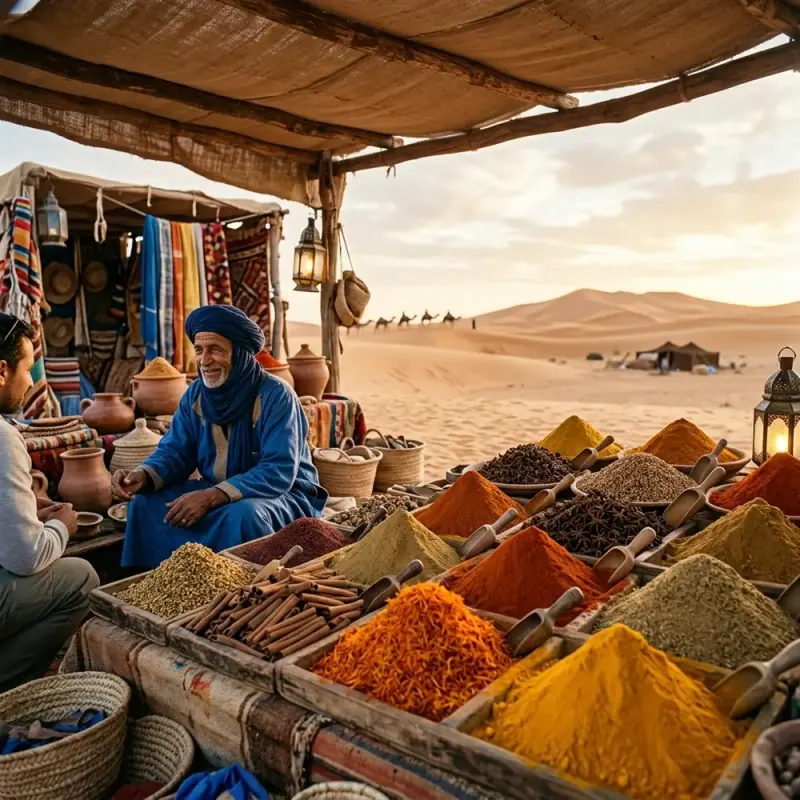
Caravans consisting of up to twelve thousand camels departed from the desert oasis terminal of Sijilmassa (modern Rissani), crossing the burning sands of the Sahara to Timbuktu and Gao on the Niger River:
- Caravans carried rock salt mined from Saharan salt pans (Taghaza), glazed ceramics from Fez, and dates.
- They returned laden with West African gold dust, ivory, and exotic botanical aromatics: Grains of Paradise (Aframomum melegueta, known in Darija as Gouza Sahrawia), gum arabic, and wild medicinal roots.
- These West African aromatics entered the royal kitchens of Marrakech and Fez, adding deep, peppery, cardamom-like complexities to imperial spice blends like Ras el Hanout.
3. The Indian Ocean Maritime Spice Lanes
Simultaneously, through maritime trade connections linking the Mediterranean through Alexandria, the Red Sea, and the Persian Gulf to the Indian Ocean, Arab and Persian merchants commanded the oceanic trade routes to the Spice Islands of Indonesia, India, and Sri Lanka:
- Ceylon Cinnamon (Qerfa Beldia): True soft cinnamon bark from Sri Lanka (Cinnamomum verum), which became the structural backbone of Moroccan sweet-and-savory meat braises.
- Ginger (Skinjbir): Pungent dried ginger root from southern Asia, essential for cutting through rich lamb fats and poultry sauces.
- Cubeb Pepper (Kebbeba): Tailed pepper berries from Java, celebrated in medieval Fassi pharmacopeias for their eucalyptus-like aroma.
- Nutmeg (Gouza) and Mace (Bsibisa): Rare tropical tree spices harvested in the Moluccas, reserved for royal banquet tagines.
4. The Andalusian Refinement: Ziryab and the Royal Riads
The final synthesis that transformed rustic ingredients into haute cuisine occurred with the arrival of Andalusian refugees. Following the progressive Christian Reconquista and the eventual expulsion of Andalusian Muslims and Sephardic Jews between 1492 and 1609, tens of thousands of cultured urban families settled in Fez, Tetouan, Rabat, and Chaouen.
They brought with them the refined courtly gastronomy of Moorish Córdoba and Granada:
- The sophisticated concept of Hlou wa Maleh (the sweet-and-savory harmony of slow-cooked meats with honeyed prunes, apricots, and cinnamon).
- The delicate distillation of bitter orange blossoms (Ma Zhar) and Damascus roses (Ma Ward) into fragrant hydrosols used to finish savory poultry pies (Pastilla) and almond pastries.
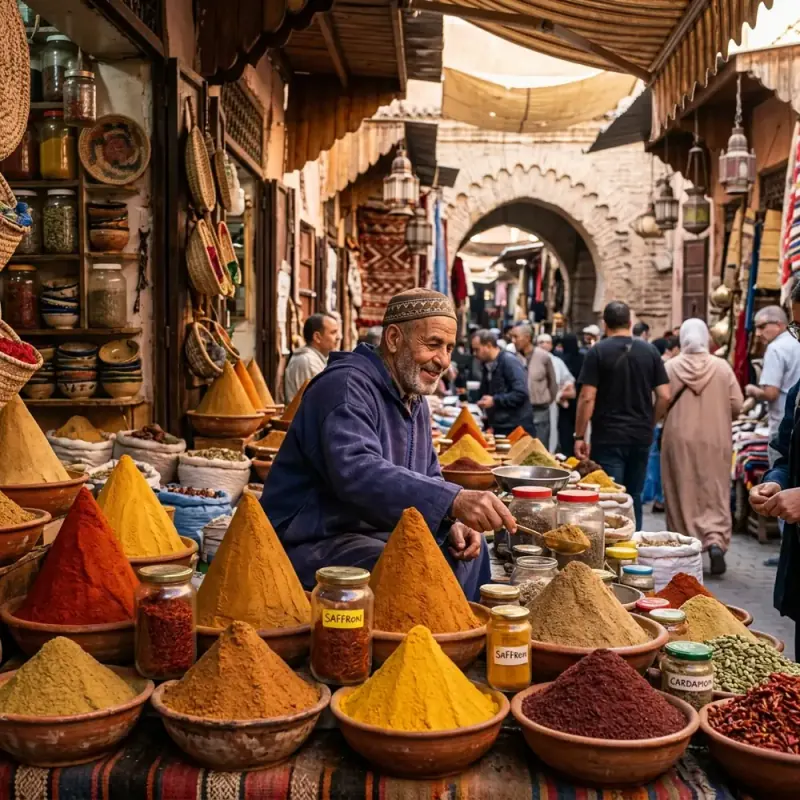
- The art of the communal spice guild (Souk el-Attarine), formalizing the training and ethical governance of spice merchants.
Frequently Asked Questions
Why is Moroccan food aromatic rather than burning hot?
Unlike Indian or Southeast Asian cuisines that use heavy quantities of fiery chili peppers (Capsicum), authentic Moroccan cuisine emphasizes aromatic warmth and complex aromatic depth. The kitchen balances sweet, woody, and herbal spices (cinnamon, saffron, ginger, cumin, coriander) with fresh herbs (cilantro, parsley), reserving fiery chili heat (Harissa or Sudaniya) as an optional condiment served on the side.
What is the most expensive spice grown in Morocco?
Saffron (Za’afran Horr) harvested in the volcanic Anti-Atlas plateau around Taliouine. It requires over 150,000 hand-picked purple crocus flowers and over four hundred hours of labor to produce a single kilogram of dried crimson stigmas, making it the most valuable agricultural product in Morocco by weight.
What is the difference between true cinnamon and cassia in Moroccan history?
Moroccan cuisine has strictly used Ceylon Cinnamon (Qerfa Beldia) from Sri Lanka since the Middle Ages. Its multiple delicate, paper-thin, soft layers and sweet floral perfume integrate seamlessly into delicate savory dishes, whereas harsh, hard, spicy Chinese Cassia bark overpowers Moroccan stews with aggressive chemical heat.
When did sweet paprika arrive in Moroccan cooking?
Sweet paprika (Tahmira) arrived relatively late in Moroccan culinary history, introduced from the Americas via Spain in the sixteenth and seventeenth centuries. Moroccan agriculturalists planted sweet round peppers (Niora) in the fertile plains of Tadla and the Gharb, sun-drying and stone-grinding them into the brilliant, fruity red powder that now defines coastal fish tagines and Chermoula marinades.
Experience the true heart of Moroccan heritage through its culinary traditions. Join us in preserving and honoring these ancestral recipes.
What People Are Saying
No comments yet. Be the first — we'd love to hear from you.
Youssef
Culturally Verified & Fact-CheckedYoussef is a food ethnology researcher documenting historic spice trade routes, Berber cooking methods, and the living food history of the Maghreb.