How Moroccan Women Use Herbs for Natural Hair Care
How Moroccan Women Use Herbs for Natural Hair Care
Wondering how Moroccan women maintain incredibly thick, glossy hair without expensive chemical treatments? The secret lies in a fierce, deeply aromatic weekly ritual of boiling wild mountain herbs, dried roses, and cloves to create potent botanical hair rinses. Discover the ancient, natural apothecary that transforms the Hammam into a restorative hair spa.
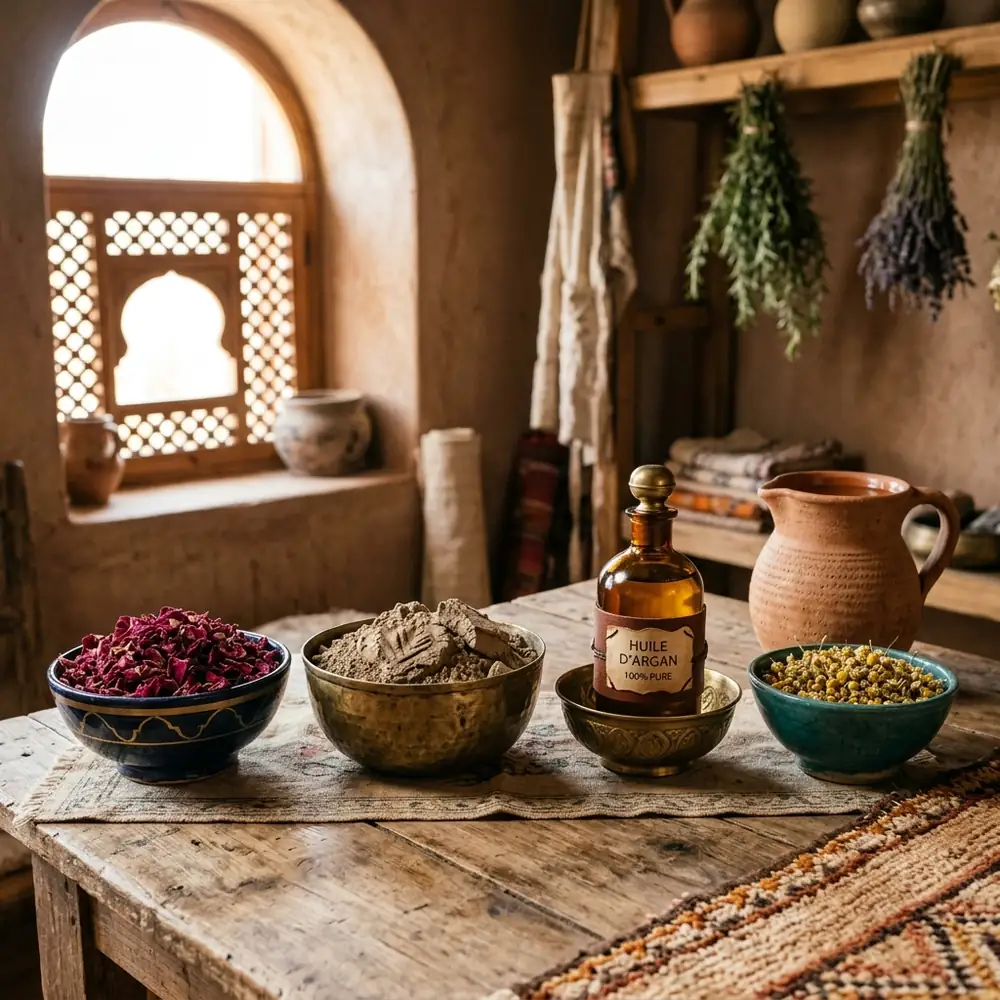
In our Kingdom, true beauty is grown in the dirt, not manufactured in a laboratory. Walk past any medina herbalist, and you will see women specifically buying bundles of dried rosemary, lavender, and myrtle strictly for cosmetic use. Our grandmothers passed down the exact boiling ratios required to stimulate the scalp and fiercely darken the hair shafts naturally. Today, I invite you to step away from synthetic shampoos. It is time to wash your hair with the earth.
What herbs are used in the traditional hair infusion?
Moroccan women brew a complex, dark, and intensely fragrant herbal tea designed exclusively to be poured over the head.
- The stimulating roots: Generous handfuls of dried rosemary (iklil) and wild lavender are boiled to stimulate blood flow to the scalp and encourage rapid hair growth.
- The darkening cloves: A heavy pinch of whole cloves (qronfel) is thrown into the boiling water, providing a sharp, spicy scent and naturally darkening the hair to a deep, glossy brown.
- The floral softening: Dried Damask rosebuds are added to the pot to intensely soften the hair cuticles and leave a lingering, romantic perfume that lasts for days.
How is the herbal rinse applied?
This botanical infusion is typically paired with the volcanic Ghassoul clay during the weekly Hammam visit to maximize its restorative power.
- The clay mixture: Instead of using plain water, the hot, strained herbal tea is used to hydrate and melt the raw chunks of Ghassoul clay into a smooth, fragrant mud.
- The heavy mask: The herbal mud is massaged fiercely into the roots and pulled down to t <truncated 58755 bytes> a.
- The strategic marriage: To cement his loyalty to the indigenous people, he married Kenza, the daughter of the powerful Awraba tribal chief, inextricably tying his royal Arab bloodline to the fierce mountain warriors of Morocco.
- The foundation of Volubilis: He initially settled his court within the crumbling, majestic stone columns of the ancient Roman city of Volubilis, using the ruins of the empire to build the foundation of a new Islamic state.
What is the legacy of the Idrissid Dynasty?
Though Moulay Idriss I was tragically assassinated by poison shortly after his rise to power, his unborn son would go on to build an empire.
- The birth of Fes: His son, Idriss II, moved the capital from the Roman ruins and founded the city of Fes, transforming it into the spiritual, intellectual, and artisanal core of North Africa.
- The holy sanctuary: The tomb of Moulay Idriss I, located in the whitewashed mountain town of Moulay Idriss Zerhoun, remains one of the holiest pilgrimage sites in the country, strictly forbidden to non-Muslims for centuries.
- The first Moroccan identity: The Idrissids successfully broke away from the control of the Eastern Caliphates, establishing the fierce, independent Moroccan political identity that has endured for over twelve centuries.
Imagine standing on a high, green ridge overlooking the sprawling Roman ruins of Volubilis, the white-washed mausoleum of Moulay Idriss gleaming on the mountain above. You trace your hand along a carved Roman stone, knowing that an escaping prince once stood exactly here, exhausted, looking for a home. Our history is ancient, and our roots are royal; come walk where Morocco began.
Meta Description: Discover the origins of the Moroccan state with the Idrissid Dynasty. Learn how Moulay Idriss I fled Arabia, united the Berber tribes, and founded the spiritual capital.
Experience the true heart of Moroccan heritage through its culinary traditions. Join us in preserving and honoring these ancestral recipes.
What People Are Saying
No comments yet. Be the first — we'd love to hear from you.
Diafa Editor
Culturally Verified & Fact-CheckedThe Moroccan Food editorial team brings together native culinary researchers, heritage preservationists, and experienced home cooks across Marrakech, Fes, and Casablanca. Every recipe and cultural guide is reviewed against ancestral oral traditions and authentic regional practices.