How to Dress Respectfully in Morocco: A Practical Guide for Men and Women
How to Dress Respectfully in Morocco: A Practical Guide for Men and Women
I was sitting in a café near the Koutoubia mosque in Marrakech last October when a young couple walked past. The man was wearing athletic shorts cut high above the knee and a sleeveless gym vest. The woman was wearing a crop top and denim cut-offs. The physical reaction of the Moroccans sitting around me was subtle but unmistakable — a collective dropping of the eyes, a slight turning away, a quiet murmur in Darija that roughly translates to ‘God guide them.’
Nobody shouted. Nobody harassed them. Moroccans are very hospitable and generally avoid public confrontation. But that couple moved through the city enveloped in an invisible cloud of social disapproval, entirely missing the warmth and connection that makes Morocco so extraordinary.
How you dress in Morocco is not just about avoiding offense; it is about how you signal your respect for the culture you are visiting. When you dress appropriately, doors open. Smiles are warmer. Prices in the souk are often fairer. You transition from being a ‘tourist to be managed’ to a ‘guest to be welcomed.’
Here is the honest, practical guide to getting it right without dying of heatstroke.
The Fundamental Rule: Shoulders and Knees
If you remember nothing else, remember this: the baseline of acceptable public dress in Morocco, for both men and women, requires covering the shoulders and covering the knees.
This is not a legal requirement. There is no religious police in Morocco. You will not be arrested for wearing shorts. But the social expectation is clear. In Moroccan culture, showing the thighs or the shoulders is considered inappropriate in public spaces outside of a beach or a swimming pool.
This rule applies differently depending on exactly where you are, but as a general principle for walking through the medina, taking public transport, or visiting rural villages, ‘shoulders to knees covered’ is your absolute minimum.
For Women: Navigating Heat and Modesty
The challenge for women visiting Morocco is significant: how to stay cool when the temperature hits 40°C (104°F) while adhering to modesty standards that are fundamentally different from Western norms.
Do I need to cover my head?
No. Unless you are entering a mosque (which, as a non-Muslim, is generally restricted to the Hassan II Mosque in Casablanca), you are not expected to wear a hijab or cover your hair. Moroccan women themselves choose whether to wear the hijab, and you will see many local women in cities with their hair uncovered.
What works best
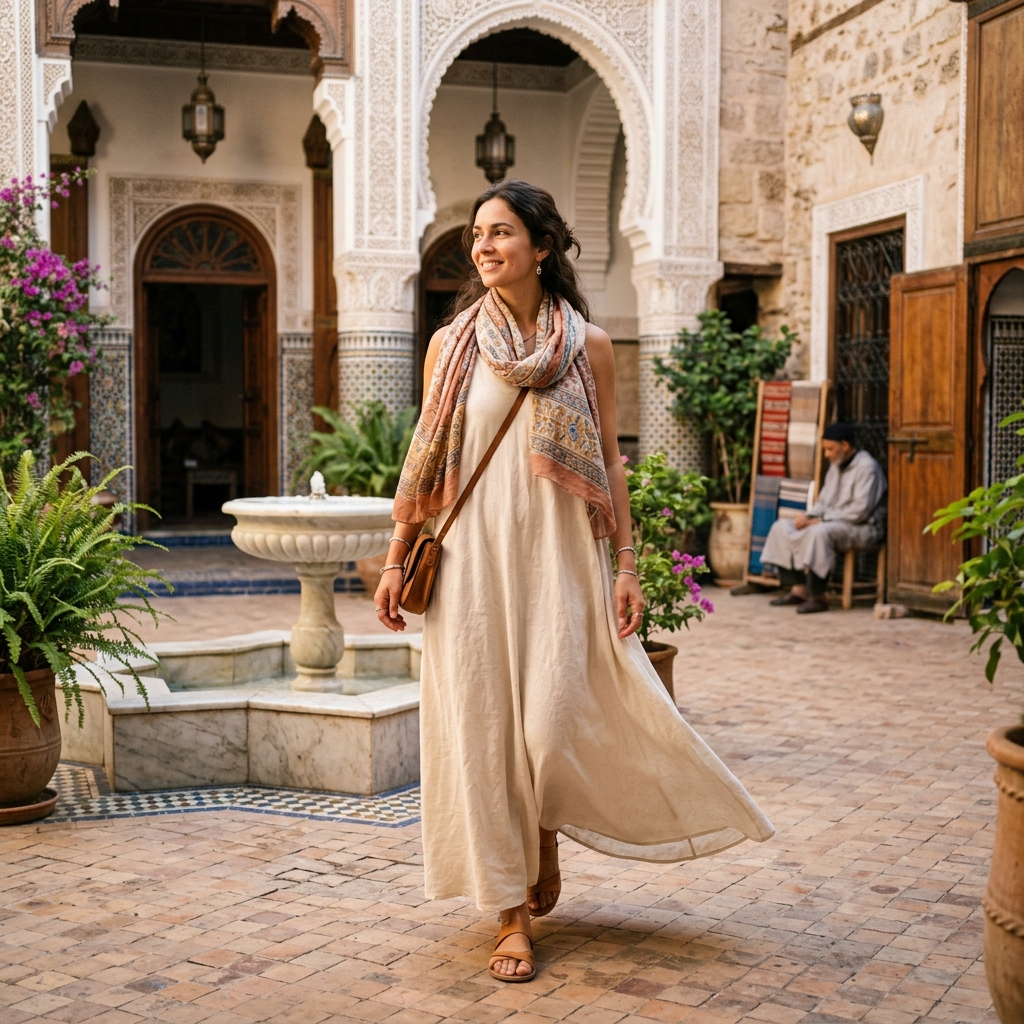
- Midi and maxi dresses: These are your best friends. A loose, breathable cotton or linen maxi dress that covers your shoulders and comes down past your calves is perfect.
- Wide-leg trousers: Linen or lightweight cotton trousers paired with a tunic or a loose T-shirt.
- The ‘cover-up’ scarf: Always carry a lightweight, wide scarf in your bag. It is invaluable for throwing over your shoulders if you are wearing a tank top, or for covering your hair if the sun is too intense.
- Long-sleeved linen shirts: Wearing a loose, lightweight long-sleeved shirt over a T-shirt actually keeps you cooler by protecting your skin from the direct sun, while satisfying all modesty requirements.
What to avoid
- Crop tops showing the midriff.
- Short shorts or miniskirts.
- Plunging necklines (cleavage attracts significant, usually unwanted, attention).
- Overly tight or form-fitting clothing (even if it covers the skin, if it leaves nothing to the imagination, it is considered inappropriate).
For Men: The Shorts Question
Men often assume that modesty rules only apply to women in Islamic countries. This is a mistake. Moroccan men do not wear shorts in public unless they are playing football or are at the beach. A grown man wearing shorts in the medina is viewed as slightly ridiculous — like an adult wearing a child’s clothing.
What works best
- Lightweight trousers: Chinos, linen trousers, or lightweight hiking trousers are ideal.
- T-shirts and polo shirts: Standard short-sleeved shirts are perfectly fine.
- Linen button-downs: The most stylish and comfortable option for the heat.
What to avoid
- Shorts (especially high-cut athletic shorts).
- Sleeveless shirts or tank tops.
- Walking around bare-chested (absolutely unacceptable anywhere except directly on the sand at the beach).
Context Matters: City vs. Village vs. Resort
The rules flex depending on your exact environment.
In modern neighborhoods of Casablanca or Rabat (like Maarif or Agdal), you will see young Moroccans wearing more Westernized clothing, including some shorts and shorter skirts. The tolerance here is higher.
In the medinas of Marrakech or Fes, the population is more traditional. The ‘shoulders and knees’ rule should be strictly observed.
In rural areas and the Atlas Mountains, the culture is deeply conservative. When hiking through Berber villages, err on the side of maximum modesty. Women should wear long trousers or ankle-length skirts, and shirts that cover the collarbone and elbows.
At your hotel or riad pool, standard Western swimwear (bikinis, swim trunks) is entirely normal and expected. The transition is the key: do not walk from the pool through the hotel lobby in your swimwear. Put on a cover-up.
On the beaches of Agadir or Essaouira, swimwear is fine on the sand, but the moment you cross the promenade to go to a café or walk into town, you must put clothes on over your swimwear.
The Magic of Moroccan Fabrics
If you find yourself unprepared for the heat and the modesty requirements, do what Moroccans have done for centuries: buy local.
The Moroccan djellaba — the long, loose-fitting robe with a pointed hood worn by both men and women — is a great piece of climatic engineering. It protects the skin from the sun, creates a microclimate of cooling air around the body, and satisfies all cultural expectations.
For visitors, buying a lightweight cotton tunic or a simple summer djellaba in the souk is an excellent solution. You will look respectful, you will feel significantly cooler, and you will have a beautiful garment to take home.
A Final Thought on Respect
I sometimes hear tourists say, ‘I’m on holiday, I should be able to wear what I want.’
This is a fundamental misunderstanding of travel. Travel is not about imposing your norms on a new environment; it is about experiencing the reality of someone else’s home. When you dress respectfully in Morocco, you are sending a quiet, powerful message: I see your culture, I respect your values, and I am grateful to be your guest.
The return on that small investment of effort is the true warmth of Moroccan hospitality. It is the best trade you will make on your entire trip.
Experience the true heart of Moroccan heritage through its culinary traditions. Join us in preserving and honoring these ancestral recipes.
What People Are Saying
No comments yet. Be the first — we'd love to hear from you.
Sanaa El Alaoui
Culturally Verified & Fact-CheckedThe Moroccan Food editorial team brings together native culinary researchers, heritage preservationists, and experienced home cooks across Marrakech, Fes, and Casablanca. Every recipe and cultural guide is reviewed against ancestral oral traditions and authentic regional practices.