Jaban: The Lost Art of Moroccan Hand-Pulled Medina Street Candy
If you ask any Moroccan who grew up before the era of plastic-wrapped supermarket candy about four o’clock in the afternoon, their eyes soften. That was the hour when school bells rang across the medinas of Fes, Sale, Marrakech, and Meknes.
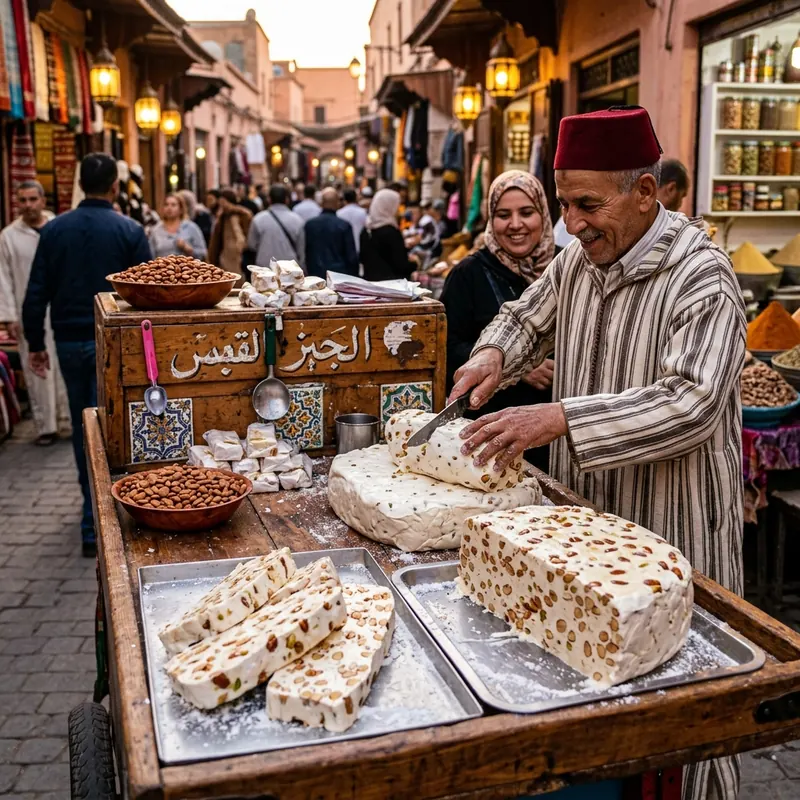
Spilling out through arched cedar gates into the afternoon sunshine, children clutched warm one-dirham coins in their fists. Their destination was never a grocery store. It was a tall wooden cart parked near the entrance, crowned by a conical wooden stand draped in glossy, pearlescent white candy that shined like silk.
Standing behind the cart was the confectioner—moul el-jaban. With a flick of his wrist, he plunged a thin wooden stick into the glossy mass, twirled it rhythmically to gather a sweet ribbon of pulled sugar, and handed over an artisanal lollipop. This is Jaban, sometimes called Jaban Kouki—Morocco’s centuries-old hand-pulled street nougat-taffy.
       +-------------------------------------------------------------+
       |                  THE CRAFT OF MEDINA JABAN                  |
       +-------------------------------------------------------------+
       | [ Origin ]       Saadian sugar era (Chichaoua & Souss)      |
       | [ Chemistry ]    Hard-ball sugar syrup aerated by pulling   |
       | [ Color Shift ]  Translucent amber to pearlescent white     |
       | [ Aromatics ]    Distilled orange blossom water & lemon oil |
       | [ The Vehicle ]  Peeled wooden stick or river reed quill    |
       | [ Texture ]      Crisp outer shell giving way to chewy taffy|
       +-------------------------------------------------------------+
The Saadian Sugar Empire: A Forgotten Heritage
During the sixteenth century, under the Saadian Sultan Ahmed el-Mansour, the river valleys of Chichaoua, Taroudant, and the Souss were blanketed in thick plantations of sugar cane. Powered by aqueducts, stone mills crushed the cane, boiling juice in copper vats to produce refined sugar loaves (soukar el-qaleb). Moroccan sugar was so pure that the Sultan traded it weight-for-weight with Italian merchants for Carrara marble to build the legendary Badi Palace in Marrakech.
While refined sugar was exported across Europe, Maghrebi confectionery flourished at home. Master confectioners (maâlemin d-le-hlawa) developed sophisticated techniques for working with hot sugar syrup. Over centuries, what began as royal palace confections filtered down into street culture, transforming into the beloved, accessible candy known as Jaban.
The Iron Hook: The Aeration Alchemy
The creation of Jaban is a physical spectacle requiring upper-body strength, heat tolerance, and precise timing. It is candy-making as manual performance art.
The artisan begins by boiling pure sugar, water, and fresh lemon juice in a copper cauldron (tanja). The lemon juice is critical: its citric acid inverts sucrose into glucose and fructose, preventing the syrup from crystallizing into grainy sand. The mixture cooks until it reaches the hard-ball stage—roughly 125°C to 130°C (255°F to 265°F). At this threshold, syrup dropped into cold water forms a pliable, firm ball that holds its shape.
The molten amber syrup is poured onto an oiled marble slab. As it cools, the confectioner folds in drops of distilled orange blossom water (ma zhar), rosewater, or vanilla.
Once the mass can be handled without burning flesh, the maâlem lifts the warm lump of golden candy and throws it over a large, smooth iron hook anchored into the wall.
What follows is rhythmic choreography. The artisan pulls the ribbon of warm sugar downward with both arms, stretching it until it is a yard long, then loops it back over the hook and pulls again. He repeats this pulling action hundreds of times without stopping.
As he pulls, the physical structure of the candy transforms. Manual stretching incorporates millions of microscopic air pockets into the dense matrix. Light begins to refract through these trapped bubbles. Within ten minutes of furious pulling, the dark, translucent amber mass turns into an opaque, gleaming white taffy with the sheen of mother-of-pearl.
The Conical Stand and the Twirling Stick
Once aerated, the candy is divided. A portion is often tinted pale rose or pastel green with natural food coloring, then twisted together with the white taffy to create striped cords.
The master transfers the glossy candy onto a tall, conical wooden armature mounted on his handcart. Covered with a clean cloth to protect it from dust, the candy cone stands like an alabaster sculpture in the souk.
When a customer orders, the seller steps into action. He holds a smooth wooden stick whittled from mountain pine or river reeds. He plunges the tip into the side of the candy cone. With a swift, circular twist of his wrist, he wraps a dollop of soft taffy around the wood, pulls back sharply to sever the ribbon, and hands it over.
The candy warms in the child’s mouth. At first, the surface is smooth and firm, releasing the floral perfume of neroli and orange blossoms. As saliva warms the sugar, it softens into a chewy, buttery taffy that stretches between your teeth.
A Vanishing Medina Craft
The rise of cheap, industrially packaged candies, chocolate bars, and chemical gums has driven traditional sugar pullers out of business.
Decades ago, every neighborhood gate in Fes, Marrakech, and Meknes boasted permanent Jaban carts. Today, only a handful of aging masters keep the fires burning. These veterans preserve their craft during seasonal religious moussems, cultural festivals, and near historic shrines like Moulay Idriss Zerhoun.
For Moroccan cultural historians, Jaban is far more than melted sugar on a stick; it represents a living line to the pre-industrial culinary heritage of the Maghreb. It demonstrates how artisans understood complex physical chemistry—sugar inversion, glass transition points, and air emulsification—centuries before modern food processing laboratories existed.
       +-------------------------------------------------------------+
       |               HOMESTYLE PULLED JABAN CANDY                  |
       +-------------------------------------------------------------+
       | * 400 g granulated pure white cane sugar                    |
       | * 120 ml pure spring water                                  |
       | * 2 tablespoons fresh strained lemon juice                  |
       | * 1 tablespoon authentic orange blossom water (ma zhar)     |
       | * 8 wooden skewers or clean craft sticks                    |
       +-------------------------------------------------------------+
Kitchen Method:
- In a heavy saucepan, combine sugar, water, and lemon juice.
- Heat without stirring until sugar dissolves completely.
- Boil until syrup reaches 128°C (262°F) on a candy thermometer (hard-ball stage).
- Remove from heat and stir in orange blossom water.
- Pour hot syrup onto a silicone mat or oiled marble slab.
- Cool 4 to 5 minutes until safe to touch with greased hands.
- Stretch and fold the candy repeatedly between greased palms for 8 to 10 minutes until opaque and pearlescent white.
- Wrap portions around wooden sticks and let cool until firm.
Grandmother’s Confection Secrets
- Do Not Stir the Boiling Pot: Once sugar dissolves, never stir the syrup with a spoon. Agitation causes premature crystallization, turning taffy into gritty sand.
- Never Omit Lemon Juice: The natural acid in lemon juice inverts sugar crystals into smooth fructose and glucose, which gives Jaban its pliable chew.
- Grease Hands Thoroughly: Sugar burns are severe. Wait until the mass cools to a safe temperature, and rub hands generously with sunflower oil before handling.
Frequently Asked Questions
What ingredients are used in traditional Moroccan Jaban?
Traditional Jaban uses only four basic ingredients: pure cane sugar, water, fresh lemon juice, and aromatic floral essences such as distilled orange blossom water (ma zhar) or rosewater. Lemon juice acts as an inverting agent to prevent crystallization, while floral waters provide its signature medina perfume. No corn syrup or artificial preservatives are used in authentic recipes.
Why does the sugar change from clear amber to pearlescent white during pulling?
The color change is a physical phenomenon caused by microscopic air incorporation. As the confectioner repeatedly stretches and folds the warm sugar mass over the iron hook, millions of tiny air bubbles become trapped within the sugar matrix. These trapped bubbles scatter light in every direction, turning the golden, translucent syrup into an opaque, gleaming white candy.
Where can you still find traditional Jaban vendors in Morocco today?
While less common than in previous decades, Jaban vendors still operate in older quarters of Moroccan imperial cities. Look for them around Bab Boujloud and Bab R’cif in Fes, near the ramparts of Sale, around the spice souks of Marrakech, and during annual cultural festivals (moussems) throughout the country.
Can Jaban be made safely at home without professional iron hooks?
Yes. Home cooks can make Jaban using a silicone baking mat and their own hands. After cooking syrup to the hard-ball stage and letting it cool until pliable, you can stretch and fold the candy repeatedly between greased palms for eight to ten minutes. While demanding arm work, it yields the same pearlescent sheen and chewy texture as street-cart taffy.
Experience the true heart of Moroccan heritage through its culinary traditions. Join us in preserving and honoring these ancestral recipes.
What People Are Saying
No comments yet. Be the first — we'd love to hear from you.
The Moroccan Food
Culturally Verified & Fact-CheckedThe Moroccan Food editorial team brings together native culinary researchers, heritage preservationists, and experienced home cooks across Marrakech, Fes, and Casablanca. Every recipe and cultural guide is reviewed against ancestral oral traditions and authentic regional practices.