Khlea: The Ancient Art of Moroccan Sun-Dried Meat and Confit Preservation
archived: false
Long before modern domestic refrigeration existed, families across Morocco solved the challenge of preserving meat under scorching North African skies through an extraordinary culinary invention: Khlea (also spelled Khlii or Qleeya). Originating in the ancient imperial cities of Fez and Marrakech, Khlea is cured, sun-dried beef or camel meat submerged and gently poached in a rich bath of melted suet and olive oil, then cooled into a shelf-stable confit that remains edible for up to two years.
Far from being a mere survival ration, Khlea is revered across the Maghreb as an exquisite delicacy. With its concentrated umami richness, intensely garlicky aroma, and meltingly tender texture, a single spoonful of Khlea transforms simple morning eggs, midday lentil stews, or flaky flatbreads into unforgettable culinary experiences.
The Historic Heritage: Fez as the Epicenter of Khlea Craftsmanship
The art of Khlea is inextricably bound to the celebration of Eid al-Adha (the Feast of Sacrifice), when Moroccan households faced the challenge of curing and preserving dozens of kilograms of fresh lamb and beef within days. In the humid winter and dry summer air of Fez, families developed an exacting curing science passed down through maternal lineages.
Historically, the rooftop terraces of Fez were strung with hundreds of meters of white cotton clotheslines draped with long, crimson ribbons of spiced beef drying under the Moroccan sun. The dry mountain air of the Saïss plain, combined with intense sun exposure, dehydrated the meat quickly, preventing bacterial spoilage while allowing complex enzymatic fermentation to develop.
Even today, the certified masters of Khlea (Al-Khallaya) operate historic workshops in the medinas of Fez, Marrakech, and Meknes, curing artisanal batches in enormous copper cauldrons over hardwood fires.
The Three Sacred Stages of Khlea Preparation
Making authentic Khlea is an exercise in patience and precision that spans over two weeks.
Stage 1: The Aromatic Dry-Cure Marination
The process begins with lean, muscular cuts of beef, particularly the rump, round, or flank (Gueddid). The beef is sliced by hand into long, uniform strips roughly two centimeters thick:
- The Spice Rub: The strips are tossed in a massive ceramic bowl with mountain sea salt, copious amounts of freshly pounded garlic cloves (Touma Beldia), freshly ground toasted coriander seeds (Kousbor Yabes), ground cumin (Kamoun), and red wine vinegar or bitter orange juice.
- The Marination Rest: The seasoned beef rests covered in a cool cellar for forty-eight hours, stirred twice daily so the salt draws out surface moisture while the garlic and vinegar penetrate deep into the muscle fibers, lowering pH and inhibiting microbial growth.
Stage 2: The Sun-Drying Ritual (Gueddid)
Once fully cured, the strips are laid over clean clotheslines or hung from wooden racks on sun-drenched rooftops:
- Solar Dehydration: The meat dries in direct sunlight for seven to ten days, depending on temperature and humidity. At sunset, the strips are brought indoors to protect them from evening dew and damp night air.
- The Ideal Texture: The dried meat (Gueddid) must become firm, dry, and leathery to the touch, having lost roughly fifty to sixty percent of its original water weight, while retaining flexibility without turning brittle.
Stage 3: The Confit Simmer (Al-Ghallia)
The final transformation occurs inside a heavy stockpot or copper cauldron:
- Rehydration and Softening: The sun-dried Gueddid strips are soaked briefly in warm water to purge excess surface salt, then transferred to the pot with olive oil, water, and finely rendered beef kidney suet (Chehma).
- The Gentle Poach: The pot simmers over very low heat for several hours. The meat absorbs moisture and gently rehydrates, while the suet liquefies into a golden, transparent cooking fat.
- The Final Moisture Evaporation: The cook must simmer the cauldron until every single drop of water has evaporated from the pot. If any water remains, the Khlea will spoil during storage. When only pure, clear, sizzling fat remains and the meat turns dark mahogany and tender enough to crush between two fingers, the cooking is complete.
- Cooling and Jarring: The meat strips and warm liquid fat are ladled into sterilized ceramic or glass jars. As it cools to room temperature, the white fat solidifies around the meat, creating an airtight, oxygen-free hermetic seal.
The Golden Treasure at the Bottom: Agour (Kriche)
When the pots of Khlea are ladled into jars, a dense, dark residue settles at the very bottom of the cauldron. This is Agour (also known as Kriche in Fez), a concentrated sediment composed of caramelized garlic, crushed coriander seeds, toasted cumin, salt crystals, and microscopic meat fibers crisped in the rendered fat.
In Moroccan home cooking, Agour is treated like culinary gold. It is kept in separate jars and used as an instant flavoring paste:
- Whisked into scrambled morning eggs.
- Folded into warm durum semolina flatbread doughs (Msemen b’Agour).
- Stirred into simmering pots of white bean stew (Loubia) or green lentil soups.
Iconic Ways to Savor Khlea
Khlea is a high-intensity ingredient used with restraint:
1. Bayd b’Khlea (Eggs with Khlea)
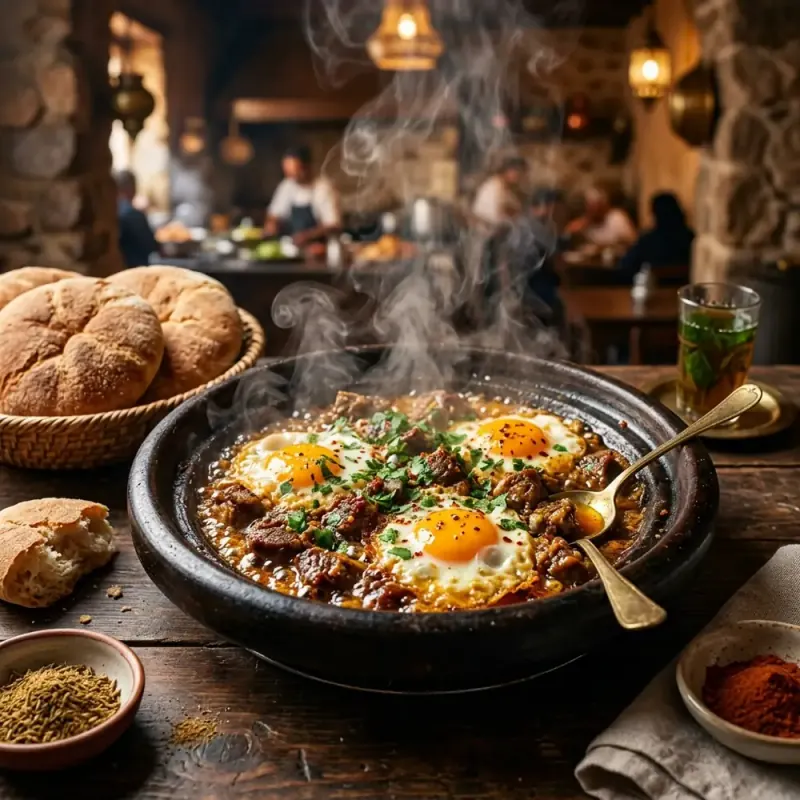
The ultimate Moroccan breakfast. In a small unglazed clay tagine, melt two tablespoons of Khlea with its surrounding white fat over medium heat. As the meat sizzles and releases its rich garlic perfume, crack two or three fresh eggs directly over the meat. Cover for two minutes until the whites set while the yolks remain runny. Dust with ground cumin and dip with warm crusty bread.
2. Harira and Winter Soups
A small handful of shredded Khlea stirred into the classic Ramadan tomato soup (Harira) during its final ten minutes of simmering imparts an unmistakable rustic depth that enriches the entire pot.
3. Savory Pastries and Msemen
Folded alongside sautéed onions inside laminated square flatbreads (Msemen), Khlea melts during griddle frying, creating a crisp, savory street pastry popular across medina market alleys.
Frequently Asked Questions
How long does homemade Moroccan Khlea keep without refrigeration?
When properly cooked until all water has evaporated and completely submerged under its protective layer of rendered fat, Khlea keeps safely in a cool, dark pantry at room temperature for twelve to eighteen months. Always use a clean, dry metal fork to remove meat; introducing moisture or contaminated utensils into the jar can cause mold.
Can I make Khlea using only olive oil instead of animal suet?
Yes, this variation is called Khlea bil-Zit. While traditional Khlea relies on beef suet to form a solid white seal, modern urban Moroccan families frequently make Khlea preserved entirely in pure extra virgin olive oil. Olive oil provides a fruity, lighter flavor, though it should be stored in the refrigerator or a cool cellar once opened.
What kind of meat is best for making authentic Khlea?
Lean, high-protein cuts with minimal connective tissue make the finest Khlea. Top sirloin, eye of round, or flank from young beef or mature lamb are ideal. Camel meat (Lahm Ibil) is also widely prized in southern desert regions for its rich, lean flavor.
Is Khlea salty?
Yes, traditional Khlea has a pronounced savory and salty profile because salt was the primary antimicrobial agent used during the sun-drying stage. Modern cooks often soak the dried strips in warm water for fifteen minutes before the final confit simmer to moderate the saltiness for contemporary palates.
Experience the true heart of Moroccan heritage through its culinary traditions. Join us in preserving and honoring these ancestral recipes.
What People Are Saying
No comments yet. Be the first — we'd love to hear from you.
Chef Rachid
Culturally Verified & Fact-CheckedChef Rachid is a Moroccan culinary specialist with decades of kitchen experience across coastal Morocco, specializing in Atlantic seafood, tagines, and traditional charcoal braising.