King Mohammed VI's Morocco: 25+ Years of Reforms, Infrastructure Boom, and Vision for 2030
King Mohammed VI’s Morocco: 25+ Years of Reforms, Infrastructure Boom, and Vision for 2030
There’s a photograph taken at Casablanca’s Mohammed V International Airport in 1999, shortly after Mohammed VI ascended the throne following the death of his father Hassan II. The young king — twenty-six years old — is surrounded by officials and dignitaries who are attempting to read him, to understand what kind of monarch he will be. His expression is composed but unreadable. The country he has just inherited is a deeply conservative state with one of the world’s highest illiteracy rates, a ruling establishment built on patronage and fear, and a civil society that had spent decades under what Moroccans called simply ‘the years of lead.’
Twenty-five years later, the transformation of Morocco under Mohammed VI’s reign is one of the most striking developments in contemporary African and Arab politics. Not uncomplicated, not without contradiction, and certainly not finished. But extraordinary in its scope.
The Early Reforms: Establishing the Tone
Mohammed VI moved quickly in the first years of his reign to signal that something had changed. The most visible early signal was the rehabilitation and release of political prisoners from the Hassan II era — most notably Abraham Serfaty, a prominent left-wing opposition figure who had spent seventeen years in prison, and Driss Benzekri, former political prisoner who would later become chair of the Equity and Reconciliation Commission.
The Equity and Reconciliation Commission (Instance Équité et Réconciliation, IER), established in 2004, was itself an extraordinary institutional gesture. For three years, it held public hearings in which victims of human rights abuses under Hassan II’s government could testify publicly — the first such process in the Arab world. The testimonies documented arbitrary detention, torture, forced disappearances, and killings carried out by the state security apparatus between the 1960s and the 1990s.
The commission’s work was incomplete — it could not identify individual perpetrators, and many human rights organizations argued that its reparations were insufficient. But its existence represented a formal acknowledgment by the state that the ‘years of lead’ had happened, which was itself historically significant.
The Mudawwana Reform: Women’s Rights and Family Law
In 2004, Mohammed VI personally championed a comprehensive reform of Morocco’s family code (the Mudawwana) — one of the most significant legislative changes in the country’s modern history.
The 2004 reforms raised the minimum age for marriage from fifteen to eighteen for women (aligning it with the male minimum), required both parties’ consent for marriage (removing the legal requirement for a male guardian’s approval), gave women the right to initiate divorce on equal terms with men, restricted polygamy dramatically (making it subject to judicial approval and requiring the existing wife’s consent), and granted mothers equal standing with fathers in matters of child custody.
I’ve always been fascinated by the political courage this required, given the opposition from conservative religious establishment figures who argued the reforms violated Islamic jurisprudence. Mohammed VI’s response — framing the reforms as consistent with the spirit of Islamic values while updating their application to contemporary realities — was a model of the kind of religiously sophisticated progressive argument that the region badly needed.
Infrastructure: The Physical Transformation of Morocco
If the early years of Mohammed VI’s reign were defined by social and political reform, the middle and later phases have been marked by a massive physical transformation of the country.
The figures are genuinely staggering. When Mohammed VI came to power, Morocco had approximately 700 kilometers of highway. Today it has over 1,800 kilometers, connecting every major city and region. The Al Boraq high-speed rail line between Casablanca and Tangier — Africa’s first high-speed railway — opened in 2018, cutting adventure time between the two cities from over four hours to two hours ten minutes.
The port of Tanger Med, opened in 2007 and massively expanded since, has become Africa’s largest port by container volume, processing over 9 million containers annually and transforming Morocco’s position in global supply chains. The port complex includes the largest automobile manufacturing hub in Africa — anchored by the Renault factory in Tangier, now joined by Stellantis (Peugeot-Citroën) — and is the primary export point for over 700,000 vehicles produced in Morocco annually.
Solar energy has been perhaps the most dramatic symbol of Morocco’s infrastructural ambition. The Noor Ouarzazate complex — the largest concentrated solar power plant in the world, built in the desert near the Atlas Mountains — is capable of generating power for 1 million homes and storing energy for up to three hours after sunset. Morocco has set a target of generating 52% of its electricity from renewable sources by 2030.
The 2011 Arab Spring and Constitutional Reform
The wave of popular protest that swept the Arab world in 2011 reached Morocco in the form of the February 20 Movement — a coalition of young activists, leftists, Islamists, and civil society organizations who took to the streets across the country demanding political reform. The movement remained largely peaceful and did not call for the overthrow of the monarchy, distinguishing it from the revolutions in Tunisia, Egypt, and Libya.
Mohammed VI responded with a constitutional reform process that moved remarkably quickly by regional standards. The 2011 constitution — approved by referendum with 98% support (though turnout was contested) — introduced several significant changes: the Prime Minister became a president of the government chosen from the leading party in parliamentary elections (rather than appointed by the king), civil liberties were expanded and explicitly guaranteed, and Tamazight (the Amazigh language) was recognized for the first time as an official language alongside Arabic.
Critics argued — reasonably — that the reforms preserved the fundamental structure of royal authority while offering the appearance of constitutional monarchy. The king retained control of the military, foreign policy, and religious affairs. The argument about how much the 2011 reforms actually changed the balance of power in Morocco continues.
The Social Compact: Housing, Education, Healthcare
In 2005, Mohammed VI launched the National Human Development Initiative (INDH), a broad social program targeting poverty and inequality across Morocco’s rural and urban peripheries. By 2019, the program had invested over 43 billion dirhams and reached approximately 12 million beneficiaries through housing improvements, basic infrastructure provision, economic support for small enterprises, and support for women’s and youth organizations.
The results are measurable. Morocco’s poverty rate fell from approximately 15% in 2000 to around 4% in 2024. The national illiteracy rate fell from 57% in 1994 to around 24% today — still high by international standards but a dramatic improvement. Health indicators across the board have improved significantly.
In 2022, Mohammed VI announced a sweeping reform of the social protection system, aiming to bring universal health coverage to all Moroccans by 2025 — an ambitious target that is behind schedule but represents a genuine policy commitment.
Vision 2030 and the World Cup
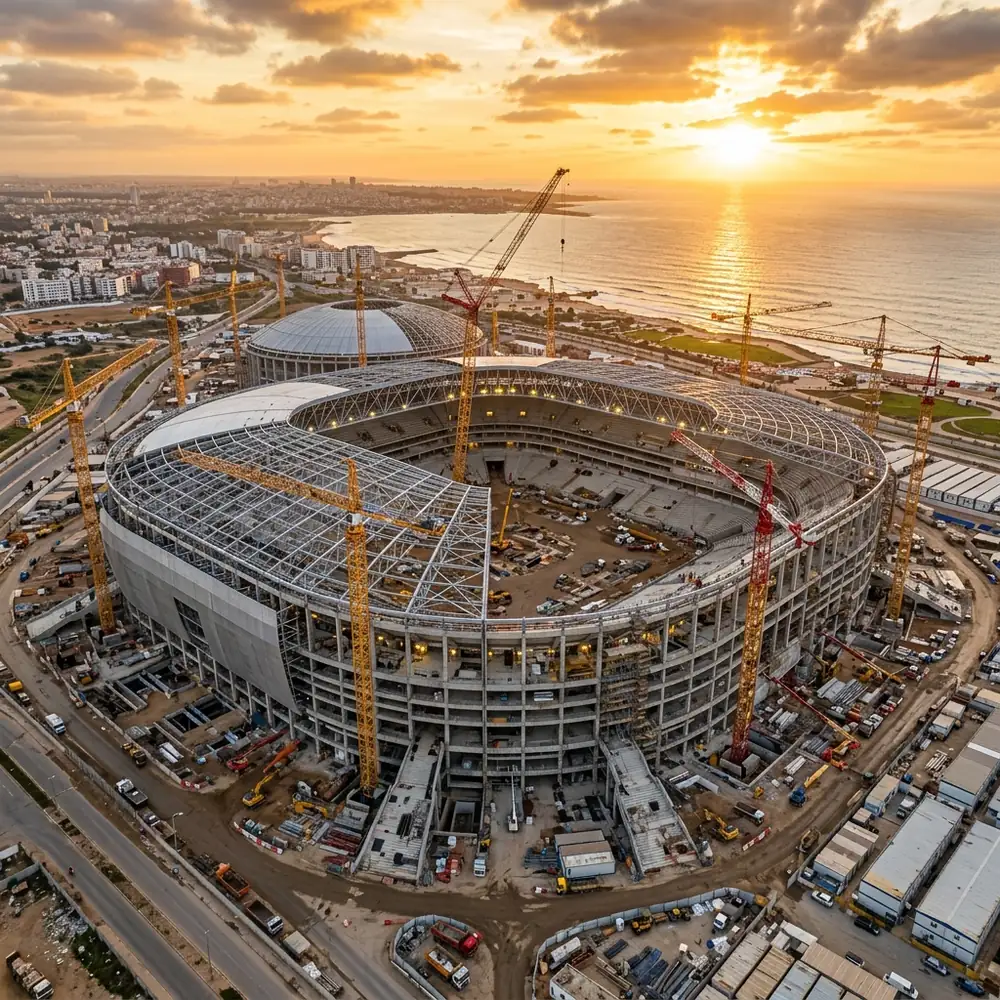
Morocco’s successful bid to co-host the 2030 FIFA World Cup (with Spain and Portugal, with additional matches in Argentina, Uruguay, and Paraguay for the centenary celebration) is perhaps the most visible symbol of the country’s contemporary ambitions.
The preparations are huge: six new or renovated stadiums, a new high-speed rail connection between Casablanca and Marrakech, expanded airport capacity across the country, and a hospitality infrastructure development that has triggered the largest construction boom in Morocco’s history.
Beyond the World Cup, Vision 2030 encompasses Morocco’s green energy targets, the ambition to become a major exporter of green hydrogen to Europe, the development of the Dakhla Atlantic port as a major West African hub, and the continuation of the automotive and aerospace manufacturing expansions that have transformed the Tangier-Kenitra industrial corridor.
The Honest Assessment
Morocco under Mohammed VI has made remarkable progress by almost any quantitative measure: infrastructure, poverty reduction, literacy, women’s legal status, renewable energy, global economic integration. The country’s 2022 World Cup semifinal run — the first African and Arab nation to reach the final four — crystallized a sense of national confidence and international recognition that would have seemed improbable in 1999.
The limitations are also real. Press freedom rankings place Morocco in difficult territory. Political opposition operates under constraints that would not be acceptable in a genuine democracy. The Western Sahara issue remains unresolved and continues to affect Morocco’s international relationships and its internal politics. Economic inequality within Morocco — between Casablanca and the rural peripheries, between the formally employed and the vast informal economy — remains a deep challenge.
What still surprises me even today is how complex the national feeling about this is. Most Moroccans I know are simultaneously proud of what their country has become and frustrated by its ongoing limitations. That combination — pride and impatience — is probably the most honest description of where Morocco stands in 2026.
Experience the true heart of Moroccan heritage through its culinary traditions. Join us in preserving and honoring these ancestral recipes.
What People Are Saying
No comments yet. Be the first — we'd love to hear from you.
Omar Kettani
Culturally Verified & Fact-CheckedThe Moroccan Food editorial team brings together native culinary researchers, heritage preservationists, and experienced home cooks across Marrakech, Fes, and Casablanca. Every recipe and cultural guide is reviewed against ancestral oral traditions and authentic regional practices.