Lkbal: The Charcoal-Roasted Sweet Corn of Moroccan Summers
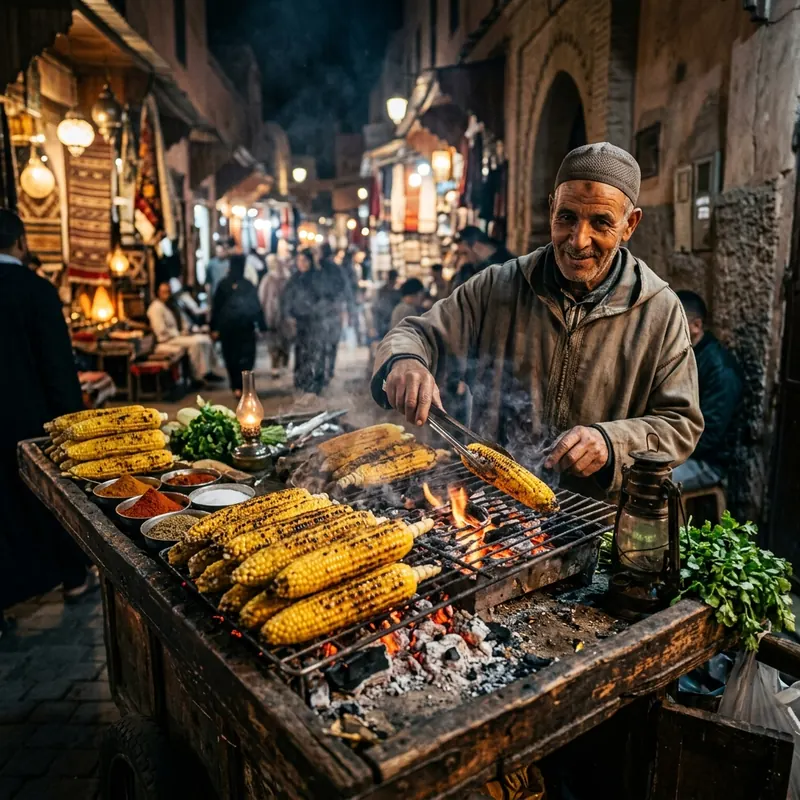
When July heat bakes the interior plains of Morocco, families head toward the ocean. As dusk falls along Atlantic promenades in Casablanca, Rabat, Tangier, and Asilah, a cool sea breeze rolls off the water. Mingled with salt spray comes a sharp perfume that every Moroccan recognizes in an instant: the scent of sweet corn roasting directly over glowing charcoal.
Look toward sidewalk edges, traffic roundabouts, or beachfront boardwalks, and you will see orange sparks drifting into the evening sky. Behind each brazier stands the vendor—moul lkbal—waving a woven palm-frond fan (habbasha) to feed oxygen to the coals. In Moroccan Arabic, corn on the cob is known simply as Lkbal. For decades, this humble roasted cob has marked the rhythm of Moroccan summer evenings, providing a link between rural harvests and seaside strolls.
       +-------------------------------------------------------------+
       |                  THE ANATOMY OF SUMMER LKBAL                |
       +-------------------------------------------------------------+
       | [ The Fuel ]     Fragrant olive or holm-oak lump charcoal   |
       | [ The Cob ]      Field corn (dra beldia) with dense kernels |
       | [ The Heat ]     Direct glowing embers on iron brazier      |
       | [ The Glaze ]    Saturated Atlantic sea-salt brine (melha)  |
       | [ The Wrapper ]  Fresh green corn leaves protecting fingers |
       +-------------------------------------------------------------+
How Maize Rooted in Moroccan Soil
While some Mediterranean cultures were slow to adopt the American grain, Moroccan farmers recognized its value almost immediately.
In the fertile alluvial river basins of the Gharb, the Sebou valley, and the plains of Tadla, maize found ideal growing conditions. Local farmers named it dra, distinguishing it from traditional durum wheat and barley. While durum wheat remained the sacred grain for daily bread and couscous, corn established itself as a prized summer crop. It matured quickly during the hottest months, providing sweet cobs for seasonal eating and sturdy stalks for cattle feed.
Over centuries of planting, Moroccan farmers developed heritage varieties (dra beldia). Unlike modern hybrid sweet corn varieties engineered for high sugar content and thin skins, traditional Moroccan field corn offers a firmer, starchier kernel with an earthy, nutty sweetness. When roasted over fire, these kernels do not collapse into mush; they blister, caramelize, and offer a satisfying, toothsome chew.
The Two Rituals: Mechwi vs Maslouq
Walk up to any seasonal vendor’s wooden cart, and you will notice a choice that divides Moroccan families into two camps: mechwi (charcoal roasted) versus maslouq (pot boiled).
1. Lkbal Mechwi: The Charcoal Kiss
This is the purist’s favorite. The vendor strips away outer green leaves, leaving a small handle at the base. He lays the pale yellow cob directly across iron rebar grates placed over glowing charcoal.
The process requires constant attention. The vendor rotates the cob every few seconds, fanning embers with his hand fan. Kernels pop quietly as moisture turns to steam inside their hulls. Where fire touches the grain, kernels turn amber, then blister into black spots. This charring converts natural starches into caramelized sugars, giving the cob a deep, smoky sweetness.
2. Lkbal Maslouq: The Gentle Simmer
At the other side of the cart sits a deep, steaming drum filled with boiling water. Inside, whole unpeeled cobs simmer for hours.
Vendors season the water with handfuls of coarse salt and lemon peel. Boiling water hydrates kernels until they swell and turn tender. When you order a boiled cob, the vendor pulls it steaming from the water with metal tongs, strips back the limp green husks, and dusts it with sea salt. It is softer and juicier than roasted corn, making it a beloved choice for younger children.
The Brine Brush: El-Ma w El-Melha
You never eat Lkbal dry off the grill, and you almost never find butter on a street corn cart. Instead, the magic ingredient is el-ma w el-melha—a saturated brine made of warm water and coarse Atlantic sea salt.
Next to the glowing brazier sits a small tin can filled with cloudy saltwater. Resting inside that container is a handmade brush crafted from dried corn husks tied tightly around a wooden stick.
The moment the corn finishes roasting, while kernels are sizzling hot, the vendor dips the husk brush into the brine and strokes the cob vigorously on all sides.
The thermal shock is immediate. The hot corn hisses violently, releasing a cloud of salty steam. As water evaporates against blistering kernels, it leaves behind a fine frost of salt crystals wedged between every single kernel. This salt cuts through charred bitterness and highlights the sweet starch of the corn.
Evening Seaside Promenades
In Moroccan culture, eating Lkbal is fundamentally a collective outdoor activity. You eat it while walking side-by-side with friends and family during the evening stroll.
In Casablanca, vendors line the rocky perimeter of Ain Diab. In Rabat, they congregate near the kasbah of the Udayas and along the Bouregreg river banks. In Tangier, smoke drifts along the corniche while the lights of Tarifa twinkle across the Strait of Gibraltar.
You hold the cob wrapped in its own peeled-back green husks to keep your fingers from scorching. You take your first bite, feeling heat radiate against your lips. The kernels are chewy, toasted, and salty, with pops of sweet starch. You inevitably burn your tongue, your thumbs get smudged with charcoal soot, and you spend minutes picking stubborn corn hulls from your teeth. That gentle struggle is an inseparable part of summer memories.
The Rural Lifeline of the Corn Vendor
Most mouline lkbal are smallholder farmers from agricultural regions like Sidi Kacem, Kenitra, or Beni Mellal.
When summer harvest arrives, these men travel to coastal cities, renting shared rooms and assembling their wheeled braziers. A single cart requires modest capital: a sack of lump charcoal, a repurposed steel drum, a few crates of fresh-picked cobs, salt, and matches.
For five to seven dirhams per cob, the vendor earns an honest livelihood that sustains his family until the autumn plowing season begins. Buying a cob from a street vendor is an unspoken transaction of mutual support that connects city dwellers with the rural soil that feeds them.
       +-------------------------------------------------------------+
       |               RECREATING STREET-STYLE LKBAL AT HOME         |
       +-------------------------------------------------------------+
       | * 4 ears fresh sweet corn, in husks                         |
       | * 150 ml warm water                                         |
       | * 2 tablespoons coarse sea salt (Atlantic or grey salt)     |
       | * Lump charcoal or heavy stovetop cast-iron griddle         |
       +-------------------------------------------------------------+
Cooking Instructions:
- Peel back outer green husks, leaving them attached at the stem as a handle. Remove silk threads.
- Dissolve coarse sea salt in warm water until fully saturated.
- Heat a charcoal grill or heavy cast-iron skillet over high flame.
- Place corn directly over heat, turning every 90 seconds until kernels blister and char in patches (10 to 12 minutes).
- Brush sizzling corn liberally with the saltwater brine. Listen for the hiss.
- Serve immediately while hot steam escapes from the kernels.
Grandmother’s Rules for Corn Cobs
- Pick Young Ears: Old field corn turns tough as gravel. Look for ears with moist silks and firm kernels that release milky liquid when pressed.
- Never Soak Before Roasting: Soaking cobs steams them instead of roasting. Dry heat is required to blister skins and create caramelization.
- Saturate the Saltwater: The brine must be heavily salted so water evaporates instantly, leaving visible salt crystals behind.
Frequently Asked Questions
Why do Moroccan vendors use a corn husk to brush saltwater onto roasted corn?
Using a dried corn husk is both practical and traditional. The tough fibers of the husk withstand extreme heat without melting or scorching against glowing corn kernels, unlike synthetic brushes. Additionally, the grooved texture holds the perfect amount of saltwater, allowing the vendor to coat the cob evenly in a single stroke without cooling down the fire.
What variety of corn is traditionally used for Moroccan Lkbal?
Traditional Moroccan Lkbal relies on heritage yellow field corn (dra beldia) grown in the Gharb and Tadla plains. Unlike Western hybrid sweet corn, which has high sugar and thin skins, Moroccan field corn has a firmer, starchier kernel with moderate sweetness. This dense starch holds up to the intense direct heat of lump charcoal without collapsing into mush, yielding a distinct, nutty chew.
Is roasted (mechwi) or boiled (maslouq) corn more popular across Morocco?
Both preparations enjoy widespread popularity, but they serve different preferences. Roasted corn (mechwi) is the undisputed icon of seaside promenades and evening walks, favored by adults who love smoky caramelization and crunchy texture. Boiled corn (maslouq) is especially popular in city centers, train stations, and among families with young children who prefer a softer, juicier bite.
Experience the true heart of Moroccan heritage through its culinary traditions. Join us in preserving and honoring these ancestral recipes.
What People Are Saying
No comments yet. Be the first — we'd love to hear from you.
The Moroccan Food
Culturally Verified & Fact-CheckedThe Moroccan Food editorial team brings together native culinary researchers, heritage preservationists, and experienced home cooks across Marrakech, Fes, and Casablanca. Every recipe and cultural guide is reviewed against ancestral oral traditions and authentic regional practices.