The Agdal Gardens of Marrakech: The 12th-Century Royal Estate That Is Not a Tourist Garden
The Agdal: What the Royal Garden Is Before It Is a Tourist Destination
The Agdal Gardens in Marrakech suffer from a specific problem of expectation: visitors who know the Menara Gardens — the smaller, more accessible, more photographed Almohad garden with its iconic pavilion reflected in the reservoir — arrive at the Agdal expecting a comparable experience and find instead something completely different in character and, I would argue, considerably more interesting in what it actually is.
The Menara is a designed landscape of formal proportions, its single large pavilion and its perfectly rectangular reflecting pool organized for visual effect. It is beautiful in a specific way — the pavilion’s green-tiled roof reflected in the dark water, the Atlas visible behind it in the right conditions — and it is deservedly famous.
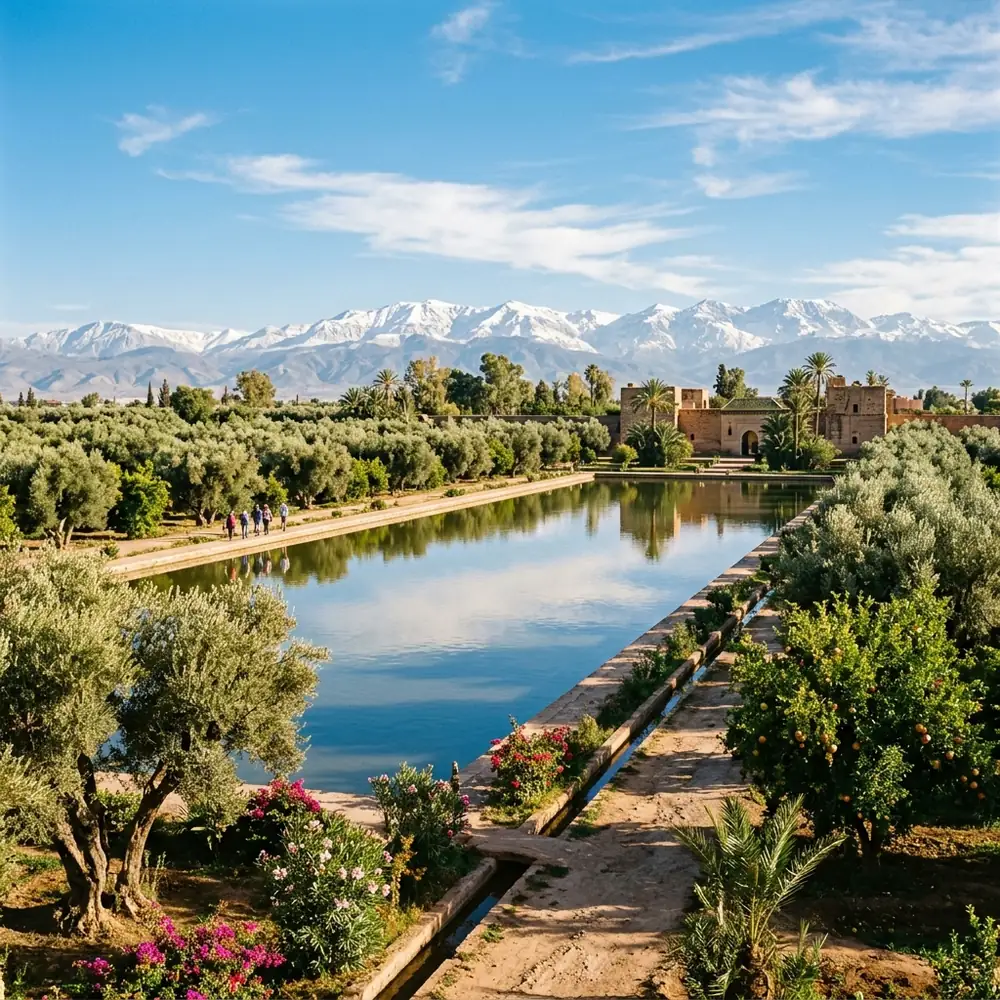
The Agdal is 400 hectares of working agricultural estate. Not designed landscape, not formal garden, not pleasure ground in the European sense — an estate that has been producing olives, citrus, pomegranates, and other crops since the Almohad period of the 12th century and that continues to produce them now, its irrigation maintained by the same hydraulic infrastructure that the Almohads established eight centuries ago.
What Is the Agdal’s History and Who Built It?
The Agdal was established in its original form by Abd al-Mumin, the first Almohad caliph, in the second half of the 12th century — approximately the same period that the Almohads were building the Koutoubia mosque, the Kasbah mosque, and the defensive walls of Marrakech. The name agdal is Amazigh — meaning “walled meadow” or “enclosed pasture” — and reflects the estate’s primary function as an agricultural enclosure rather than an ornamental garden.
The hydraulic infrastructure that sustains the Agdal — the system of canals (seguia) that bring water from the Ourika valley through underground channels (khettara) to the two large reservoirs within the estate — was constructed in the Almohad period and extended and maintained by subsequent dynasties, particularly the Saadians and the Alaouites. The two reservoirs — the Sahraj el-Hana and the smaller Dar el-Hana tank — serve both as water storage for the estate’s irrigation and as fish ponds, and are large enough that they have historically served as boating venues for the royal family.
Subsequent Moroccan dynasties — the Merinids less so, the Saadians and Alaouites more extensively — used the Agdal as a royal retreat, adding pavilions and reception buildings at various points in its history. The current pavilion near the main entrance dates from the 19th century Alaouite period. These additions are relatively modest compared to the estate’s agricultural scale, and the Agdal reads primarily as an agricultural landscape punctuated by occasional architectural elements rather than as a formal garden with agricultural elements.
What Does the Agdal Look Like Inside and What Can You See?
Entering the Agdal — through the main gate on the days it is open to visitors, currently on Fridays and Sundays — reveals a landscape that requires a moment to register correctly, because the scale is so different from the more compact gardens that most visitors have encountered in Morocco.
The olive groves are centuries old in parts — individual trees with the gnarled, multi-trunked forms that signal great age, the bark silver-grey, the canopy providing deep shade. These trees were planted by nameless Almohad agricultural workers in the 12th century and have been maintained, pruned, and harvested by the royal estate’s agricultural staff for every generation since. Eating an olive from one of these trees — and the olives are real, the trees productive, the harvest real — is an act of connection with a continuity of agricultural practice that is genuinely extraordinary when you hold both ends of the chain in mind.
The citrus — orange, lemon, citron — was introduced in the Saadian period and now occupies a significant portion of the estate. The reservoir, when you reach it after walking through the groves, is large enough that the far bank is not clearly detailed at this distance, and the flatness of the water in the windless morning is complete enough that the sky’s reflection is the primary visual experience of the surface.
Why Is the Agdal UNESCO World Heritage and What Does That Mean for Access?
The Agdal is listed as part of the UNESCO World Heritage designation of Marrakech’s historic city (1985), alongside the medina, the Menara Gardens, and other historic elements. The UNESCO designation does not change the access conditions — it is a royal estate and its public opening schedule is determined by the palace administration rather than by any public heritage body.
The opening schedule — currently Fridays and Sundays to the best of current information, though this should be verified before visiting as it has changed historically — means that the Agdal requires planning to visit, unlike the medina which is continuously accessible. The occasional closure for royal use adds an additional unpredictability. For visitors who can accommodate these conditions, the Agdal on an open day is one of the most genuinely peaceful and genuinely ancient landscapes accessible to the public in Marrakech.
The Invisible Invitation
It is a Friday morning and the Agdal is open. Go immediately when the gates open — by mid-morning the visitor numbers reduce the solitude, though they never approach the crowds of the Djemaa el-Fna or the major museums. Walk directly into the olive grove and find one of the oldest trees — identifiable by the width of its trunk, the complexity of its form, the density of its canopy. Stand under it. The tree was planted approximately eight hundred years ago. The person who planted it had a specific task that day: to put this tree in this position in an agricultural plan that was being executed across 400 hectares. They completed their task. The tree grew. You are standing in its shade. Eight centuries is a very long time and also, in this shade, not an incomprehensible one. The olive is still producing. The water still runs in the seguia below. The estate is still a working farm. This is the Agdal. This is what eight centuries of continuous agricultural practice looks like from underneath one of its trees.
SEO Meta Description: What are the Agdal Gardens of Marrakech? The Almohad agricultural estate, 12th-century hydraulic infrastructure, UNESCO status, visiting hours, and why the centuries-old olive groves are the main event.
Experience the true heart of Moroccan heritage through its culinary traditions. Join us in preserving and honoring these ancestral recipes.
What People Are Saying
No comments yet. Be the first — we'd love to hear from you.
Omar Idrissi
Culturally Verified & Fact-CheckedThe Moroccan Food editorial team brings together native culinary researchers, heritage preservationists, and experienced home cooks across Marrakech, Fes, and Casablanca. Every recipe and cultural guide is reviewed against ancestral oral traditions and authentic regional practices.