The Medina of Fes: Navigating the 9,000 Alleys of the World's Largest Car-Free Urban Area
Fes el-Bali: The Architecture of the Labyrinth
When you step through the massive blue tiles of Bab Boujloud into Fes el-Bali (the Old City of Fes), you cross a physical and chronological boundary. You are entering the largest intact medieval Islamic urban area in the world, and the largest contiguous car-free urban zone on the planet.
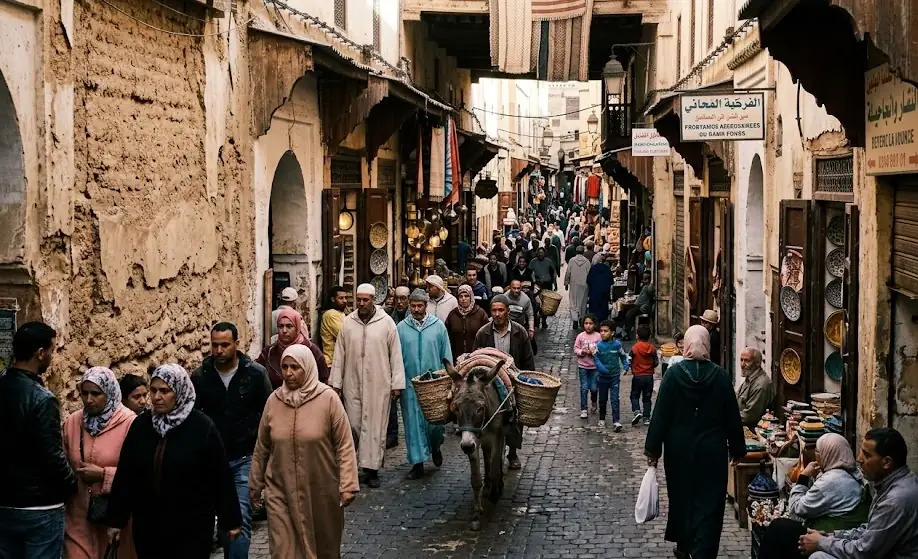
The immediate sensory experience is overwhelming. The medina is a dense, seemingly chaotic network of approximately 9,000 alleys, many of them blind, twisting back on themselves, or narrowing to the width of a single person’s shoulders. Above you, the overhanging wooden balconies and cedar beams block out the sky, plunging the streets into a cool, shadowed twilight even at midday. The air smells sharply of cedar dust, mint, raw leather from the tanneries, and cumin. The only warning you receive of an approaching hazard is the sharp shout of “Balak! Balak!” (Watch out!), signaling a heavily laden donkey plunging down the cobblestones toward you.
For the visitor, the medina is a labyrinth designed to confuse. But for the Fassi (the residents of Fes), it is a highly structured, perfectly logical urban organism.
The Five Pillars of the Neighborhood
To navigate Fes without a guide, you must stop looking at the map (which is useless) and start looking at the urban anatomy. The medina is not a single chaotic mass; it is a collection of distinct, self-sustaining neighborhoods (houmas).
Every traditional houma in Fes is anchored by five essential communal structures. If you find one, you will invariably find the others nearby, forming the social nucleus of the neighborhood. Look for:
- The Mosque (Jamaa): The spiritual center. You will hear the call to prayer, but you will also see the physical structure — often indicated by a green-tiled roof or the intricately carved wooden awnings over the entrance.
- The Public Fountain (Seqqaya): The source of water, usually decorated with stunning zellige tilework, located near the mosque for ablutions and public use.
- The Communal Oven (Ferran): Follow the smell of baking bread or the sight of children carrying wooden planks loaded with dough. Families prepare their bread at home and bring it here to be baked in the massive wood-fired oven.
- The Bathhouse (Hammam): The center of physical purification and social gossip. You can often spot the hammam by looking for the men feeding sawdust and olive pits into the massive underground furnaces that heat the water.
- The School (Msid/Madrasa): The center of early Qur’anic education for the children of the neighborhood.
When you identify these five elements, you know you are in the heart of a residential sector.
The River and the Slope
Fes el-Bali is built in a basin shaped like a bowl, bisected by the Oued Fes (the Fes River). The topography is your compass. If you are walking downhill, you are walking toward the center of the medina, toward the river, the ancient Karaouine University, and the heavily polluting industries (like the Chouara Tannery, situated by the water for washing skins).
If you want to leave the medina, simply walk uphill. It doesn’t matter which alley you take; as long as the incline is upward, you will eventually hit the exterior defensive walls and find one of the massive gates (babs).
The Logic of the Blind Alley
The narrow, twisting alleys (derbs) that dead-end abruptly are not mistakes of urban planning. They are deliberate defensive and social architecture.
In Islamic urban design, privacy is paramount. The exterior walls of the houses facing the street are blank, windowless, and anonymous, revealing nothing of the wealth or poverty inside. The blind alleys deter strangers from wandering into residential areas. They force movement onto the main commercial arteries (talaas), keeping the domestic spaces quiet, secure, and private. The beauty of Fes is turned entirely inward, facing the central courtyards of the riads.
The Invisible Invitation
Get lost. It is the only way to truly experience Fes. Put your phone away — the GPS signal will bounce off the high walls and fail you anyway. Walk down the Talaa Kebira (the Great Slope), the main commercial artery. Listen to the rhythmic tap of the coppersmiths near Place Seffarine shaping massive cauldrons. Look up at the intricately carved cedar corbels supporting the roofs above you. When the crush of the market becomes too intense, turn left into a narrow residential alley. Instantly, the noise vanishes. The air cools. The walls press in close. You will find a small fountain covered in faded blue tiles, and the smell of woodsmoke from the hidden bread oven will drift through the stone archway. You have found the true anatomy of the city.
SEO Meta Description: A guide to navigating the Medina of Fes (Fes el-Bali). Understand the medieval urban layout, the 9000 car-free alleys, and the five essential structures that anchor every traditional Moroccan neighborhood.
Experience the true heart of Moroccan heritage through its culinary traditions. Join us in preserving and honoring these ancestral recipes.
What People Are Saying
No comments yet. Be the first — we'd love to hear from you.
Omar Idrissi
Culturally Verified & Fact-CheckedThe Moroccan Food editorial team brings together native culinary researchers, heritage preservationists, and experienced home cooks across Marrakech, Fes, and Casablanca. Every recipe and cultural guide is reviewed against ancestral oral traditions and authentic regional practices.