Eating in the Sahara: The Real Desert Food Experience Near Merzouga
Eating in the Sahara: The Real Desert Food Experience Near Merzouga
You drive for hours through the pre-Saharan south — past Errachidia, past Erfoud, past the Tafilalet palm groves — and the landscape gets progressively more stripped of everything that does not belong. By the time the sand dunes of Erg Chebbi appear on the horizon, orange-pink in the late afternoon light, you have forgotten about restaurants and menus and Instagram and all the other noise. Good. That is exactly the right state of mind for what comes next.
Eating in the desert near Merzouga is not about a restaurant experience. It is about fire, time, patience, and an 800-year-old Berber cooking tradition that has never once needed a social media strategy to be worth talking about.
Medfouna: The Dish That Changes How You Think About Bread
No single food in Morocco surprised me more the first time I encountered it than medfouna. The name comes from the Arabic word for “buried,” and that tells you exactly how it is made.
Medfouna is sometimes called “Berber pizza” in guidebooks, which is a description so inadequate it borders on insult. It is, in fact, a stuffed flatbread — but the stuffing is where things get interesting. Ground lamb or camel meat, onion, preserved lemon, cumin, ras el hanout, sometimes fresh herbs, sometimes hard-boiled egg, sometimes almonds and raisins in a sweeter variation — all of this is sealed inside an envelope of unleavened dough, then pressed flat and placed directly in the embers of a fire, or buried in sand that has been heated for hours.
The dough cooks slowly from both sides. The filling steams inside. After 30 to 45 minutes, the cook pulls it out with a flat stick, beats the ash from the exterior, and brings it to the table whole. You tear it with your hands. The outside has a thin, slightly charred crust. The inside is soft and fragrant from the trapped steam of the spiced meat. It is one of the most honest, elemental, and flat-out delicious things you can eat in Morocco.
The key to finding a real medfouna and not a tourist version (same name, oven-baked, mediocre) is to ask specifically for it to be made fil-jamr — in the embers. This takes planning: you need to order it at least an hour and a half in advance, which also means you will not be eating it at a restaurant that turns tables every 45 minutes.
The Desert Camp Dinner Experience: How to Tell Real from Theater
Let me be direct about something. Most desert camps near Merzouga offer what they call a “Berber dinner experience” that consists of mediocre tagines reheated from a gas canister, a few musicians playing tourist-facing music, and an inflated price tag sold through a tour operator in Marrakech. This is not what you came for.
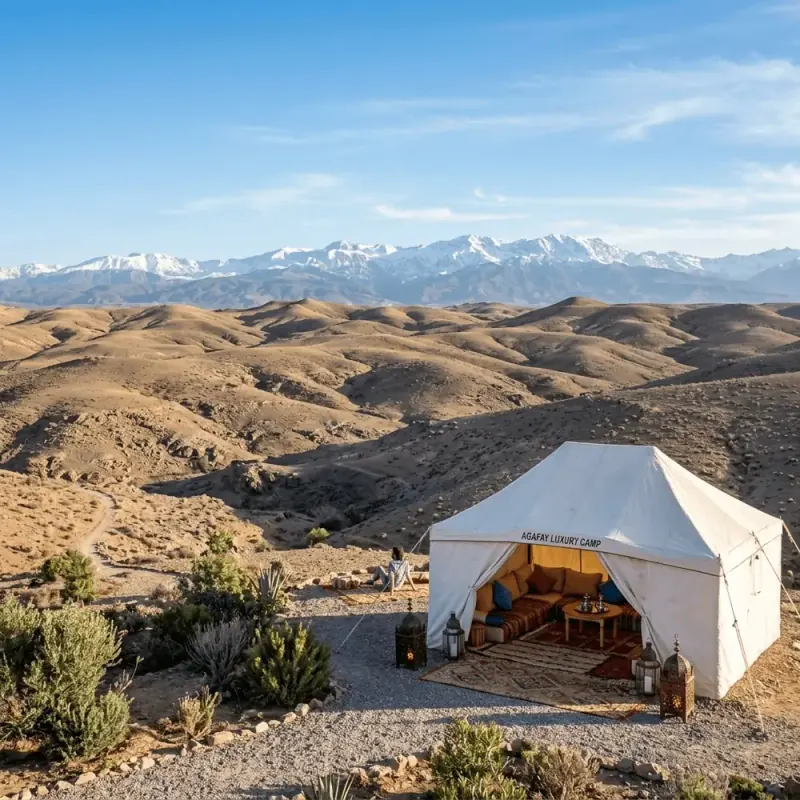
The real camp dinner experience requires a little more effort to find. Ask in Merzouga village itself — at the small cafés and guesthouses on the main street — for family-run camps rather than agency-booked ones. Look for operations run by actual Ait Khebbach or Ait Atta families from the area. Ask whether the food is cooked on-site over fire. Ask whether the camp has a fixed menu or whether they cook what is available. The answers will tell you everything.
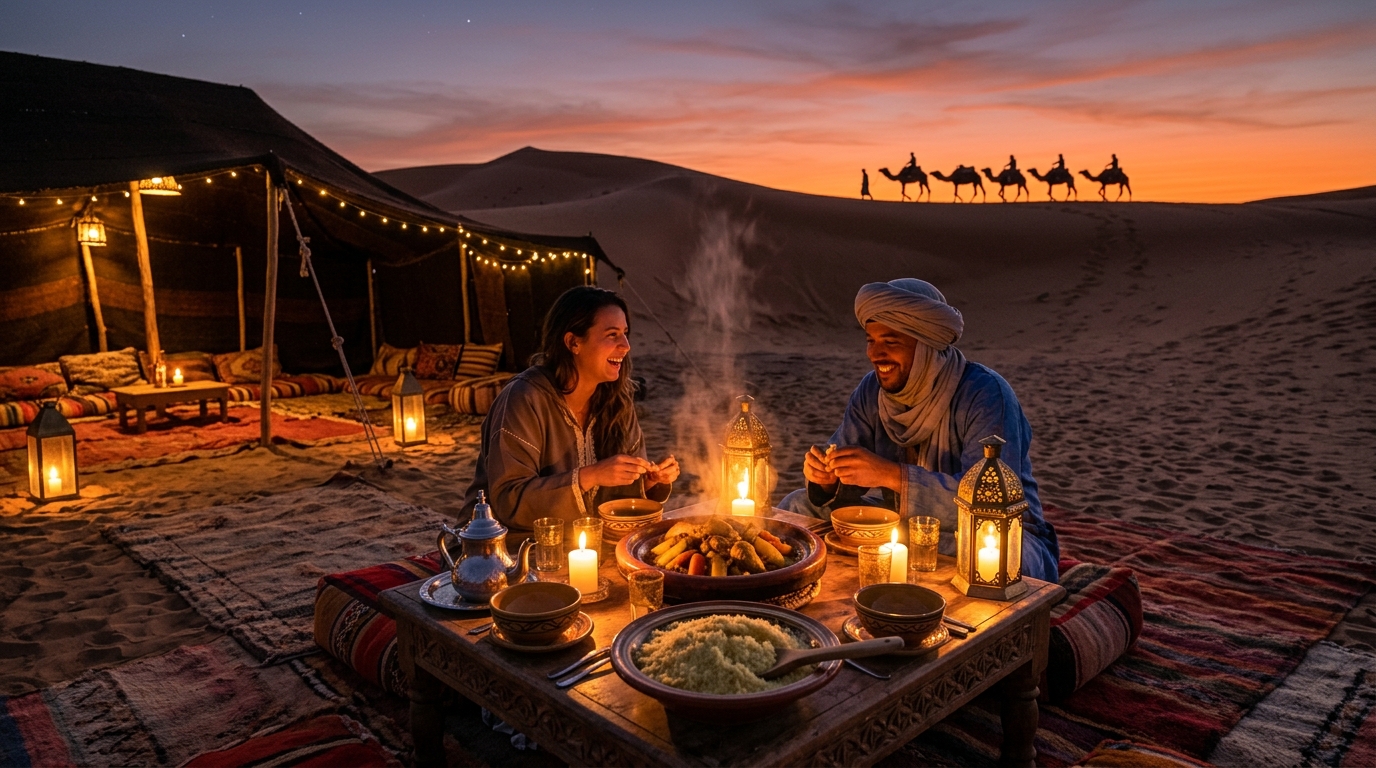
A genuine desert camp dinner starts before dark. While the kitchen fire is being built and the first pot of water is going on for tea, you sit with the host family. The tea arrives in the traditional three-glass sequence — the first glass bitter as life, the second sweet as love, the third gentle as death, as the Touareg proverb goes — and this is not performance. It is how they drink tea. It is how they have always drunk tea.
The dinner itself, when it comes, is typically built around one large communal dish: either a lamb tagine cooked in a clay pot over embers, or a barley couscous made with whatever vegetables the camp has — turnip, carrot, dried tomato, squash — finished with a ladle of reduced broth. Lamb from the desert south tastes different from what you get in the city. The animals eat desert herbs and scrub. The meat is leaner, more mineral, and better for it.
Tafilalet Dates: The Best in Morocco, Grown Next Door
Merzouga sits at the edge of the Tafilalet region, the largest oasis system in Morocco and one of the oldest agricultural zones in the Sahara. And the Tafilalet grows dates — specifically, the Medjool and Mejhoul varieties that Moroccan farmers have cultivated here for at least a thousand years.
If you have eaten dates from a supermarket and thought they were good, you have no idea. Fresh Tafilalet dates — not dried, not packaged, but pulled from a palm in October — have a honeyed, caramel sweetness with a slight creaminess that dried dates simply cannot replicate. The skin is thin and slightly wrinkled. The flesh is plump and dense.
Locals eat them for breakfast with amlou or just with a glass of fresh milk. They eat them with coffee at the end of a meal. They stuff them with almond paste and sell them at the Erfoud date festival each October, which draws buyers from all over the region. Buy your dates from a family in the palm grove if you can, or from the small sellers in Erfoud’s daily market. The ones sold at highway rest stops on the way in are fine, but the price is inflated for travelers.
Camel Milk Tea and Other Desert Drinks
Camel milk is available throughout the south, but it is particularly fresh and well-sourced near Merzouga where the pastoral families keep small herds. The milk is thinner than cow’s milk, slightly salty, with a faint grassy aftertaste. It is served warm, sometimes with a small amount of dried ginger, as a morning drink that also functions as a digestive aid. The Sahrawi families who have herded camels for generations treat it as a near-medicinal staple.
Camel milk tea — made by brewing dried mint or dried sage in warm camel milk rather than water — is something you will rarely find offered to tourists, but if you build any kind of relationship with a host family over a day or two, it may appear at breakfast. Accept it. It is sweet and unusual and genuinely warming in the cold desert mornings.
The three-glass mint tea ritual needs no explanation beyond what most Morocco guides will tell you, except this: in the desert south, the tea is often made with sheeba (wormwood) blended with mint rather than mint alone. It is more bitter, more medicinal, and more interesting.
Nomadic Preservation: Dried Meat and Fermented Butter
Two preservation techniques from the nomadic tradition survive in the Merzouga area that are worth knowing about.
Khli’i (also spelled khlii or gueddid) is dried, spiced meat — usually lamb or camel — cured with cumin, coriander, and salt, then air-dried in the sun for weeks. The result is intensely flavored, slightly chewy, shelf-stable without refrigeration, and historically essential for long desert journeys. Locals fry it with eggs for breakfast. It has a flavor that sits somewhere between beef jerky and a well-aged charcuterie, but with a Saharan spice profile that makes it completely its own. You can buy it vacuum-packed in Erfoud, but the loose, freshly made version from a village butcher is another thing entirely.
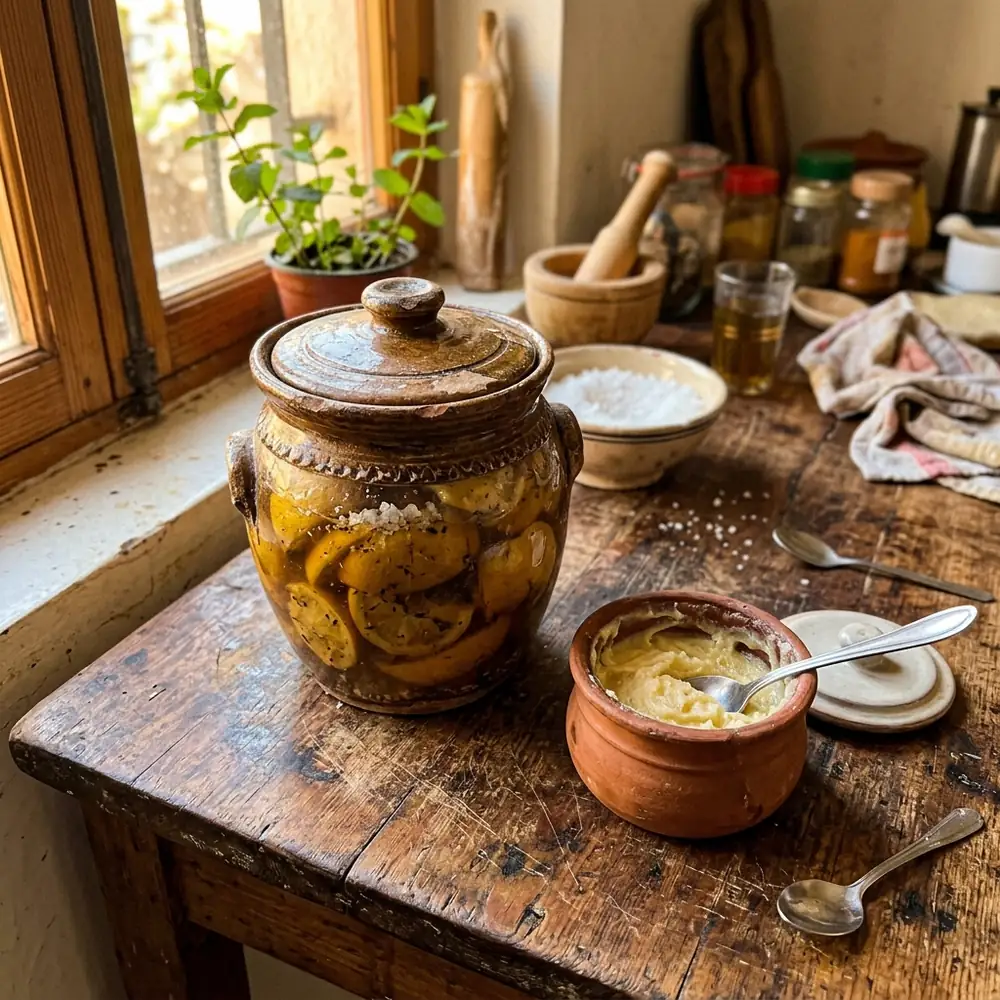
Smen is fermented butter, packed into containers — traditionally goat or camel leather pouches — and aged for months or even years. It develops a sharp, funky, pungent character that Westerners often compare to blue cheese. A small amount stirred into couscous broth transforms the dish. An older smen, aged for more than a year, is considered a delicacy and a symbol of domestic prosperity. It is an acquired taste, but once acquired, it is unforgettable.
Sunrise Breakfast with a Berber Family
Set your alarm for 5:30am. This is not negotiable. The dunes of Erg Chebbi at sunrise are a separate category of experience from the dunes at any other time of day, and eating breakfast as the light changes from gray to pink to gold while sitting on a carpet on top of a dune with a glass of hot tea in your hands is the kind of memory you will actually keep for life.
A simple Berber family breakfast in the desert is: khobz (round, dense flatbread) still warm from a clay oven, olive oil for dipping, amlou if you are lucky, fresh dates, hard-boiled eggs, a soft fresh cheese, and as much mint tea as you can drink. It costs almost nothing and is worth more than any tasting menu you have ever paid for.
FAQ
How do I find an authentic desert camp rather than a tourist one? Avoid booking through travel agencies in Marrakech or Fes; they take a commission and often prioritize price over quality. Instead, book directly with guesthouses in Merzouga village or ask locally when you arrive. Ask whether the camp is family-operated, whether cooking is done over fire, and whether you will eat with the host family. The price for a genuine camp is often lower than an agency-booked one.
When is the best time of year to eat in the Merzouga area? October through March gives you cooler temperatures that make outdoor eating and sitting around fires genuinely pleasant. The October date harvest is a bonus. Summer (June–August) is hot enough that outdoor dining after dark requires some acclimatization, though the nights do cool considerably.
Is medfouna available in restaurants outside Merzouga? Some Marrakech restaurants offer a version, and you will occasionally find it in Ouarzazate, but the authentic ember-cooked preparation is really a southern specialty. It is worth eating it here and nowhere else.
Is camel meat commonly eaten in the Merzouga area? Yes, more so than anywhere else in Morocco. Camel tagine, camel kefta, and camel kebabs appear in the small restaurants in Merzouga and Erfoud. The meat is lean and slightly gamey, with a flavor somewhere between lamb and beef. Worth trying at least once.
Experience the true heart of Moroccan heritage through its traditions. Join us in preserving these ancestral rituals.
What People Are Saying
No comments yet. Be the first — we'd love to hear from you.
The Moroccan Food
A Moroccan cultural writer dedicated to documenting the authentic voice, history, and heritage of the Kingdom. Writing from within — to share what truly makes Morocco extraordinary.
Our Mission →