The Middle Atlas: Forgotten Lakes, Cedar Forests, and Berber Villages Few Tourists Reach
The Middle Atlas: Forgotten Lakes, Cedar Forests, and Berber Villages Few Tourists Reach
When most travelers think of Morocco’s mountains, they think of the High Atlas — the dramatic, jagged peaks of Toubkal, the dry valleys, the stark alpine beauty. I understand why. But there is another mountain range in Morocco, one that fundamentally shatters the cliché of the country as a purely arid, desert landscape.
Welcome to the Middle Atlas (Moyen Atlas).
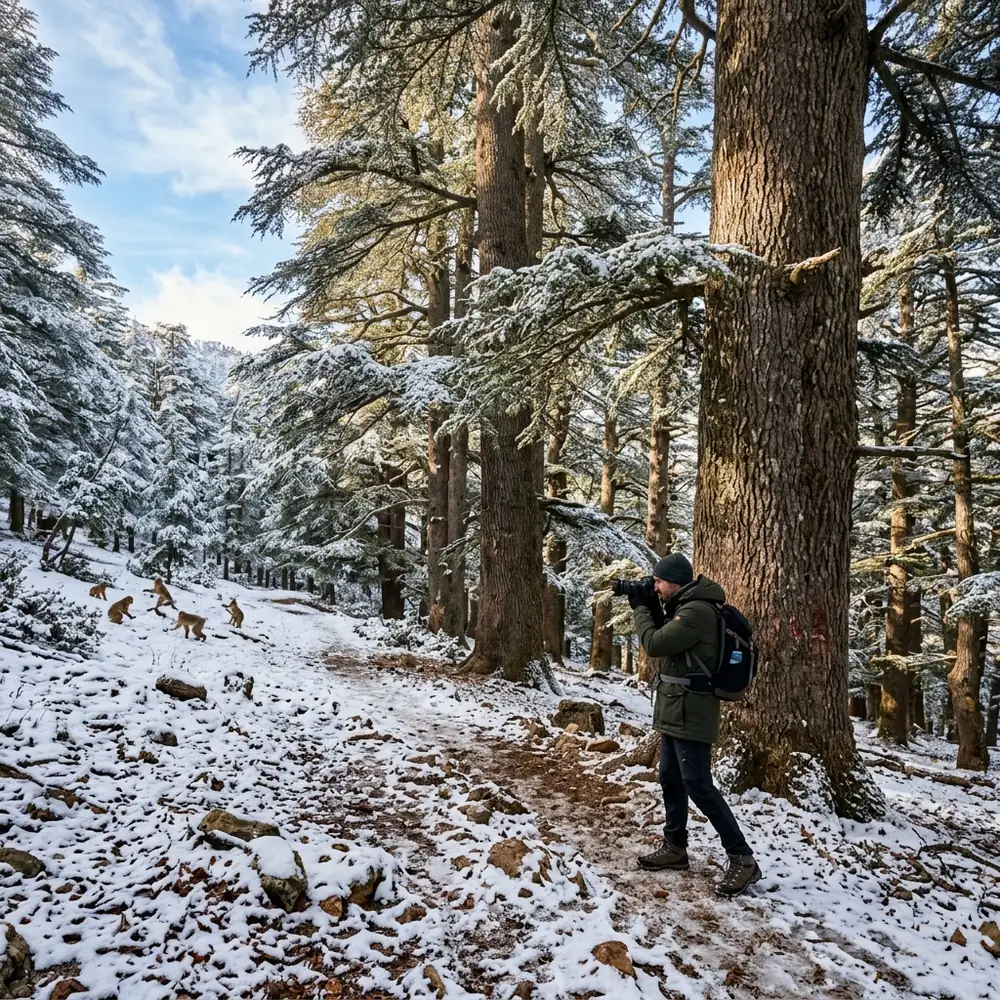
If I blindfolded you in Fes, drove you an hour south, and took the blindfold off in the heart of the Middle Atlas, you would not believe you were in North Africa. You would see dense, ancient forests of Atlas cedar trees. You would see steep-pitched roofs designed to shed heavy winter snow. You would feel a crisp, cool wind. You might see a troop of Barbary macaques moving through the branches.
This is the ‘Switzerland of Morocco,’ a region that remains largely untouched by international mass tourism, offering a quiet, deeply authentic alternative to the heavily trodden paths of the south.
The Gateway: Ifrane and Azrou
The adventure usually begins in Ifrane, a town that induces severe cognitive dissonance. Built by the French in the 1930s as an alpine resort for colonial administrators escaping the summer heat, Ifrane features chalets, manicured parks, and tree-lined avenues. It is impeccably clean, often freezing in winter, and famously houses Al Akhawayn University, the country’s elite English-language institution. It is fascinating, but it is not the real Middle Atlas.
The real Middle Atlas begins a few kilometers south, in and around the town of Azrou. Azrou (which means ‘rock’ in Tamazight) is a working Amazigh (Berber) market town, famous for its green-tiled roofs, its cherry and apple orchards, and its Tuesday souk where shepherds from the surrounding mountains come to trade.
Azrou is the perfect base. It is unpretentious, the air is spectacular, and the access to the wilderness is immediate.
The Forest of the Giants: The Cedre Gouraud
Just outside Azrou lies the Cèdre Gouraud forest, the largest remaining expanse of Atlas Cedars (Cedrus atlantica) in the world. These trees are magnificent — massive, ancient evergreens that can live for hundreds of years. The scent of the forest, a sharp, clean mixture of cedar resin and cold mountain air, is something I look forward to every time I travel north.
The forest is famous for two things. The first is the ‘Cèdre Gouraud’ itself, a monumental, dead cedar tree that stands as a haunting local landmark. The second is the population of Barbary macaques.
These are the only macaque species found outside of Asia, and the only primate native to Europe and North Africa (the same species found in Gibraltar). In the areas close to the road, the monkeys have become habituated to humans feeding them peanuts.
A plea: Please do not feed them. It ruins their natural foraging habits, makes them aggressive, and leads to health problems. Walk deeper into the forest, away from the parking areas, and you will see the wild macaques behaving naturally in the canopy. It is a far more rewarding experience.
The Route of the Lakes (Route des Lacs)
South of Azrou, the landscape opens up into a high volcanic plateau punctuated by a series of dayets (natural lakes). This is the ‘Route of the Lakes,’ a circuit that takes you through some of the most isolated and peaceful scenery in Morocco.
Dayet Aoua is the most famous, though its water levels fluctuate wildly depending on recent rainfall (it can dry up entirely during droughts). When full, it reflects the surrounding forests perfectly and is a popular weekend picnic spot for Moroccan families.
Further along, you find Dayet Ifrah, Dayet Hachlaf, and Aguelmame Azigza. These lakes are surrounded by rolling pastures where semi-nomadic Amazigh families graze their flocks of sheep and goats. You will see their low, dark tents woven from goat hair, guarded by the formidable, massive Atlas mountain dogs.
This is a landscape for hiking, for horseback riding, and for deep silence. There are very few facilities, which is precisely its charm.
Khenifra and the Sources of the Oum Er-Rbia
Deeper into the Middle Atlas lies Khenifra, the historical capital of the Zayane Berber confederation. The Zayane, led by the legendary resistance fighter Mouha ou Hammou Zayani, fought a fierce war against the French colonial forces in the early 20th century, winning a famous victory at the Battle of El Herri in 1914. The history here is proud and untamed.
Near Khenifra are the Sources of the Oum Er-Rbia, the largest river in Morocco. The river emerges from the ground in a series of 40 springs (some fresh, some salty) cascading into a narrow limestone gorge.
The area immediately around the springs is lined with dozens of small, rustic cafes built on bamboo platforms directly over the rushing water. You sit on carpets, order a tagine (which they cook over a charcoal brazier while you wait), and listen to the deafening, beautiful sound of the water. It is a classic Moroccan domestic tourism experience, joyful and communal.
The Practicalities of the Middle Atlas
When to visit
The Middle Atlas has real seasons.
- Winter (December to March): It snows heavily. The roads can be blocked, and it is genuinely cold. Unless you are going to the small ski resort at Mischliffen, it is a tough time to visit.
- Spring (April to June): The best time. The snowmelt fills the lakes, the wildflowers (including wild orchids) are blooming in the forests, and the temperatures are perfect for hiking.
- Summer (July to September): While Marrakech bakes at 40°C, the Middle Atlas sits at a comfortable 25-28°C. It is the perfect escape from the heat.
- Autumn (October to November): Crisp air, autumn colors in the deciduous trees, and a quiet melancholy that suits the landscape perfectly.
How to get there
You need a car. While you can get buses to Ifrane or Azrou, exploring the lakes and the deep forests requires your own transport. The roads are generally in good condition, though they are winding mountain routes.
Where to stay
Do not expect luxury mega-resorts. The Middle Atlas is about boutique guesthouses, small eco-lodges, and rural homestays (gîtes d’étape). Places like the Tourmaline in Azrou or the various small auberges near the lakes offer warm hospitality, roaring fireplaces in the evening, and exceptional mountain food (expect a lot of local trout, fresh butter, and wild honey).
Why It Matters
The Middle Atlas requires a shift in expectations. You are not coming here for the sensory overload of the medina or the vast emptiness of the Sahara. You are coming here to see the green heart of Morocco, the water tower of the country, and a proud, quiet Amazigh culture that operates at the slow rhythm of the seasons.
It is the Morocco that tourists forget exists. Which makes it exactly the place you should go.
Experience the true heart of Moroccan heritage through its culinary traditions. Join us in preserving and honoring these ancestral recipes.
What People Are Saying
No comments yet. Be the first — we'd love to hear from you.
Driss Benali
Culturally Verified & Fact-CheckedThe Moroccan Food editorial team brings together native culinary researchers, heritage preservationists, and experienced home cooks across Marrakech, Fes, and Casablanca. Every recipe and cultural guide is reviewed against ancestral oral traditions and authentic regional practices.