The Apples of Midelt: High-Altitude Orchards, Moulouya Valley Irrigation & Cold-Chain Logistics
The Apples of Midelt: High-Altitude Orchards, Moulouya Valley Irrigation & Cold-Chain Logistics
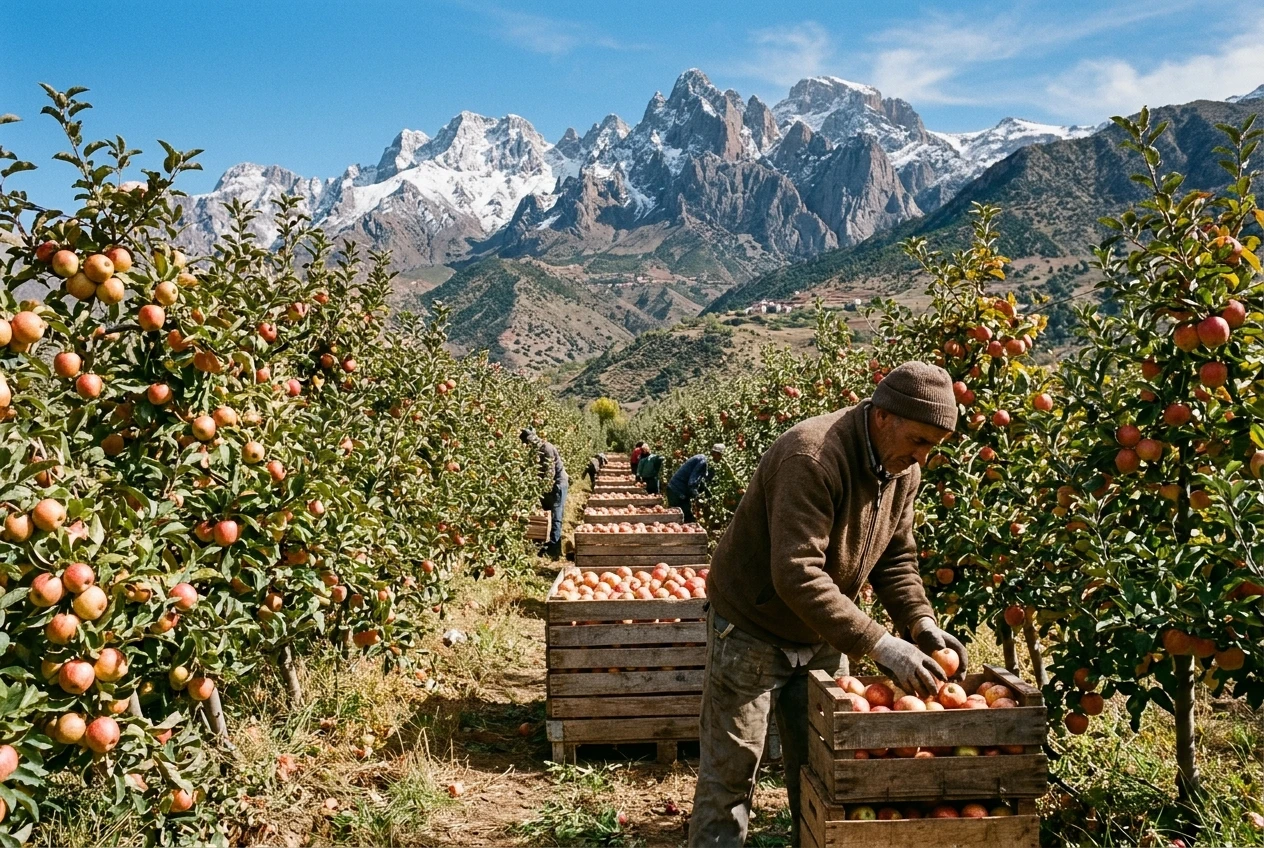
Perched at an elevation of 1,500 meters in the high windswept gap between the majestic peaks of the Middle Atlas and the soaring eastern ramparts of the High Atlas lies the provincial capital of Midelt. Guarded to the south by the colossal limestone massif of Mount Ayachi (Jbel Ayachi, 3,747 meters), Midelt was once known primarily as an ancient mineral-mining outpost. Today, it stands proudly as the indisputable apple capital of the Kingdom of Morocco.
Over the past three decades, visionary agro-economic planning, modern drip irrigation fed by Atlas snowmelt, and an extraordinary alpine microclimate have transformed this semi-arid plateau into a flourishing sea of intensive fruit orchards. Producing more than half of Morocco’s total national apple harvest, the Apples of Midelt (IGP Pomme de Midelt) represent a triumph of territorial marketing, demonstrating how mountain terroir and precision cold-chain infrastructure can generate sustainable regional wealth.
This agricultural and economic investigation examines the geographic factors behind Midelt’s fruit quality, official production metrics from MAPMDREF and DPA Midelt, modern controlled-atmosphere storage technologies, and the place of crisp mountain apples in the Moroccan culinary lexicon.
High-Altitude Terroir: The Microclimate of Mount Ayachi
The sensory and structural excellence of Midelt apples is directly governed by their unique alpine environment:
- Stark Diurnal Thermal Amplitude: During the critical maturation months of August and September, daytime temperatures regularly reach +28°C under intense high-altitude sunlight, while nighttime temperatures plunge abruptly to +4°C or even -2°C as cold glacial air drains down from Mount Ayachi. This daily thermal shock of 20°C to 25°C stimulates the tree to convert starches into complex fructose while locking in crisp cellular firmness and vibrant red anthocyanin skin coloration.
- Winter Chilling Requirement (Heures de Froid): Apple trees (Malus domestica) require between 800 and 1,200 cumulative hours of winter temperatures below 7°C to break dormant bud rest and ensure uniform spring flowering. Midelt routinely registers over 1,400 chill hours between November and March, ensuring complete vegetative renewal without artificial chemical rest-breaking agents.
- Moulouya River Basin Aquifers: Situated in the upper valley of the Moulouya River, orchards draw mineral-rich irrigation water directly from pristine limestone mountain runoff, distributed across tree root zones via solar-powered micro-drip networks.
- Dry Mountain Atmosphere: The low relative humidity of the High Atlas foothills naturally prevents the spread of apple scab (Venturia inaequalis) and powdery mildew, drastically minimizing the need for synthetic plant-protection sprays.
Official Harvest Statistics & Economic Capacity (DPA Midelt & MAPMDREF)
The apple sector in Midelt is governed by the Provincial Directorate of Agriculture (DPA Midelt) under the Drâa-Tafilalet Regional Agricultural Directorate, in close coordination with the Moroccan Association of Apple Producers (ASPAM).
The following data reflects multi-year official agricultural censuses and regional storage capacity audits:
| Strategic Sector Parameter | Official Quantitative Metric | Institutional & Statistical Source |
|---|---|---|
| Provincial Cultivated Apple Area | 33,200 Hectares Under Modern Orchard Cultivation | DPA Midelt Agricultural Cadastre |
| Annual Harvest Volume | 460,000 to 520,000 Metric Tons | MAPMDREF National Arboriculture Directorate |
| National Production Share | Over 55% of Morocco’s Total Apple Supply | Ministry of Agriculture Economic Studies |
| Average Commercial Yield | 22 to 35 Metric Tons per Hectare | National Agricultural Research Institute (INRA) |
| Controlled Atmosphere (CA) Cold Units | 68 Modern Industrial Cold Storage Facilities | Regional Investment Center (CRI Drâa-Tafilalet) |
| Total Cold-Storage Capacity | Exceeds 130,000 Metric Tons of Fruit | Office of Food Safety & Storage Standards |
| Primary Cultivated Varieties | Royal Gala, Golden Delicious, Starking, Fuji | Moroccan Apple Interprofessional Federation |
| Direct & Indirect Employment | 2.5 Million Work-Days Annually (Harvest & Packing) | Social Security & Rural Employment Census |
These statistics reveal a modern, highly capitalized agro-industrial cluster that supplies year-round fresh fruit to domestic wholesale markets in Casablanca, Tangier, and Marrakech, while expanding high-value exports to West African and Middle Eastern markets.
The Cold-Chain Revolution: Controlled Atmosphere (CA) Storage
One of the greatest historical challenges for mountain farmers was the seasonal price crash: flooding the market in September caused prices to collapse, followed by severe fruit shortages in spring.
Under the Plan Maroc Vert and Génération Green 2020-2030, Midelt became a national showcase for high-tech Controlled Atmosphere (CA) cold storage:
- Oxygen & Carbon Dioxide Modulation: Freshly picked apples are placed in hermetically sealed cold chambers where oxygen levels are reduced from the ambient 21% down to a precise 1.2 to 1.5%, while carbon dioxide is regulated at 1.0%. This biochemical “stasis” halts cellular respiration without chemical waxes.
- Ethylene Scrubbers: Advanced catalytic converters scrub ethylene gas (the natural hormone that triggers fruit ripening) out of the air column, keeping apples in suspended animation for up to 10 months.
- Year-Round Supply Security: Consumers in Moroccan coastal cities enjoy crisp, juicy Midelt Golden and Gala apples in May and June with the exact same cellular turgor, vitamin C content, and aroma as the day they were picked off the tree.
Varietal Diversity & Flavor Chemistry
Midelt’s growers have carefully selected rootstocks and cultivars optimized for high-altitude sunlight and calcareous soils:
- Royal Gala (Midelt Clone): Harvested from late August to mid-September. Boasts a brilliant bi-colored crimson-striped skin over a golden base. Firm, dense flesh with a sugar-to-acid ratio that delivers an explosive, honeyed crunch.
- Golden Delicious (AOP Midelt Terroir): Harvested in October. Unlike spongy, bland industrial supermarket Goldens, Midelt’s high-altitude Goldens develop a pale pink blush on the side exposed to direct mountain sun, accompanied by an intense perfume of ripe banana, wild honey, and green pear.
- Starking & Red Chief: Deep garnet-red, highly elongated fruits with five pronounced bottom calyx lobes. Thick skin loaded with polyphenols and a mild, low-acid, sweet profile favored in traditional baking.
- Fuji: Late-maturing winter apple harvested in November. Exceptionally dense cell walls, high natural brix (14° to 16° Brix sugar scale), and prolonged juiciness.
Midelt Apples in the Moroccan Gastronomic Tradition
While fresh Midelt apples are enjoyed daily as a crisp table fruit, the Moroccan culinary repertoire transforms this mountain harvest into magnificent savory-sweet creations:
- Tagine d’Agneau aux Pommes Caramélisées: A regal autumn tagine from the Middle Atlas. Tender shoulder of lamb is braised with grated ginger, saffron, yellow onions, and smen. Thick wedges of Midelt Golden apples are simmered separately in a reduction of cooking broth, raw orange blossom honey, and cracked Ceylon cinnamon until translucent, then arranged over the tender lamb and garnished with toasted sesame seeds.
- Pastilla aux Pommes et Noix de l’Atlas: A contemporary mountain adaptation of royal pastilla. Sautéed Midelt Gala apples spiced with nutmeg and cardamom are layered with crushed High Atlas walnuts and caramelized almond cream between crisp, buttered sheets of Warqa pastry, dusted with fine powdered sugar and cinnamon.
- Apple & Saffron Jam (Confiture de Pommes au Safran): In Midelt’s artisan cooperatives, diced apples are slow-simmered with unrefined cane sugar, whole lemon juice, and crushed Taliouine saffron threads, creating a glowing golden preserve enjoyed with warm morning Msemen.
Frequently Asked Questions (FAQ)
What makes Midelt apples crispier than imported European apples?
Midelt’s elevation (1,500m+) and dramatic day-night temperature swings (over 20°C variation) force apple trees to develop tighter, denser cell structures with lower water dilution, resulting in a noticeably crisper, louder crunch and higher natural fructose concentration.
How does the annual Midelt Apple Festival support local farmers?
Held every October, the Festival National de la Pomme de Midelt brings together over 150 local cooperatives, agricultural scientists, and international buyers. It provides smallholder farmers with direct access to wholesale contracts, awards prizes for best orchard management, and promotes the official IGP Pomme de Midelt label.
Are Midelt orchards protected against hail storms?
Yes. Given that severe high-altitude thunderstorms can produce destructive hail in late spring, over 65 percent of Midelt’s commercial orchards are now sheltered under heavy-duty anti-hail protective netting (filets anti-grêle), co-financed by the government’s Agricultural Development Fund (FDA).
Experience the true heart of Moroccan heritage through its culinary traditions. Join us in preserving and honoring these ancestral recipes.
What People Are Saying
No comments yet. Be the first — we'd love to hear from you.
Houssam Elmrabet
Culturally Verified & Fact-CheckedHoussam Elmrabet is a Moroccan researcher in territorial marketing and cultural heritage preservation. His work documents regional gastronomic identities, local agricultural heritage, and how ancestral culinary traditions define authentic territorial branding across the Kingdom.