Amlou: The Liquid Gold of the Amazigh South
Amlou: The Liquid Gold of the Souss
If the north of Morocco wakes up to the sharp, savory intensity of khlii (preserved meat) and eggs, the Amazigh south — the region stretching from Essaouira down to the Anti-Atlas mountains — wakes up to the deep, nutty sweetness of amlou.
Often lazily described by tourists as “Moroccan peanut butter” or “Moroccan Nutella,” amlou is entirely its own entity. It is a thick, viscous liquid paste characterized by a complex, roasted flavor profile that is impossible to replicate outside of its native geography. The magic of amlou lies in its strict minimalism: it contains exactly three ingredients. If you compromise on any one of them, the structure collapses.
The Three Pillars of Amlou
1. The Almonds (Louz): The foundation of the paste. The almonds must be local, grown in the arid soils of the south, which gives them a concentrated, intense flavor. Crucially, they are toasted before grinding. This toasting releases the oils and provides the deep, warm, roasted baseline that grounds the entire mixture.
2. The Argan Oil (Zit Argan): This is the soul of amlou, and the reason true amlou cannot be mass-produced cheaply. It must be culinary argan oil — the oil extracted from argan kernels that have been carefully roasted over a fire before pressing. This roasted argan oil imparts a deep, smoky, hazelnut-and-sesame aroma that elevates the paste from a simple nut butter to a culinary luxury.
3. The Honey (Aassal): The sweetener. True amlou relies on local, raw honey — often orange blossom or the sharp, slightly bitter thyme honey from the Atlas Mountains. The honey binds the paste and cuts through the intense richness of the nuts and oil.
The Stone Quern: The Art of the Grind
You can make amlou in a modern food processor in five minutes, but the texture will be wrong.
Traditionally, amlou is produced by the Amazigh women of the Souss region using a rha — a traditional hand-cranked rotary stone quern. The toasted almonds are fed into the hole in the top stone. As the heavy upper stone is turned against the lower stone, the almonds are crushed, releasing their oils. The argan oil is slowly drizzled into the turning stones, emulsifying with the almond paste. Finally, the honey is added.
The stone grinding does not heat the ingredients the way the high-speed metal blades of a food processor do, preserving the delicate volatile compounds of the argan oil. also, the rha produces a specific texture — incredibly smooth, but with a microscopic, sandy grit from the crushed almonds that provides a satisfying friction on the tongue.
How to Eat Amlou
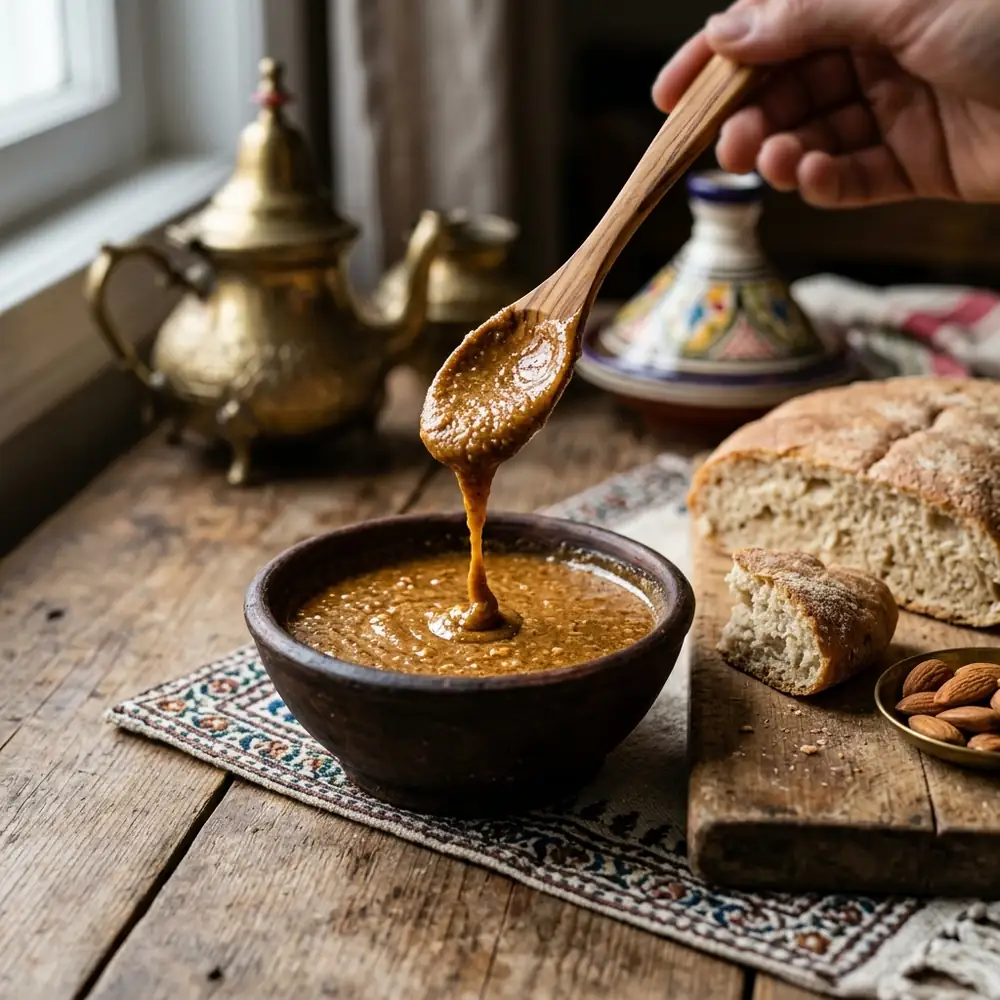
Amlou is not cooked; it is served exactly as it is made, usually in a small clay or ceramic bowl. Because it contains no artificial emulsifiers, the heavy almond paste naturally settles to the bottom, leaving a golden layer of pure argan oil floating on top. You must stir it vigorously before eating to re-incorporate the oil and the paste.
It is served at breakfast or during the late-afternoon tea time (l’kaskrout). There is only one correct way to eat it: tear off a piece of warm, crusty khobz (bread) or a hot, flaky square of msemen, and dip it directly into the bowl. It is rich, heavy, incredibly calorie-dense, and possesses a flavor that lingers in the mouth long after the meal is over.
The Invisible Invitation
Drive south from Essaouira along the Atlantic coast, where the argan trees twist out of the rocky, red earth. Stop at a small, roadside cooperative run by the local Amazigh women. Walk inside. You will hear the heavy, grinding sound of stone on stone. Watch the dark, golden paste slowly extrude from the edges of the rha as the woman turns the wooden handle. Sit down at the small table they offer. They will bring you hot, fresh bread, a glass of mint tea, and a bowl of the freshly ground amlou. Stir the dark oil back into the paste. Dip the bread. The taste is smoke, toasted nuts, deep mountain honey, and the specific, undeniable flavor of the Moroccan south.
SEO Meta Description: What is Moroccan amlou? Discover the traditional recipe of toasted almonds, roasted culinary argan oil, and honey, traditionally stone-ground by Amazigh women in the Souss region.
Experience the true heart of Moroccan heritage through its culinary traditions. Join us in preserving and honoring these ancestral recipes.
What People Are Saying
No comments yet. Be the first — we'd love to hear from you.
Khadija Tahiri
Culturally Verified & Fact-CheckedThe Moroccan Food editorial team brings together native culinary researchers, heritage preservationists, and experienced home cooks across Marrakech, Fes, and Casablanca. Every recipe and cultural guide is reviewed against ancestral oral traditions and authentic regional practices.