Al-Ala: The Andalusian Classical Music of Morocco and Why It Refused to Die
Al-Ala: The Eight-Century-Old Music That Morocco Kept Alive When Spain Was Done With It
The history of Al-Ala — the classical Andalusian music tradition — is also the history of a cultural rescue operation that took place across the 15th and 16th centuries, conducted by refugees.
When the Catholic monarchs Ferdinand and Isabella expelled the Muslim population of Islamic Spain between 1492 and 1502, the communities that had maintained the sophisticated musical culture of al-Andalus — the poets, the musicians, the scholars who had developed and refined the nawba (musical suite) tradition across four centuries in Córdoba, Seville, Granada, and Valencia — fled to North Africa. The largest communities arrived in Morocco, settling primarily in the northern cities that were closest to the Strait: Tetouan, Chefchaouen, Fes, and Meknès.
They brought their music with them. Not in notation — the classical Andalusian tradition was transmitted orally and by memory, not through written scores — but in the memories of trained musicians who knew the repertoire and could perform and transmit it. The nawba suites were preserved in the minds of people who crossed the Mediterranean with the political catastrophe of the Reconquista unfolding around them.
This is why Al-Ala as it exists in Morocco today is a medieval music. Not influenced by medieval music, not inspired by it — it is, to the extent that any living performed tradition is the same as its historical origin, the actual medieval Andalusian classical repertoire, maintained through continuous oral transmission from those refugee musicians to the present day. The nawba performed in Fes or Tetouan tonight shares its modal structure, its poetic texts, its compositional architecture with the nawba performed in 15th-century Granada.
What Is a Nawba and How Is It Structured?
A nawba is a complete musical suite organized around a specific modal scale (tab'). There are eleven nawba in the Moroccan Al-Ala repertoire, each in a different mode, each with a fixed succession of sections that move from slow and solemn to fast and ecstatic across the suite's duration. A complete nawba performance, with all its sections, can run four to five hours.
The sections of a nawba follow a prescribed sequence: from the slow, meditative opening (mshaliya and bsit) through progressively faster sections (qd'im, darj, barawal) to the rapid, joyful close (mukhlas). The progression from slow to fast across a complete nawba is not merely a change in tempo — it is a change in emotional register, a narrative arc from contemplation to celebration that the suite's structure enforces. You do not play the mukhlas before the bsit. The form has an internal logic and a direction.
The texts set to these musical forms are classical Arabic poetry — some of it composed specifically for the al-Andalus musical tradition, some of it pre-existing poetry adapted for musical setting — dealing with the classical Arabic poetic themes of love, separation, nature, and the transcendent. The specific poetic texts associated with each nawba section are also fixed by tradition: you do not substitute different poetry at will. The nawba is a unified work in which music and text are inseparable.
What Are the Instruments of Al-Ala and What Does the Orchestra Look Like?
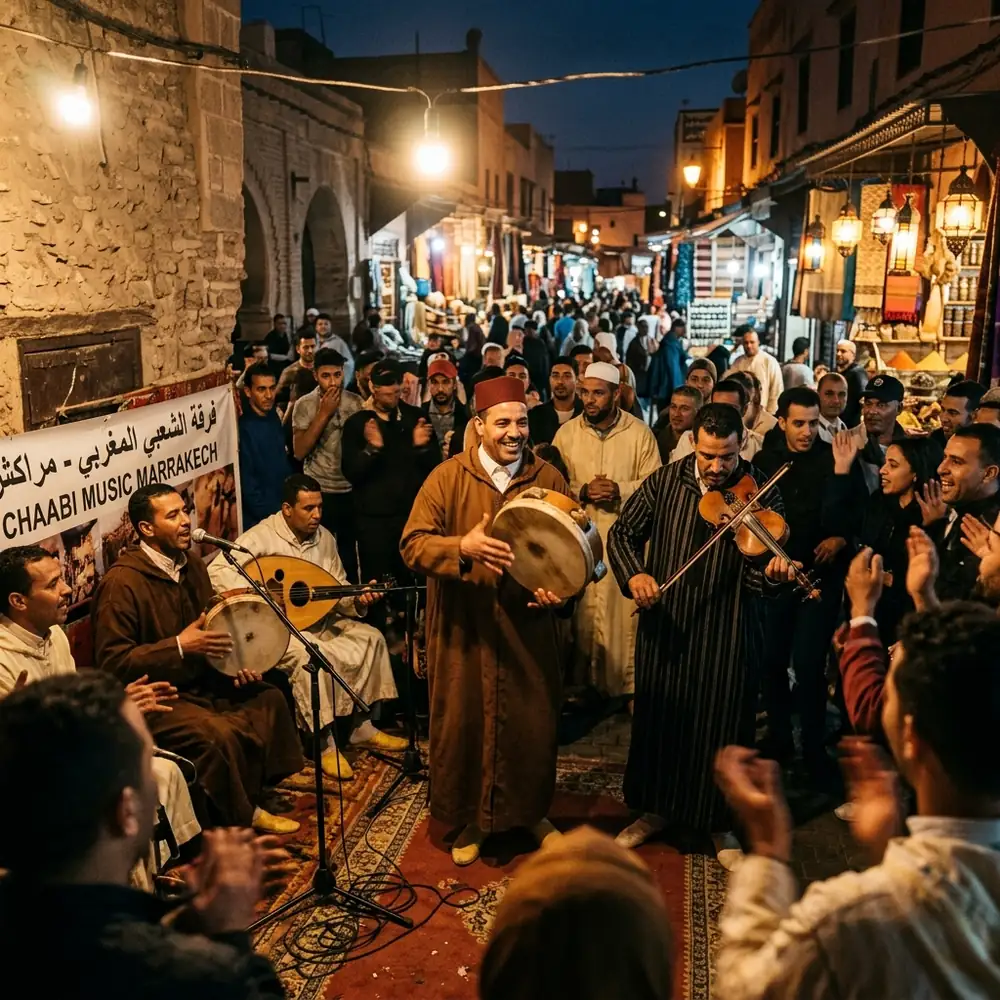
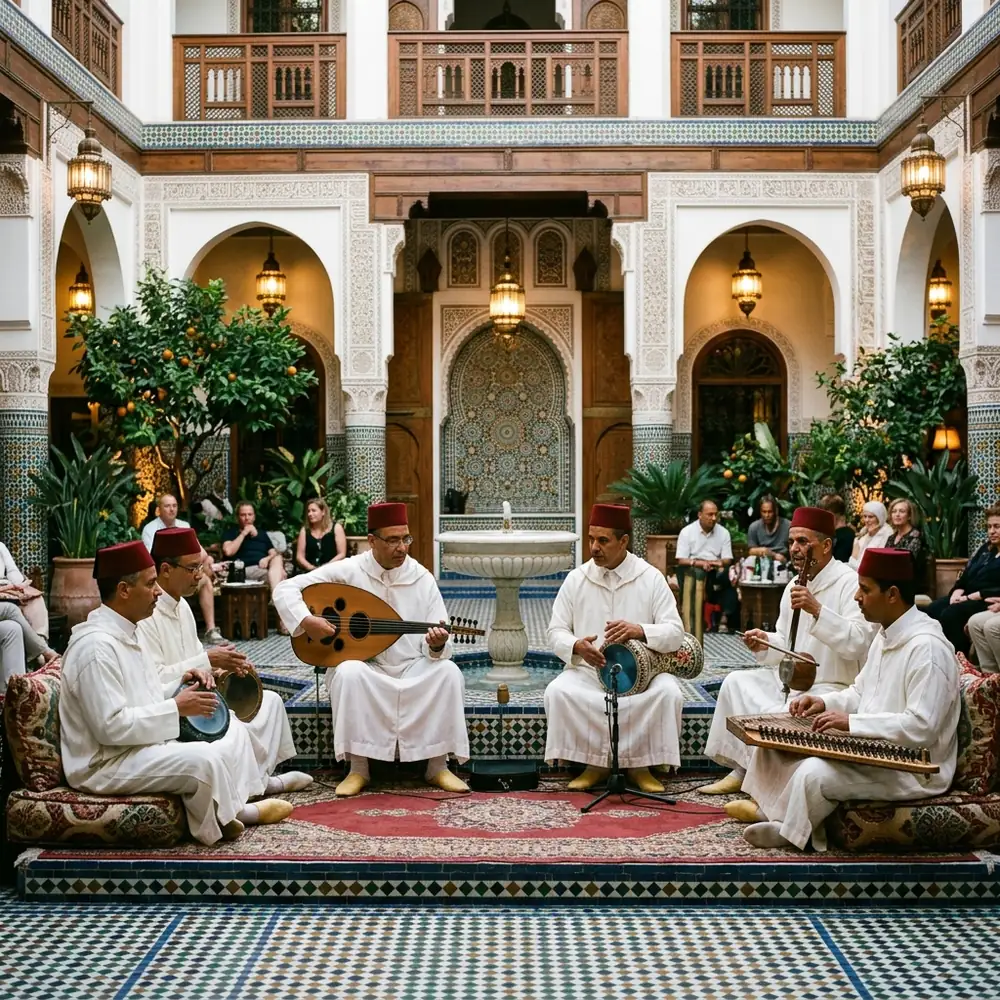
The Al-Ala orchestra — jauq — consists of plucked string instruments, bowed string instruments, and percussion, with vocals. The specific instrumentation:
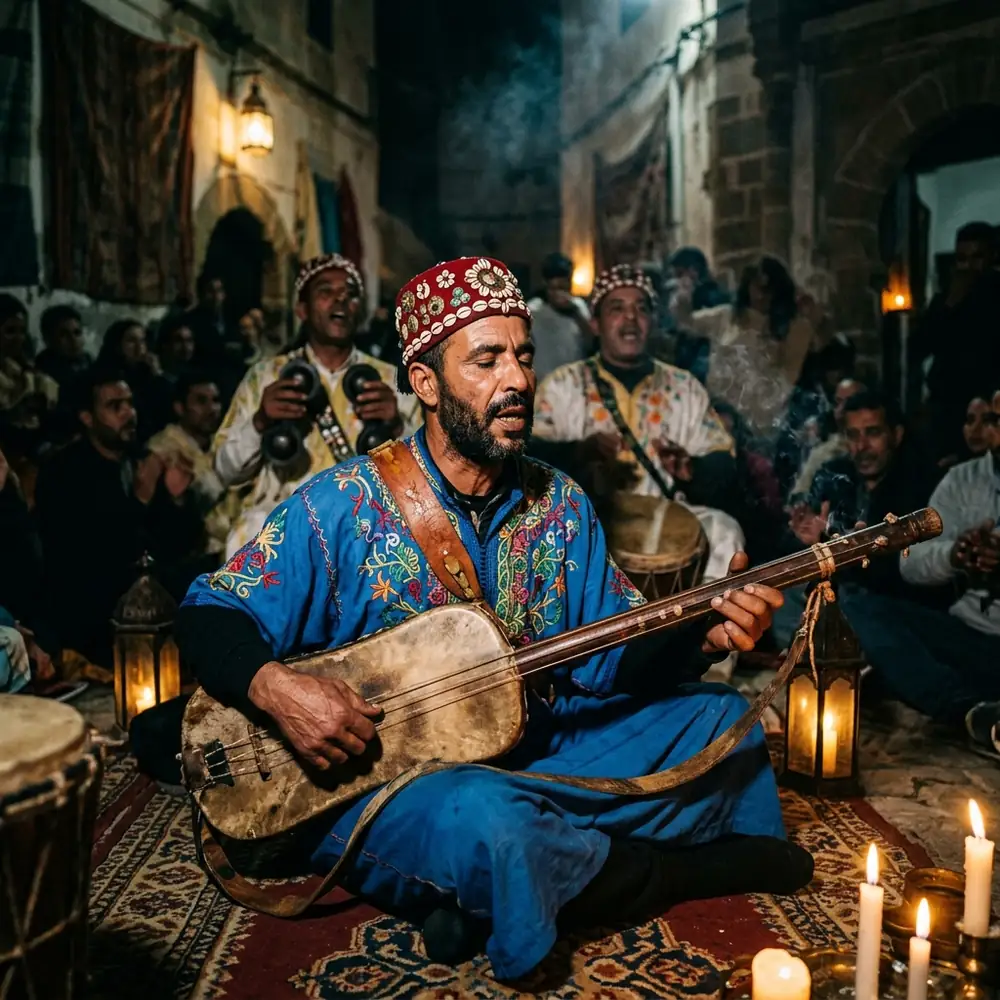
The oud (short-necked lute, the ancestor of the European lute) is the primary melodic and harmonic instrument. The rabab (a bowed pear-shaped instrument played upright like a cello held at the knee) is the primary bowed instrument and provides a sustained melodic counterpoint to the oud. The kamanja (violin in its classical position, under the chin) arrived in Moroccan orchestral practice later than the rabab but is now standard. The darbuka (goblet drum) and tar (frame drum) provide the rhythmic foundation.
All members of the orchestra sing. The vocal style — unison singing, with the orchestra playing the same melodic lines as they sing, which is characteristic of classical Arabic musical traditions — produces a thick, complex unison texture where the human voice and the instruments are not in distinct roles but are all contributing to the same melodic line simultaneously. The effect is dense and warm in a way that Western harmonized choral singing is not.
Why Is Al-Ala Not More Widely Known Outside Morocco?
Multiple reasons, none of them having to do with the music's quality.
The tradition is transmitted within closed institutions — the Al-Ala orchestras in Fes, Tetouan, and Meknès operate as associations with formal membership, structured apprenticeship, and a conservatism about transmission that makes the music difficult to access from the outside. This conservatism is both the music's protection and a limitation on its visibility.
The music is slow. The bsit section of a complete nawba, performed at the correct tempo, can sustain a single melodic phrase for several minutes. This is not music that submits to the three-minute attention span of contemporary media culture. It requires the kind of sustained listening that is increasingly unusual in the current attention environment, and it rewards that sustained listening with experiences of gradually unfolding complexity that are simply not available in faster music.
The recordings that exist — primarily from Moroccan Radio archives and from the SNRT classical collection — are the best available access point for listeners outside Morocco. They are not widely distributed internationally, which reflects the music's cultural position rather than any decision to restrict access.
The Invisible Invitation
The Al-Ala association in Fes rehearses on Thursday evenings in a room in the medina that is not marked externally — you find it through a member, or through the conservatoire, or through patient inquiry. If you arrive and are welcomed — sit quietly at the edge of the room. The orchestra is warming up. The oud tuning and the rabab's first long bow stroke and the tentative initial phrase of the vocalist happen simultaneously. Then the conductor gestures and they begin together, and the nawba opens in its slow first section, and the room — which is not large, and not decorated, and smells of the medina outside — becomes, for the duration of the music, the city of Granada in 1490 and a rehearsal room in Fes in 2026 at the same time. Both things are equally true.
SEO Meta Description: What is Moroccan Al-Ala music? The Andalusian classical tradition — eleven nawba suites, 15th-century refugee origin, orchestra instruments, and why this medieval music still exists only in Morocco.
Experience the true heart of Moroccan heritage through its culinary traditions. Join us in preserving and honoring these ancestral recipes.
What People Are Saying
No comments yet. Be the first — we'd love to hear from you.
Youssef Amazigh
Culturally Verified & Fact-CheckedThe Moroccan Food editorial team brings together native culinary researchers, heritage preservationists, and experienced home cooks across Marrakech, Fes, and Casablanca. Every recipe and cultural guide is reviewed against ancestral oral traditions and authentic regional practices.