Baghrir: The Thousand-Hole Moroccan Pancake and the Yeast Science Behind Its Texture
Baghrir: Why the Holes Are the Point and How to Get Them Right
Baghrir is one of those preparations that is impossible to explain adequately to someone who hasn't seen one being made, because the thing that makes it what it is — the network of holes that covers the top surface — is a process rather than a technique. You cannot make the holes. They make themselves, if you have done everything else correctly.
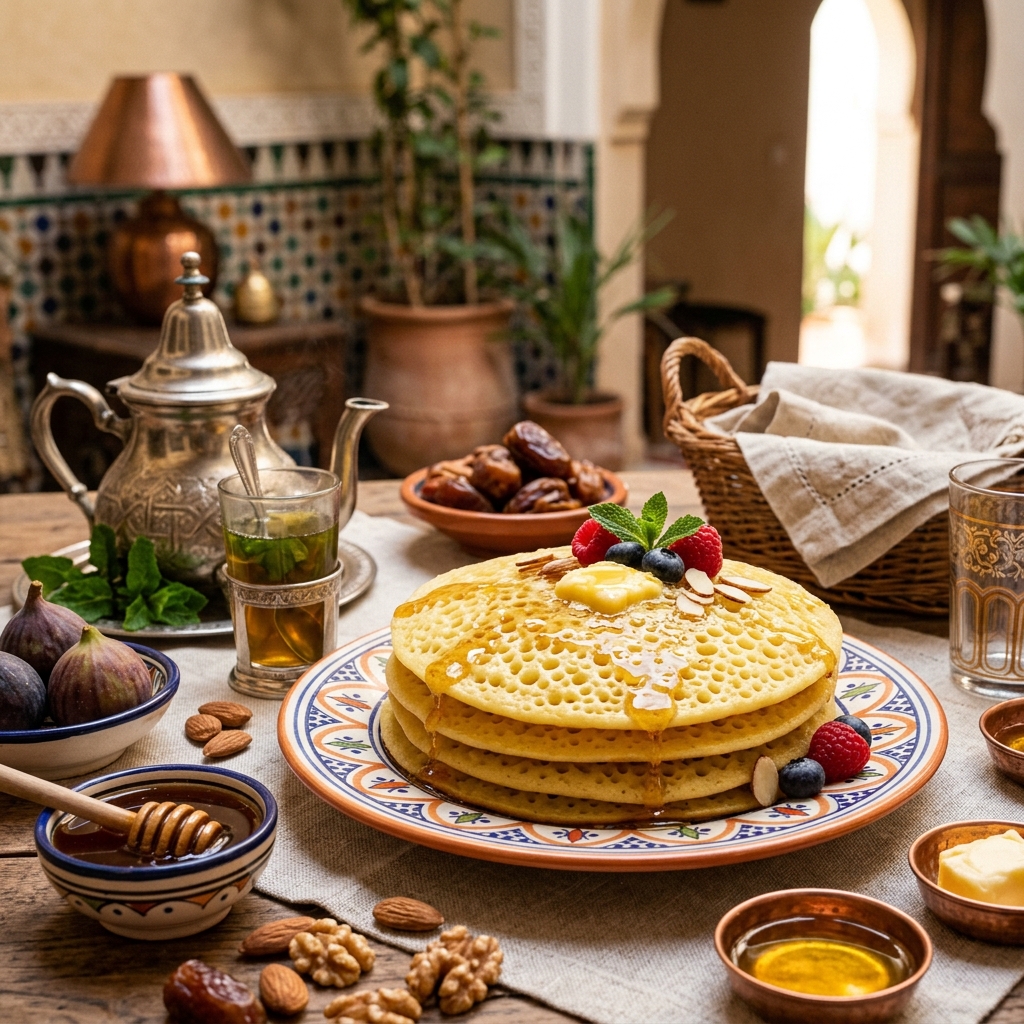
Let me explain this more precisely. Baghrir batter contains both yeast and baking powder as leavening agents. When the batter is poured onto a hot pan — a single pour per pancake, from a ladle, with no spreading, just the batter settling into a circle under its own weight — the leavening activates from the heat at the base of the pancake. Bubbles form at the bottom of the batter, rise through it, and break through the surface, leaving small holes. Because the pancake is cooked on only one side — the bottom cooks while the top remains liquid until the bubbles create their holes and the surface just barely sets — the holes remain open rather than being sealed by the contact of a spatula or the weight of the cooking surface.
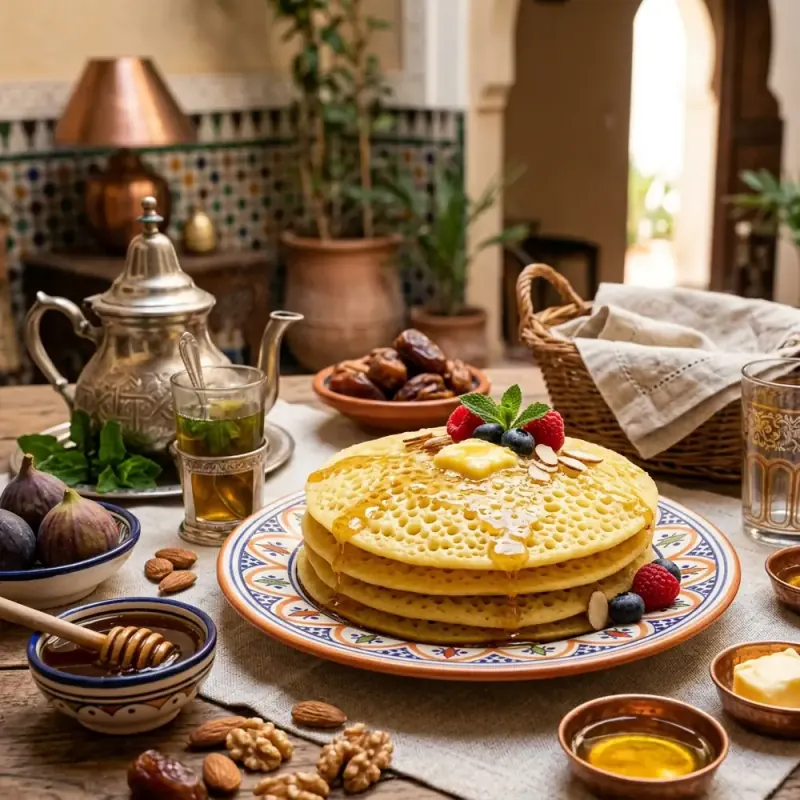
The result is a pancake with a smooth, slightly browned bottom and a top surface that looks like a honeycomb or a very fine sponge — open-pored, slightly tacky, designed specifically to absorb liquid. Baghrir is served immediately with warm honey and melted butter poured over the hole-covered top surface, which is absorbed directly through the holes into the interior of the pancake rather than pooling on the surface. Every hole is a tiny funnel for butter and honey. This is the design.
What Is in the Batter and What Does Each Component Do?
The batter is simple: fine semolina, a smaller amount of flour, yeast (dried, dissolved in warm water with a pinch of sugar to activate), baking powder, salt, and water. That is everything. The ratio of semolina to flour — approximately three to one — produces the specific texture that distinguishes baghrir from a conventional flour pancake: a slightly grainy, slightly chewy crumb that holds the hole structure open rather than collapsing it.
The water quantity is the critical variable. The batter must be thinner than crepe batter but not as thin as water — somewhere in the range of a liquid you can pour easily from a ladle in a single controlled stream, that settles into a circle of its own accord, that is thick enough to maintain its shape but thin enough to allow the bubbles to rise through it freely. Too thick and the bubbles cannot penetrate the batter before the surface sets. Too thin and the batter spreads too wide and produces a flat, hole-free pancake.
The batter needs to rest. After mixing, it should rest for twenty to thirty minutes while the yeast activates and begins producing carbon dioxide in the liquid. During this rest, the batter will visibly thicken slightly as the semolina absorbs moisture and as the yeast activity begins. Do not skip this rest — batter poured too early, before the yeast has started working, produces a denser, less holey result.
How Is Baghrir Cooked and What Pan Is Correct?
A non-stick pan of medium weight works. Cast iron also works, and produces a slightly more evenly browned bottom. The pan should be preheated over medium heat until a drop of water on the surface sizzles and evaporates immediately — this is the correct temperature, and maintaining it consistently across multiple pancakes is the practice skill that baghrir requires.
No fat goes in the pan. Baghrir is cooked without oil or butter on the cooking surface — the batter itself contains enough moisture that it does not stick to a properly preheated non-stick surface, and the bottom should release cleanly without any fat. Fat in the pan would disrupt the bubble formation at the base of the batter, which is the foundational process of the whole preparation.
Pour the batter from the ladle from approximately ten centimeters above the pan — the height allows the batter to fall into a controlled circle rather than spreading. Once poured, do not move the pan. Do not touch the batter. Watch it.
The holes will begin appearing within thirty seconds in a correctly made batter and a correctly heated pan. They appear first at the edges, where the batter is thinnest and heats first, and progress toward the center. When the last hole appears at the center of the pancake and the surface just barely loses its wet, liquid look — when it has set but not dried — the baghrir is done. Do not flip it. Remove it from the pan directly onto a plate. Serve immediately.
When Is Baghrir Eaten and With What?
Baghrir is a breakfast and iftar (Ramadan fast-breaking) preparation primarily, served with warm butter and honey as its traditional companions. The butter should be melted but not hot — just liquid enough to pour — so that it soaks through the holes without immediately evaporating. The honey goes over the butter, and both are absorbed almost immediately into the open-pored structure.
The combination of butter and honey on baghrir is one of those flavor pairings that works because the baghrir is specifically designed for it: the slight savory-grain character of the semolina balances the sweetness of the honey, and the butter provides the fat that carries the honey's flavor deeper into the pancake's interior. Honey on baghrir without butter is fine. Butter on baghrir without honey is less interesting. Both together, on a hot baghrir with a good Morocco jben (fresh cheese) on the side and a glass of lben (buttermilk), is the traditional Moroccan breakfast at its most complete.
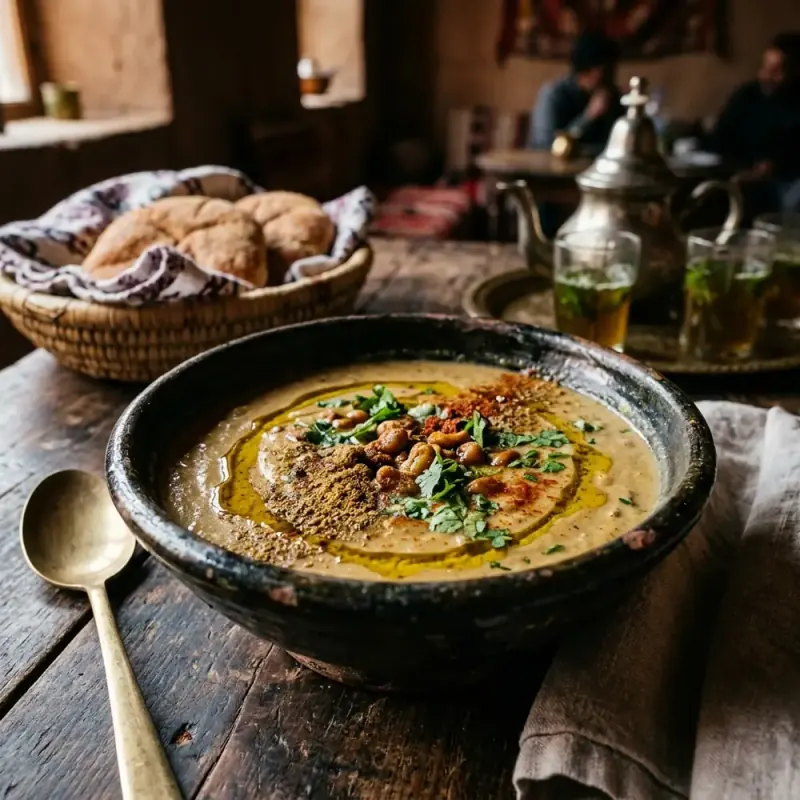
In the Ramadan context, baghrir appears at iftar — the fast-breaking meal — as one of the sweet accompaniments to the harira. Its quick preparation (once the batter has rested, each pancake cooks in under two minutes) makes it practical for the precise timing that iftar requires.
The Invisible Invitation
The pan is at temperature and the batter has rested for twenty-five minutes. Ladle into the pan, stand back, watch. The holes begin at the edge within forty seconds — small, regular, the pattern progressing inward. At the center, the last hole appears and the surface shifts from wet to just-set. Remove it. Immediately, from the small pot warm on the stove, pour the melted butter. The butter disappears into the holes. Pour the honey. The honey follows. By the time you carry the plate to the table, the baghrir has absorbed both completely and is waiting. This is the point of the holes. This is what they were for. Sit down and eat it warm. The warmth is not optional.
SEO Meta Description: How to make Moroccan baghrir pancakes? The semolina batter recipe, why the thousand holes form, the no-flip cooking technique, and the traditional butter-and-honey serving method.
Experience the true heart of Moroccan heritage through its culinary traditions. Join us in preserving and honoring these ancestral recipes.
What People Are Saying
No comments yet. Be the first — we'd love to hear from you.
Khadija Tahiri
Culturally Verified & Fact-CheckedThe Moroccan Food editorial team brings together native culinary researchers, heritage preservationists, and experienced home cooks across Marrakech, Fes, and Casablanca. Every recipe and cultural guide is reviewed against ancestral oral traditions and authentic regional practices.