The Sacred Architecture of Moroccan Bread: Khobz, Batbout, and the Living Culture of the Neighborhood Ferran
ARTICLE 2: The Sacred Architecture of Moroccan Bread: Khobz, Batbout, and the Living Culture of the Neighborhood Ferran
Slug: moroccan-bread-khobz-ferran-communal-oven-culture
Category: Food & Cuisine
Excerpt: Why bread in Morocco is never cut with a knife, how neighborhood children navigate the wood-fired communal oven (Ferran) with custom family dough stamps, and the semolina science behind every golden loaf.
The Sacred Architecture of Moroccan Bread: Khobz, Batbout, and the Living Culture of the Neighborhood Ferran
Let me tell you a secret before we even light the fire.
If you walk down any alleyway in the ancient medinas of Fez, Marrakech, or Tetouan, you will eventually notice something strange and beautiful resting on the narrow ledge of a windowsill or tucked into the crook of a stone archway: a single crust of dried bread.
No one threw it away. In Morocco, bread is not mere food. It is called N'ama—a divine blessing, a sacred grace. If a Moroccan accidentally drops a piece of bread onto the floor, watch what they do. They will instantly stoop down, pick it up, dust it off, bring it reverently to their lips, kiss it (boussa), touch it to their forehead, and place it gently high on a wall ledge where a passing bird or animal may eat it with dignity.
"Bread is our spoon, our plate, our greeting, and our peace."
In a traditional Moroccan home, you will rarely see a bread knife at the table. To cut bread with a cold steel blade is considered harsh, almost violent to the blessing. Instead, bread is shared by hand. We say Bismillah (in the name of God), break the warm golden disc with our thumbs and fingers, and pass the steaming quarters around the table.
Here is the story of Moroccan bread—from the durum wheat fields of the Chaouia plains to the subterranean crackle of the neighborhood communal oven (ferran).
1. The Living Theater of the Neighborhood Ferran
Every quarter (derb) of a traditional Moroccan medina was designed around five sacred communal pillars: the mosque for prayer, the madrasa for learning, the hammam for cleansing, the saqaya (fountain) for fresh water, and the ferran—the communal wood-fired bakery.
THE FIVE PILLARS OF THE MEDINA DERB[MOSQUE] ───────── [HAMMAM] ───────── [FERRAN (COMMUNAL OVEN)] │ │ └───────────── [SAQAYA] ────────────────┘ (FOUNTAIN)
Long before private domestic electric ovens existed, the ferran was the core of the morning neighborhood. The architecture was brilliant in its communal economy: instead of fifty families each burning precious firewood in their individual kitchens, one master baker (tarrab or ferratch) tended a massive wood-fired vaulted brick oven that burned sawdust, eucalyptus, olive wood, or almond shells.
The Morning Procession of the Wassa
Every morning at around ten o'clock, the medina alleys fill with a charming, timeless procession. Children and young women step out of riad doorways carrying a long rectangular wooden board called a wassa balanced gracefully upon their heads or shoulders.
Rested upon the wassa are four to six round discs of raw dough, each lovingly tucked under a heavy, flour-dusted wool blanket (manta) to keep them warm during their final proof.
                         THE FERRAN LIFE CYCLE
[Home: Mixing & Kneading]  ──► Durum Semolina + Water + Salt + Khmira Beldia
[The adventure: The Wassa]   ──► Carried on head under wool blankets through alleys
[The Hand-Off: Ferratch]   ──► Baker recognizes family stamp / unique cut pattern
[The Oven: Vaulted Brick]  ──► 3-meter wooden peel (Matraha); blistering heat
[The Return: Crisp Khobz]  ──► Golden, hollow-thumping, semolina-crusted bread
The Genius of the Ferratch
Step inside the subterranean warmth of the ferran. The air is thick with the sweet aroma of toasted semolina, woodsmoke, and caramelizing crusts. The master baker stands before a blazing brick mouth, wielding a wooden paddle with a handle four meters long, called the matraha.
In a single morning, the ferratch will bake between three hundred and six hundred loaves from dozens of different families in the neighborhood. Yet, there are no order tickets, no written names, no digital tags.
How does he know which bread belongs to the family of the tailor, the shoemaker, or the judge?
2. The Fingerprint of the House: Stamps, Slits, and the Silent Code
Every Moroccan family possessed a unique visual "fingerprint" stamped into their dough before it left the house. This was the silent language of the medina:
                       MEDINA DOUGH SIGNATURES
┌──────────────────────┬─────────────────────────────────────────────────┐
│ Family Identifier    │ Visual Technique on Raw Dough                   │
├──────────────────────┼─────────────────────────────────────────────────┤
│ Carved Wooden Stamp  │ Geometric seal pressed firmly in the center     │
│ Fork Piercing Count  │ Exactly 3 pricks in a triangle, or 5 in a ring   │
│ Artisan Knife Slits  │ Single diagonal slash, cross-hatch, or crescent │
│ Aromatic Seed Marker │ Black nigella (sanouj) vs. Anise (habbt hlwa)│
│ Edge Pinching        │ Scalloped borders or triple thumb dents         │
└──────────────────────┴─────────────────────────────────────────────────┘
The baker took the loaf from the wooden board, looked at the signature mark in a split second, and slid it into the specific zone of the oven floor that suited that family's dough.
If Lalla Fatima made a dense whole-wheat and barley loaf (Khobz d'Ch'ir), it went to the cooler back corner where it could bake slowly through its thick crumb. If Lalla Aicha sent a light, white-semolina loaf (Fino) intended for a light lunch, it was placed closer to the roaring hardwood embers where it would blister and rise instantly into a golden dome.
When the children returned at noon with their empty boards, the ferratch stacked their family’s exact loaves back onto their wassa—piping hot, golden-brown, smelling of sweet cedar smoke—without a single mistake in forty years of baking.
3. The Semolina Science: Why Moroccan Khobz Is Not Sandwich Bread
If you cut a French baguette or an Italian ciabatta, you look for a wild, cavernous, open-hole crumb (alveolage). If you try to eat a Moroccan tagine with a French baguette, you will quickly discover a catastrophe: the light, airy structure collapses, sauce leaks through the holes onto your fingers, and the crust goes soggy.
Moroccan Khobz was engineered over centuries for a completely different mechanical purpose: it is the ultimate edible utensil.
THE ANATOMY OF A TAGINE SCOOP[Golden Semolina Crust (Crisp, Seed-Dusted)] ┌───────────────────────────────────────────┐ │ ░░░░░░░░░░░░░░░░░░░░░░░░░░░░░░░░░░░░░░░░ │ │ ▒▒▒▒▒▒▒▒▒▒▒▒▒▒▒▒▒▒▒▒▒▒▒▒▒▒▒▒▒▒▒▒▒▒▒▒▒▒▒▒ │ │ [Dense, Micro-Porous "Babboush" Crumb] │ │ (Absorbs Spiced Sauce Without Collapsing) │ │ ▒▒▒▒▒▒▒▒▒▒▒▒▒▒▒▒▒▒▒▒▒▒▒▒▒▒▒▒▒▒▒▒▒▒▒▒▒▒▒▒ │ │ ░░░░░░░░░░░░░░░░░░░░░░░░░░░░░░░░░░░░░░░░ │ └───────────────────────────────────────────┘ [Bottom Hearth Crust (Sturdy, Non-Soggy)]
The Durum Wheat Advantage (Triticum durum)
While European bakers rely heavily on common soft wheat (Triticum aestivum / Type 55 or Type 65 flour), the soul of Moroccan bread is durum wheat semolina:
- Smida Rkika: Fine-milled durum wheat semolina with high tensile protein strength.
- Finou (Farine de Blé Dur): Ultra-fine durum flour, naturally golden-yellow due to rich concentrations of lutein and carotenoid pigments.
Durum Wheat Semolina vs. Common White Wheat Flour:
┌─────────────────────────┬─────────────────────────┬─────────────────────────┐
│ Characteristic          │ Fine Durum Semolina     │ Common White Wheat      │
├─────────────────────────┼─────────────────────────┼─────────────────────────┤
│ Protein Structure       │ Strong, inextensible    │ Elastic, highly extensible│
│ Carotenoid Pigment      │ High (Golden-Yellow)    │ Very Low (Chalky White) │
│ Water Absorption Ratio  │ High (Long shelf life)  │ Moderate                │
│ Crumb Structure         │ Uniform, micro-porous   │ Irregular, large holes  │
│ Mechanical Function     │ Firm scoop; heat-proof  │ Soft, tears easily      │
└─────────────────────────┴─────────────────────────┴─────────────────────────┘
The Kneading Physics of Dlek
Moroccan dough is not folded gently like high-hydration sourdough. It is subjected to intense, rhythmic friction called dlek. The baker uses both fists, knuckles, and the heel of the hands to smash, stretch, and compress the semolina against the ribbed clay walls of the gsa'a.
Water is added not all at once, but in tiny splash increments (rshas) as the semolina slowly drinks the liquid. This forces the tough durum proteins to hydrate completely, aligning the gluten into a tight, dense, sponge-like mesh capable of lifting a chunk of tender braised lamb and a ladle of onion gravy without tearing.
4. The Bread Blend: A Field Guide to Moroccan Breads
While standard Khobz is the daily monarch, the Moroccan baking landscape is an extraordinary regional mosaic:
                           THE MOROCCAN BREAD ATLAS
                                      │
        ┌──────────────────┬──────────┴──────────┬──────────────────┐
        │                  │                     │                  │
        ▼                  ▼                     ▼                  ▼
    [KHOBZ]            [BATBOUT]             [MSEMMEN]         [MEDFOUNA]
 The Daily Round     Pan-Puffed Pocket    Laminated Flaky     Saharan Stuffed
 Flatbread with      Cooked on Cast-Iron  Pancake Folded      "Berber Pizza" with
 Anise & Nigella     *Farrah* Pan         with Smen & Semolina Spiced Beef & Suet
1. Khobz el-Dar / Khobz el-Koucha (The Classic Round Loaf)
The iconic disc of Morocco, about 20 to 25 cm in diameter and 2 to 3 cm thick. Often perfumed with toasted anise seeds (habbt hlwa) and wild nigella seeds (sanouj), and rolled in coarse golden semolina or wheat bran (nakhala) before baking to create a crunchy, rustic exterior.
2. Batbout / Mkhamer / Toghrift (The Stove-Top Pillow)
Cooked not in an oven, but atop a blazing heavy cast-iron ribbed skillet called a farrah or enjad. When the thin round disc hits the blistering dry iron, steam builds rapidly within the dough, forcing the top and bottom crusts to separate and balloon into a spherical football. When cooled, it forms a hollow, velvety pocket ideal for stuffing with spiced kefta, tuna salad, or slathering with melted honey-butter.
3. Msemmen and Melwi (The Laminated Wonders)
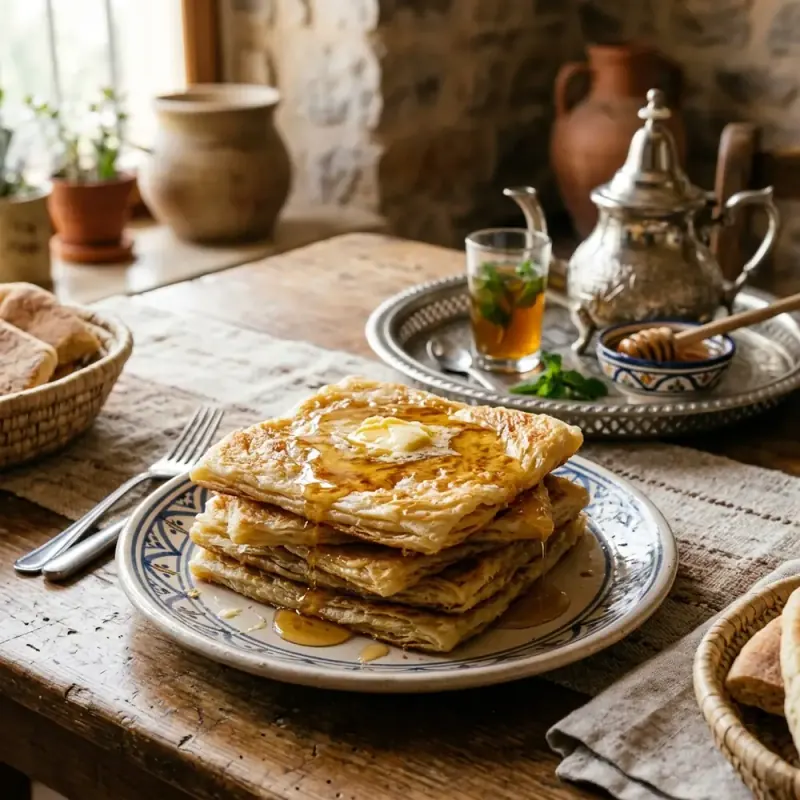
The absolute peak of Moroccan pastry engineering. A dough of fine semolina and flour is stretched over an oiled marble counter until it is as thin as cigarette paper. It is dotted with softened smen and dusted with dry raw semolina grains (which act as tiny ball-bearings to keep the delicate layers apart).
- Msemmen: Folded into a square envelope (four layers folded onto themselves) and seared on the griddle until flaky, crisp, and golden.
- Melwi: Rolled into a long coil like a turban and pressed flat from the top into concentric rings of paper-thin pastry.
4. Medfouna (The Saharan Stuffed Bread of Rissani)
Deep in the desert oasis of the Tafilalet region, bread becomes a complete meal. Medfouna is a grand two-crusted flatbread stuffed with finely minced beef or lamb, beef kidney fat (suet), almonds, hard-boiled eggs, onions, cumin, coriander, and fiery ginger. Baked directly on the heated sand or in earthen clay ovens, the internal fat melts into the spiced filling, perfuming the semolina crust from the inside out.
5. The Living Soul: Khmira el-Beldia (Traditional Wild Sourdough)
Before packets of commercial baker's yeast (Khmira Rimiya) arrived in medina grocery stalls in the mid-20th century, every Moroccan loaf was leavened with Khmira el-Beldia—wild Moroccan sourdough starter.
                  TRADITIONAL KHMIRA BELDIA ANCESTRY
Whole-Wheat / Barley Flour + Tepid Water + 2 Dried Figs (Chriha) OR 1 Garlic Clove
│
[48 - 72 Hours in Dark Terracotta Pot]
│
Indigenous Wild Yeasts (Saccharomyces) & LAB (Lactobacillus)
│
Gentle Lactic Acidity (Lowers Glycemic Index)
│
Complete Phytate Breakdown (Maximizes Iron & Zinc)
In the old days, a grandmother would start her khmira beldia by burying two dried sweet mountain figs (chriha) or a peeled clove of wild garlic inside a mixture of whole-grain barley flour and warm water. The natural sugars on the fig skin and the natural microbes in the ambient air ignited a vigorous fermentation within 48 hours.
Why is bread made with Khmira Beldia vastly superior?
- Phytic Acid Deactivation: Whole grains contain phytic acid, which binds to iron, zinc, and magnesium in the gut, preventing absorption. The long, slow 12-hour fermentation of khmira beldia activates phytase enzymes, freeing the minerals for full bioavailability.
- Digestive Comfort: The lactic acid bacteria partially pre-digest the gluten proteins during the extended rise, explaining why many who struggle with modern industrial bread digest authentic Moroccan khobz beldi with ease.
- The Unmistakable Earthy Tang: It gives the bread a subtle, nutty, sour fragrance that cuts cleanly through the rich, fatty sauces of lamb tagines and marrow bone stews.
6. Lalla’s Secrets for the Perfect Golden Khobz at Home
If you are baking Moroccan bread in a modern kitchen without a medina ferran, here are the ancestral secrets that make all the difference:
                            LALLA'S 4 LAWS
[LAW 1: THE DOCKING]       ──► Pierce dough with a fork 10-12 times to
prevent uncontrollable dome ballooning.
[LAW 2: THE SEMOLINA COAT] ──► Roll proofed disc in dry coarse semolina
for crunch and non-stick handling.
[LAW 3: THE MAXIMUM HEAT]  ──► Crank oven to 240°C-250°C (475°F); pre-heat
a heavy baking stone or cast-iron pan.
[LAW 4: THE STEAM BURST]   ──► Throw ice cubes into an iron pan on the
oven floor for an authentic golden shine.
Secret 1: The Fork Docking Rule
Why do Moroccan women furiously stab their proofed dough with a fork before it goes into the oven? If you do not "dock" Moroccan bread, the steam trapped by the dense semolina will blow the top crust completely off the crumb, leaving you with an empty balloon rather than a sturdy, sauce-scooping loaf. Ten to twelve quick pricks allow steam to vent uniformly.
Secret 2: The Two-Stage Proof
Never let the dough rise too long in a single ball. In Morocco, the dough is given a short initial rest of 15 minutes, divided into balls (kewwrat), flattened out immediately into wide discs, and allowed to do its primary and final rise directly in its flat disc shape on a flour-and-semolina-dusted cloth. Moving a fully risen round loaf will deflate it; shaping it early preserves the delicate gas web.
Secret 3: The Cast-Iron Hearth Simulation
Your domestic oven does not have the massive thermal mass of a brick ferran. To compensate, place an inverted heavy cast-iron pan or a baking stone on the lowest rack and preheat your oven for at least 45 minutes at maximum temperature (250°C / 485°F). Slide the docked dough directly onto the scorching stone. You will see an immediate spring, creating a crisp bottom crust that sounds hollow when tapped with your knuckles.
7. Frequently Asked Questions About Moroccan Bread
Why is Moroccan bread shaped as a flat round disc rather than a high loaf?
The round, flat shape (2 to 3 cm thick) serves three vital functions: first, it cooks rapidly in wood-fired communal ovens (taking just 8 to 12 minutes); second, it ensures an ideal crust-to-crumb ratio where every bite provides both sturdiness and sauce absorption; and third, it allows the loaf to be broken symmetrically by hand into equal wedges (quartiers) around a communal tagine.
What is the difference between Khobz and Batbout?
Khobz is an oven-baked bread with a golden, semolina-dusted crust and a structured, dense crumb designed for dipping into tagines and broths. Batbout (also called Mkhamer) is cooked exclusively on a dry, flat stovetop griddle; it puffs up like a pita, has a soft, pale crust with no crunch, and has a hollow interior perfect for sandwiches and honey-butter spreads.
How do I store Moroccan khobz so it does not dry out?
Never store Moroccan bread in a plastic bag while it is still warm, or the trapped condensation will turn the crisp semolina crust rubbery. Once completely cooled, wrap the loaves in a clean cotton tea towel and store in a wooden bread box for up to 24 hours. For longer storage, slice the bread into quarters, seal them airtight in freezer bags, and freeze. Reheat frozen wedges directly on a dry cast-iron skillet or toaster oven for two minutes to restore the freshly baked ferran crunch.
What do Moroccans do with stale leftover bread?
Nothing is ever wasted! Day-old or dried bread (Khobz karm) is transformed into beloved traditional comfort dishes:
- Trid / Rfissa: Stale flatbreads are torn into tiny shreds and steamed over a rich broth of chicken, lentils, and fenugreek.
- Moroccan Panada / Chorba: Dried bread is cubed and simmered into rustic garlic and cumin soups.
- Lablabi / Chickpea Soaks: Broken dried crusts are placed in the bottom of soup bowls and drenched in boiling chickpea broth with olive oil and harissa.
Can I make authentic Moroccan Khobz using only white all-purpose flour?
You can make a palatable flatbread, but it will lack the authentic golden color, the nutty sweet grain flavor, and the essential structural density of true Moroccan Khobz. For authentic results, use at least 50% to 70% fine durum wheat semolina (smida rkika or durum flour/fino) blended with unbleached bread flour.
8. Curated Visual Prompts for the Moroccan Bread Odyssey
Image Prompt 1: The Medina Bread Procession
- Subject: A young Moroccan girl walking down a sun-dappled, narrow blue-and-ochre alley in the Chefchaouen medina, gracefully balancing a long wooden bread board (wassa) on her head with four proofed dough discs covered under a fringed vintage wool blanket.
- Vibe: Timeless tradition, vibrant medina life, warmth, peaceful morning atmosphere.
- Style: Authentic environmental portraiture, natural side lighting, vivid cinematic depth.
- Format: 4:3 Portrait.
Image Prompt 2: Inside the Wood-Fired Ferran
- Subject: The master baker (ferratch) sliding a long, four-meter wooden paddle (matraha) loaded with six golden-brown, seed-studded loaves of Khobz into the glowing, wood-fired cavern of a centuries-old brick oven with embers flickering in the dark.
- Vibe: Sacred craft, intense fire warmth, ancient masonry, rustic artisanal power.
- Style: Dramatic chiaroscuro lighting, deep shadows, glowing orange highlights, rich smoke textures.
- Format: 16:9 Landscape.
Image Prompt 3: The Sacred Table Breaking
- Subject: Warm, tanned hands breaking a steaming golden disc of freshly baked semolina Khobz at a carved cedar wood table, releasing a plume of steam, surrounded by painted ceramic bowls of green olive oil, dark cured black olives, and a bubbling ceramic tagine in the soft background.
- Vibe: Moroccan hospitality, sensory richness, communal sharing, deep cultural reverence.
- Style: High-end culinary photography, macro detail of crumb and steam, shallow depth of field.
- Format: 16:9 Landscape.
Image Prompt 4: The Msemmen Folding Artistry
- Subject: Hands of a cook stretching a sheet of golden semolina dough so thin on an oiled wooden surface that the wood grain shows through, sprinkling raw fine semolina grains and melted smen across the delicate gossamer layer.
- Vibe: Culinary mastery, mesmerizing texture, geometric precision, morning breakfast prep.
- Style: Overhead 45-degree angle, crisp lighting, high-speed shutter freezing lipid and semolina micro-textures.
- Format: 1:1 Square.
Experience the true heart of Moroccan heritage through its culinary traditions. Join us in preserving and honoring these ancestral recipes.
What People Are Saying
No comments yet. Be the first — we'd love to hear from you.
Lalla Fatima & The Medina Culinary Guild
Culturally Verified & Fact-CheckedThe Moroccan Food editorial team brings together native culinary researchers, heritage preservationists, and experienced home cooks across Marrakech, Fes, and Casablanca. Every recipe and cultural guide is reviewed against ancestral oral traditions and authentic regional practices.