The Great Moroccan Morning: Bissara Cauldrons, Jben Beldi, Honeycomb Baghrir, and Medina Dawn
title: "The Great Moroccan Morning: Bissara Cauldrons, Jben Beldi, Honeycomb Baghrir, and Medina Dawn" slug: "moroccan-breakfast-rituals-bissara-jben-baghrir" category: "Food & Cuisine" excerpt: "How a kingdom wakes up: bubbling copper cauldrons of dried fava bean Bissara drenched in raw olive oil and cumin, fresh goat-milk Jben wrapped in palm leaves, and steaming thousand-hole Baghrir pancakes."
The Great Moroccan Morning: Bissara Cauldrons, Jben Beldi, Honeycomb Baghrir, and Medina Dawn
Let me take you by the hand and lead you through the arched stone gates of the medina at 6:00 AM, just as the first call to prayer echoes across the minarets into the cool, indigo-blue North African dawn.
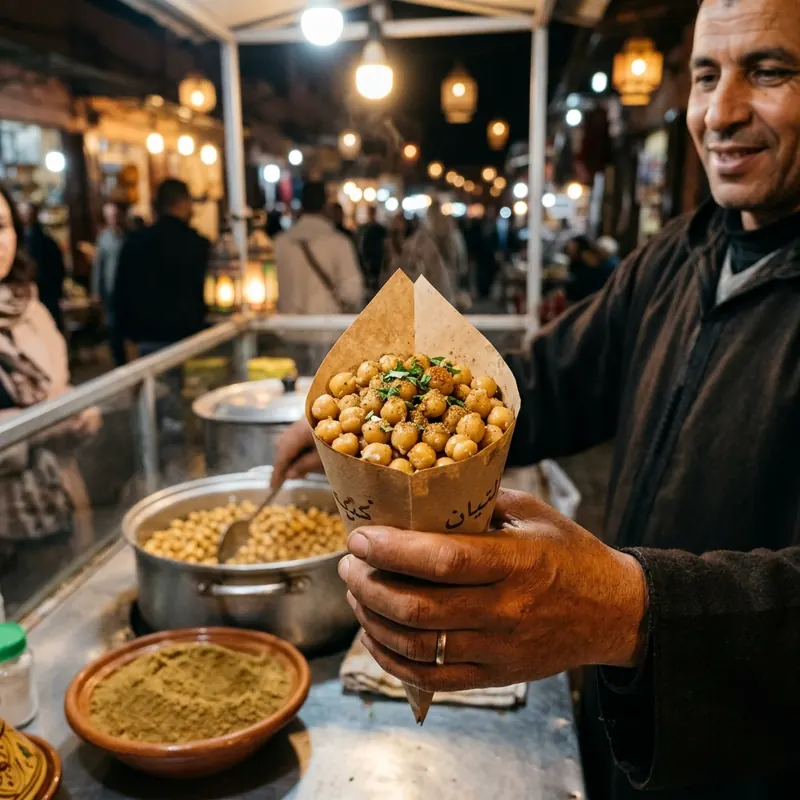
The morning chill still clings to the lime-washed walls. But turn the corner into the souk, and your senses are greeted by an unmistakable sensory mix: the hissing crackle of cast-iron griddles glistening with clarified butter, the intoxicating aroma of mountain pennyroyal and fresh spearmint rising from polished brass teapots, and the deep, volcanic gurgle of massive copper cauldrons brimming with golden, garlic-perfumed Bissara.
                           THE MOROCCAN DAWN RHYTHM
  05:30 AM ──▶ The Farnatchi fires roar; bakers slap dough in the public Ferran.
  06:00 AM ──▶ Copper cauldrons of Bissara hit peak simmer; street stalls open.
  06:30 AM ──▶ Women knead Msemen on marble slabs; Baghrir bubbles on heavy pans.
  07:00 AM ──▶ Fresh Jben Beldi arrives from Rif mountain shepherdesses on donkeys.
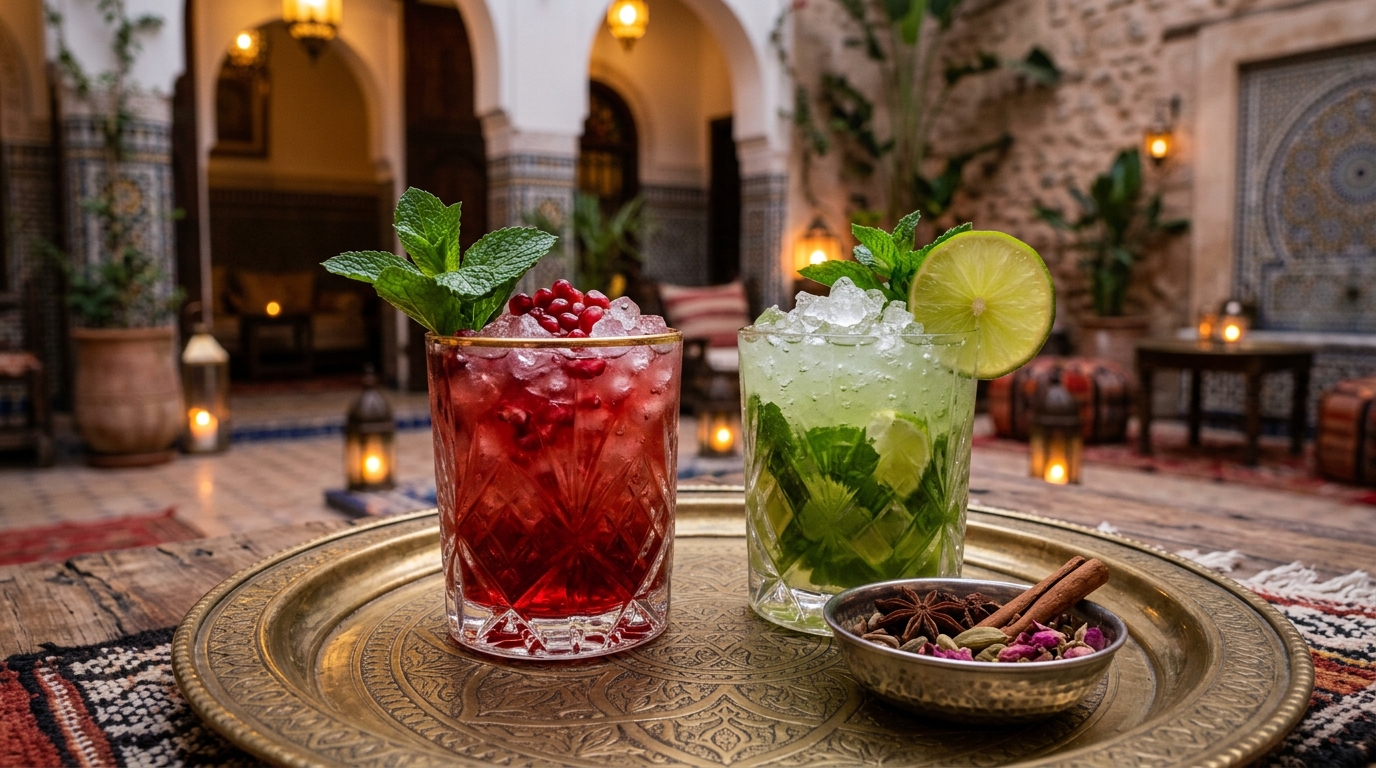
  07:30 AM ──▶ High-arched streams of Atay bi Na'na' crash into tea glasses across the kingdom.
In Morocco, breakfast is not a hurried transaction of cold cereal or grab-and-go coffee. It is a sacred daily resurrection—a democratic feast that unites the mountain shepherd, the medina craftsman, the schoolchild, and the riad patriarch around the same ancestral table.
From the hearty sustenance of peasant legume soups to the delicate, thousand-holed honeycomb of our pancakes, let us explore the extraordinary art and science of the great Moroccan morning.
1. The Alchemical Cauldron: Bissara and the Mountain Fuel of the North
If you ask any working person from Tangier to Chefchaouen what fuels their spirit on a freezing winter morning, they will answer with a single word: Bissara.
                ┌──────────────────────────────────────┐
                │        THE BISSARA EMULSION WHEEL    │
                └──────────────────────────────────────┘
                                    │
          [ Split Dried Fava Beans (Ful) or Green Peas (Jilbana) ]
                                    │
          [ Simmered with Whole Garlic Bulbs & Water (1:4 ratio) ]
                                    │
          [ Mechanical Agitation: Traditional Wooden Mikhada Whisk ]
                                    │
   ┌──────────────────────────────────────────────────────────────────┐
   │ THE BOWL CEREMONY (Served in rustic glazed terracotta 'Zlafa')   │
   ├──────────────────────────────────────────────────────────────────┤
   │ 1. Deep crater of Early-Harvest, Unfiltered Green Olive Oil      │
   │ 2. Dusting of Pungent Mountain Wild Cumin (Kamoun Beldi)         │
   │ 3. Pinch of Fiery Sun-Dried Cayenne Pepper (Soudaniya)           │
   │ 4. Steaming, Crusty Wedge of Wood-Fired Semolina Bread (Khobz)   │
   └──────────────────────────────────────────────────────────────────┘
Bissara is not merely a soup; it is a velvety, thick legume purée that straddles the line between a dip and a porridge. Born in the rugged limestone valleys of the Rif Mountains and the Middle Atlas, this ancient dish dates back to pre-Islamic Berber antiquity.
The Science of the Legume Breakdown
The foundation of authentic Bissara rests on two legumes:
- Ful Yabes (Dried Split Fava Beans): The classic choice of Fes and the southern plains, delivering an earthy, deep, nutty profile.
- Jilbana Yabsa (Dried Split Green Peas): Beloved in the Northern Rif (Tetouan, Tangier, Chefchaouen), creating a sweeter, vibrant emerald-green nectar.
The dried split beans are rinsed multiple times to remove excess surface starches that cause cloudiness, then submerged in cold water with generous handfuls of whole garlic cloves, salt, and a splash of olive oil.
As the water hits a rolling boil, the cook vigilantly skims away the thick white foam (reghwa) containing bitter saponins. Over three hours of slow simmering, the pectin in the cell walls breaks down completely.
In traditional medina stalls, the cook does not use an electric blender. Instead, they use the Mikhada—a heavy, carved wooden churning stick with ribbed cross-blades. Whirling the Mikhada between their palms shears the soft fava starches into a silky, suspended colloid without breaking the starch molecules into the gluey mess that high-speed blenders often create.
The Serving Ritual at the Stall
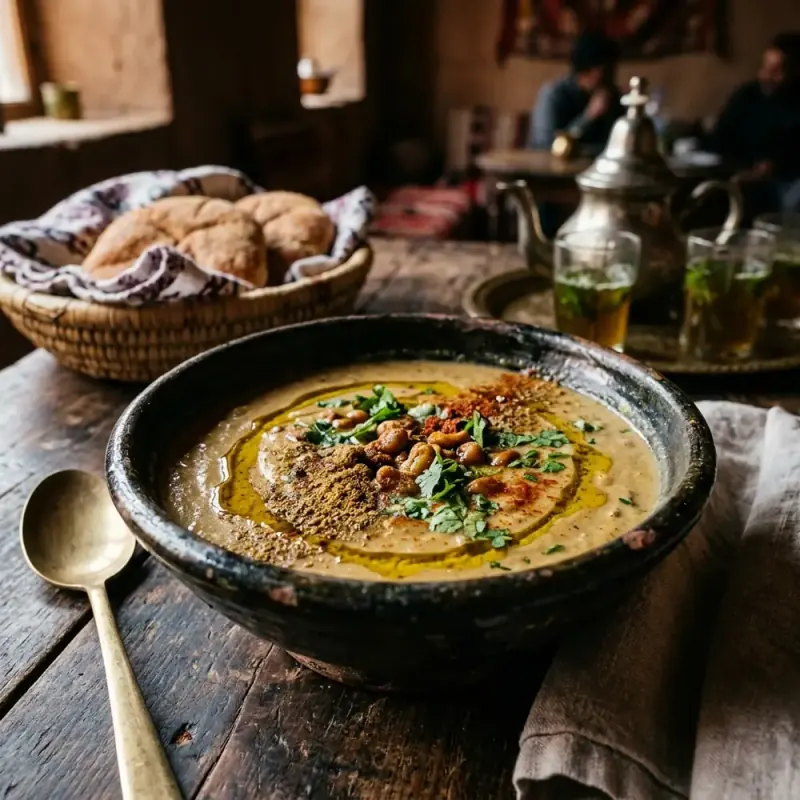
Bissara must be served boiling hot in a heavy, shallow earthenware bowl (zlafa). The vendor uses the back of an iron ladle to create a circular trench in the center of the soup, then pours in an almost scandalous amount of raw, peppery, first-press olive oil (Zit Zaytoun el-Horr).
He presents the bowl alongside small clay spice shakers of roasted wild cumin and fiery red soudaniya (ground cayenne). You dust the surface to your liking, tear off a steaming wedge of hot wood-fired khobz, dip deep into the oil-slicked fava cream, and feel the cold morning melt away from your chest.
2. Jben Beldi: The Pastoral Magic of the Jebala Hills
Descend the mountain roads into the northern markets of Chefchaouen, Asilah, or Tetouan on a market morning, and you will encounter the iconic Jebala women. Dressed in their red-and-white striped woven skirts (mendil) and broad-brimmed straw hats adorned with wool pompoms, they sit beside flat wicker baskets lined with wild ferns and fresh mint.
In front of them lie small, round, glistening wheels of Jben Beldi—Morocco’s legendary fresh mountain cheese.
       RAW MOUNTAIN GOAT MILK (Rich in wild pasture aromatics)
                 │
                 ▼
  [ Coagulated with Wild Cardoon Flower Extract (Hakk) or Raw Whey ]
                 │
                 ▼
  [ Curds ladled gently into Hand-Woven Palm Frond Mats (Doum) ]
                 │
                 ▼
  [ Drained without pressing to preserve delicate whey moisture ]
                 │
                 ▼
  DISC OF JBEN BELDI WITH CROSS-HATCH WOVEN PALM TEXTURE
 ┌─────────────────────────────────────────────────────────────┐
 │                 THE FLAVOR ARCHITECTURE OF JBEN             │
 ├─────────────────────────┬───────────────────────────────────┤
 │ PAIRING 1: SAVORY MEDINA│ Drizzled with peppery olive oil,  │
 │                         │ fresh oregano, black cured olives │
 ├─────────────────────────┼───────────────────────────────────┤
 │ PAIRING 2: SWEET RIAD   │ Bathed in amber orange blossom    │
 │                         │ honey & crushed toasted walnuts   │
 └─────────────────────────┴───────────────────────────────────┘
The Artisanal Craft of Jben
Unlike mass-produced fresh cheeses made from pasteurized milk and industrial rennet, authentic Jben Beldi is an expression of pastoral terroir:
- The Milk: Raw, unpasteurized milk from local mountain goats and cows that graze on wild mint, mastic shrubs, thyme, and olive foliage.
- Plant-Based Coagulation: Historically, mountain cheesemakers used natural vegetable rennet—the dried filaments of the wild cardoon flower (Cynara cardunculus) or the milky sap of wild fig branches (Hlib ed-Dkkar)—which contains proteases that curdle the warm milk into fragile, tender curds.
- The Palm Leaf Loom (Medjdel): The curds are scooped into small cylindrical molds hand-braided from fresh dwarf palm fronds (doum). As the whey drains naturally under the cheese's own weight, the palm fronds impart a subtle herbal note and leave their signature cross-hatch basket pattern embossed across the snowy white rind.
Tasted fresh at dawn, Jben Beldi offers a bright, lactic tang with a pillowy, spreadable texture and a finish that hints of sweet pasture grasses. Spread onto warm griddle breads with a spoonful of bitter wild mountain honey (Asal el-Horr), it is one of the world's great dairy triumphs.
3. The Geometry of Baghrir: The Thousand-Hole Honeycomb Phenomenon
Step into the kitchen of any Moroccan grandmother on a weekend morning, and you will hear the rhythmic sizzle of batter hitting hot metal, followed immediately by the visual miracle of Baghrir (often celebrated as the Moroccan "Thousand-Hole Pancake").
CROSS-SECTION: THE PHYSICS OF BAGHRIR HOLES▲ ▲ ▲ ▲ ▲ ▲ ▲ ▲ ▲ ▲ ▲ ▲ (Open Steam Craters) │ │ │ │ │ │ │ │ │ │ │ │ │ │ │ │ │ │ │ │ │ │ │ │ ├───┴───┴───┴───┴───┴───┴───┴───┴───┴───┴───┴──┤ <─ Spongy Semolina Body └──────────────────────────────────────────────┘ <─ Smooth Golden Underside ▲ ▲ ▲ [ Cast-Iron Griddle ]
Baghrir is a culinary anomaly: it is a yeast-fermented pancake made of fine durum wheat semolina (smida rkika) that is cooked strictly on one side. It is never flipped.
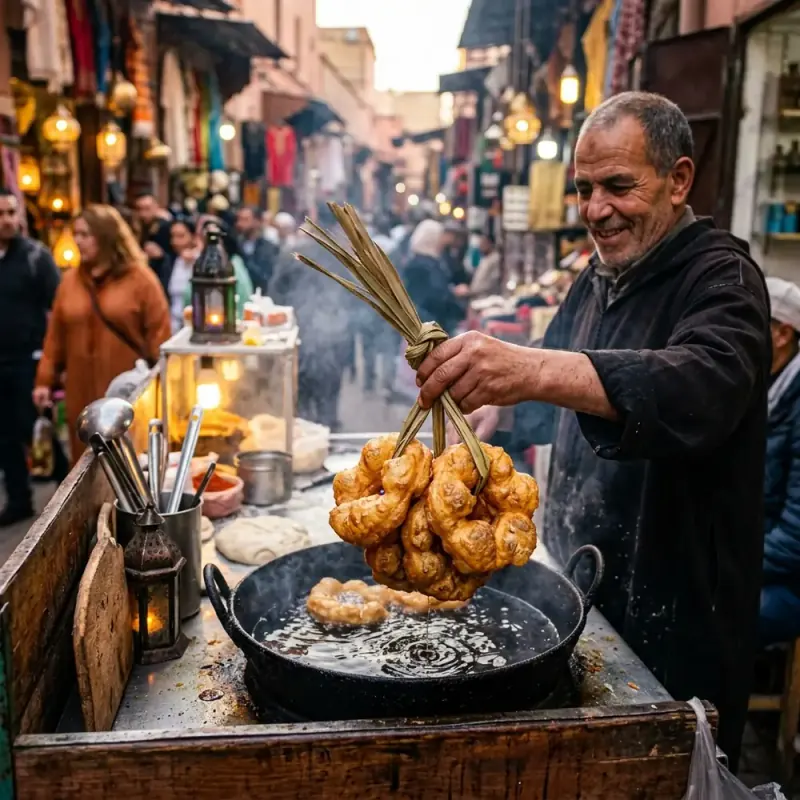
Within seconds of the pale golden batter touching the griddle, hundreds of tiny bubbles nucleate at the base, surge vertically toward the surface, and burst open to form an intricate, lace-like honeycomb of open chambers.
 ┌────────────────────────────────────────────────────────────┐
 │               BAGHRIR: FERMENTATION & THERMAL SCIENCE      │
 ├──────────────────────┬─────────────────────────────────────┤
 │ HYDRATION & GLUTEN   │ Fine durum semolina creates a light │
 │                      │ gluten lattice without doughiness.  │
 ├──────────────────────┼─────────────────────────────────────┤
 │ DUAL LEAVENING       │ Active dry yeast (slow expansion) + │
 │                      │ Baking powder (instant flash burst).│
 ├──────────────────────┼─────────────────────────────────────┤
 │ UNILATERAL HEAT      │ Bottom sets into a smooth sheet;    │
 │                      │ escaping steam carves open pores.   │
 └──────────────────────┴─────────────────────────────────────┘
The Chemical Matrix of the Holes
Why does Baghrir form these perfect, open craters while a French crepe or American pancake stays smooth?
- Dual Gas Generation: Traditional modern Baghrir utilizes a dual leavening system: biological yeast (Saccharomyces cerevisiae) for deep flavor fermentation, combined with a touch of chemical leavening (baking powder). When the cold, bubbly batter hits the hot pan, the baking powder releases an immediate thermal burst of carbon dioxide.
- Durum Semolina Matrix: Unlike all-purpose wheat flour, which contains elastic glutenin proteins that trap gas bubbles inside closed elastic domes (like sandwich bread), fine durum semolina creates a batter with lower elasticity. The rising gas bubbles easily puncture the surface film without elastic recoil, leaving permanent, open vertical chimneys.
- The Unilateral Steam Highway: Because the pancake is never flipped, all water vapor must escape upward through the top. These steam corridors become the famous "thousand holes."
The Anointing (Moutabala)
A naked Baghrir is merely a canvas. The moment it comes off the griddle, while still steaming, it is bathed in M'ssamen Sauce: equal parts pure clarified farm butter and wild orange blossom or eucalyptus honey melted together in a small copper pot.
The open honeycomb structure acts as a million micro-reservoirs, drinking in the sweet, golden butter-honey syrup until the entire pancake is saturated. When you bite into it, it releases a warm, sweet, buttery burst against the tongue with a delicate chew found nowhere else on earth.
4. The Griddle Trinity: Msemen, Melwi, and Harcha
No Moroccan breakfast spread is complete without the sizzling presence of the griddle breads, cooked over the heavy, circular iron pan known as the Farrah.
                           THE MOROCCAN GRIDDLE TRINITY
                                        │
           ┌────────────────────────────┼───────────────────────────┐
           ▼                            ▼                           ▼
     [ MSEMEN ]                     [ MELWI ]                  [ HARCHA ]
  Laminated Square Parcels     Concentric Coiled Wheels     Crumbly Semolina Pan-Cake
  Translucent stretched sheets Spiral folds rolled like     Coarse semolina, butter,
  folded with semolina-butter  turbans, flattened &         milk & sea salt; crispy,
  dust for dozens of micro-    slapped on hot griddle       crumbly scone-like bite
  flaky layers.                for fluffy, shreddy crumb.   with golden toasted crust.
 ┌─────────────────────────────────────────────────────────────────┐
 │               THE LAMINATION MECHANICS OF MSEMEN                │
 ├─────────────────────────────────────────────────────────────────┤
 │ 1. Rested durum-flour dough ball rolled in oil.                 │
 │ 2. Stretched on marble with oiled palms until see-through thin. │
 │ 3. Dappled with soft butter and dusted with dry raw semolina.   │
 │ 4. The raw semolina grains act as non-stick physical spacers.   │
 │ 5. Folded into an envelope (letter fold) ──▶ Squared & fried.   │
 └─────────────────────────────────────────────────────────────────┘
1. Msemen: The Layered Masterpiece
Msemen is a marvel of lamination. A rested dough of fine semolina and white flour is stretched over an oiled marble counter until it becomes a gossamer, translucent membrane through which you can read a newspaper.
The cook smears the sheet with soft butter, then performs the critical step: dusting with dry, fine raw semolina. These dry semolina granules act as physical barrier spacers between the folds of dough. When the square packet hits the hot griddle, the butter boils, the moisture turns to steam, and the semolina spacers prevent the layers from fusing, creating dozens of distinct, paper-thin, crispy-chewy laminated strata.
2. Melwi: The Concentric Spiral of the Atlas
While Msemen is square, Melwi is circular, originating from the Berber heartlands of the Middle Atlas.
The dough is stretched into a long, paper-thin ribbon, buttered, dusted with semolina, and rolled into a tight cylinder like a sleeping serpent. The cylinder is stood vertically on end, squashed down flat with the heel of the palm into a round disc, and baked.
The result is a griddle cake composed of concentric spiral rings. The moment it leaves the griddle, the cook slaps the edges between both hands; the disc shatters into flaky, tender ribbons reminiscent of Malaysian roti canai.
3. Harcha: The Golden Semolina Pan-Bread
If Msemen is about gluten elasticity, Harcha (from the Arabic word for "rough" or "abrasive") is about the tender, crumbly magic of coarse golden semolina (smida ghlida).
It is not kneaded like bread; rather, coarse semolina is rubbed with melted butter and olive oil until every grain is coated in fat (the sand-rubbing technique or bessous), then brought together with milk, salt, and a touch of sugar into a wet, loose dough.
Shaped into thick discs and cooked in a dry pan dusted with raw semolina, Harcha develops a speckled, crunchy, golden-sand crust that yields to a warm, crumbly, melt-in-the-mouth interior. It is the ultimate vehicle for strong salty Jben, bitter orange marmalade, or creamy Laughing Cow cheese (La Vache Qui Rit, a beloved modern Moroccan breakfast staple).
5. The Morning Tea Ceremony: Atay bi Na'na' and the High Pour
A Moroccan morning without tea is like a sky without the sun. But our morning tea is distinct from the sweet, heavy mint tea served after midnight feasts.
       GUNPOWDER GREEN TEA (Zhu Cha)
                 │
                 ▼
  [ WASH 1: 'Er-Rooh' (The Soul) extracted in boiling water ──▶ SAVED ]
                 │
                 ▼
  [ WASH 2: Bitter surface tannins rinsed away ─────────────▶ DISCARDED ]
                 │
                 ▼
  [ Return 'Soul' to pot with fresh water, sugar cone & herbs ]
                 │
                 ▼
  [ The 'Tesh-hira' (Low flame decoction to marry tea & sugar) ]
                 │
                 ▼
  THE HIGH POUR (Rezza / Kaaba Foam Collar in decorative glass)
In the morning, the tea master chooses herbs tailored to the season and the morning air:
- Spring/Summer: Fresh Moroccan Spearmint (Na'na' el-Maghrebi) with sweet, menthol-rich leaves, occasionally paired with fresh lemon verbena (Louisa).
- Autumn/Winter: Bitter Wormwood (Sheeba), wild pennyroyal (Flio), or mountain sage (Salmia) to warm the lungs, aid digestion, and protect the throat from mountain chills.
The Science of the "Rezza" (The Crown of Foam)
When the host pours tea from a height of three feet above the table, it is not merely theater.
The long, graceful curved spout of the Moroccan Berrad creates a narrow, laminar stream of boiling liquid. As this stream crashes into the narrow glass, it creates violent micro-cavitation, drawing in ambient oxygen.
This oxygenation softens the astringent polyphenols and catechins in the green tea, cools the liquid to the perfect drinking temperature (65°C), and generates a dense, velvety collar of foam on top of the glass known as the Rezza or Kaaba. If a host serves you a glass of tea without this frothy crown, it is considered an insult—a sign of hurried carelessness.
6. Grandmother's Secrets: Sacred Rules for the Morning Griddle
Before you step to the stove to create your Moroccan breakfast, memorize these essential pearls of ancestral kitchen wisdom:
Secret 1: The Cold Water Pan Shock for Baghrir
If your Baghrir comes out flat with no holes after the first pancake, your griddle is too hot! Professional street vendors keep a shallow basin of cold water beside their stove. Between every single pancake, they take the hot cast-iron pan and briefly dip the bottom of the pan into cold water for two seconds. This cools the metal down just enough so that when the next ladle of batter hits, it doesn't sear immediately, allowing the gas bubbles time to migrate upward and burst into holes before the bottom sets.
Secret 2: Never Salt Bissara at the Beginning
Never add salt to your pot of dried fava beans or split peas when you first turn on the fire. Salt strengthens the pectin bonds in the legume skins and prevents the beans from absorbing water, doubling your cooking time and resulting in a grainy purée. Always add salt during the final 30 minutes of simmering when the beans have already completely collapsed.
Secret 3: The Msemen Butter-Oil Dual Protocol
Never use 100% butter to stretch your Msemen—the milk solids in butter will burn on the griddle, and the dough will tear. Always use vegetable oil on your marble counter and hands to stretch the dough paper-thin, and use soft clarified butter (ghee or smen) inside the folds for flavor and flaky lamination.
Secret 4: The Harcha "No-Knead" Rule
Treat Harcha dough like pie crust, not bread dough. The moment you add the milk to the butter-coated semolina, mix it gently with your fingertips for only 15 seconds. If you knead Harcha dough, you will develop the gluten, and your bread will turn out tough and rubbery instead of crisp, crumbly, and melt-in-the-mouth.
7. Frequently Asked Questions
Can I make Baghrir batter ahead of time and keep it in the fridge?
No. Baghrir batter is extremely delicate. If it over-ferments, the yeast will consume all the sugars, the gluten structure will collapse, and the batter will turn sour and watery, producing large, irregular tears instead of a fine honeycomb. Blend your batter, let it rest for exactly 15 to 20 minutes in a warm spot until small bubbles form on top, and cook the entire batch immediately.
What is the primary difference between Northern and Southern Moroccan Bissara?
The primary difference is the legume base. In Northern Morocco (Tangier, Tetouan, Chefchaouen, the Rif), Bissara is predominantly made with split dried green peas (Jilbana), giving it a vibrant green hue and a naturally sweeter taste. In Southern and Central Morocco (Fes, Meknes, Marrakech), Bissara is made exclusively with split dried fava beans (Ful), producing a golden-tan soup with an earthier, deeper, more savory profile.
How do I store and reheat leftover Msemen and Baghrir?
Msemen freezes beautifully. Stack cooled Msemen between sheets of parchment paper, place in a freezer bag, and freeze for up to three months. Reheat directly on a hot, dry skillet for 1 minute per side until the layers puff and crisp. Baghrir, however, should not be frozen; store cooked Baghrir in an airtight container at room temperature for up to 24 hours and reheat briefly in a toaster or warm pan (never in a microwave, which turns them rubbery).
What makes Moroccan mint tea taste different from regular mint tea?
Authentic Moroccan tea is not a simple herbal infusion of mint leaves in water. It is a decoction built on a base of Chinese Gunpowder green tea (Zhu Cha), which has been washed and gently boiled (tesh-hira) with water and sugar cones before fresh spearmint (Mentha spicata) is submerged directly into the boiling pot. The combination of green tea tannins, caramelization of sugar, and fresh aromatic essential oils produces its signature depth.
Can I make Jben Beldi without raw goat milk at home?
While authentic Jben relies on raw milk, you can create a very close homemade version using high-quality pasteurized whole cow or goat milk (avoid ultra-pasteurized / UHT milk). Warm the milk to 35°C (95°F), stir in cultured buttermilk or natural plain whole yogurt as a starter culture, add a few drops of liquid vegetarian rennet, let it set for 2 hours into a clean curd, and drain in a cheesecloth-lined basket.
8. Detailed Image Prompts for the Visual Storyteller
Prompt 1: The Medina Bissara Cauldron at Dawn
- Subject: A massive, steaming tinned copper cauldron filled with bubbling golden fava bean Bissara in an open-air medina stall, with a vendor using a brass ladle to pour green olive oil into a rustic clay bowl dusted with cumin and red pepper.
- Vibe: Early dawn atmosphere, mystical medina blue hour transitioning to warm morning light, rising steam, authentic Moroccan street life.
- Style: Environmental documentary food photography, rich cinematic tones, natural soft lighting highlighting the texture of the bubbling soup.
- Format: Horizontal 16:9, wide aperture with atmospheric depth showing the stone alleyway behind.
Prompt 2: The Thousand Holes of Baghrir
- Subject: Extreme close-up macro shot of a golden-yellow Baghrir pancake cooking on a dark cast-iron pan, with hundreds of tiny honeycomb bubbles bursting open simultaneously into intricate circular craters.
- Vibe: Mesmerizing culinary science, warmth, textural perfection, appetizing morning energy.
- Style: High-detail macro culinary photography, warm side-lighting catching the raised rims of every open pore and steam curl.
- Format: Square 1:1 or 4:5 vertical, tack-sharp focus on the center bubbles with soft depth of field fall-off.
Prompt 3: Jben Beldi on Mountain Palm Fronds
- Subject: Three fresh, snowy-white wheels of Jben Beldi goat cheese resting on hand-woven green palm leaf mats (doum), drizzled with golden wildflower honey and surrounded by plump black olives, fresh mint sprigs, and coarse sea salt.
- Vibe: Rustic mountain pastoral, Chefchaouen artisanal serenity, organic, fresh from nature.
- Style: Editorial food styling, bright natural northern daylight, crisp textures of woven palm fronds and glistening fresh cheese whey.
- Format: Horizontal 3:2, styled on weathered blue-washed cedar wood.
Prompt 4: The High Pour of Morning Atay
- Subject: An ornate silver Moroccan teapot pouring a long, sparkling, crystal-clear stream of amber mint tea from three feet high into a traditional patterned glass, creating a rich white collar of frothy foam (rezza) at the rim.
- Vibe: Vibrant hospitality, morning celebration, cultural elegance, dynamic kinetic movement.
- Style: High-speed action food photography, frozen liquid droplets in the air catching morning sunbeams, soft background showing steaming Msemen and honey pots.
- Format: Vertical 9:16 or 4:5 portrait, vibrant color grading with emerald mint greens and warm amber tea hues.
Experience the true heart of Moroccan heritage through its culinary traditions. Join us in preserving and honoring these ancestral recipes.
What People Are Saying
No comments yet. Be the first — we'd love to hear from you.
Lalla Fatima & The Medina Culinary Guild
Culturally Verified & Fact-CheckedThe Moroccan Food editorial team brings together native culinary researchers, heritage preservationists, and experienced home cooks across Marrakech, Fes, and Casablanca. Every recipe and cultural guide is reviewed against ancestral oral traditions and authentic regional practices.