The Art of Feeding a Family on Almost Nothing: Budget Secrets of the Moroccan Kitchen
How the Moroccan Kitchen Feeds Many People Beautifully on Very Little
My grandmother never had a food budget, as such. She had money, and she had a family to feed, and the two facts were always in conversation with each other. What she had — and what I think has been almost entirely lost in the way modern food media talks about "budget cooking" — was an intimate knowledge of how to make inexpensive ingredients taste extraordinary.
Not how to make them taste "good for the price." How to make them genuinely, uncomplicatedly extraordinary. Full stop.
The Moroccan culinary tradition was built on this. Not on scarcity as a problem to overcome, but on the proposition that limited ingredients, handled correctly, with the right spices and the right technique and the right patience, produce meals of real depth and real satisfaction.
The Economics of the Spice Investment
The single most counterintuitive lesson of Moroccan budget cooking is this: spend on spices. The spice budget is not where you economize. A small amount of saffron, properly used, transforms a pot of cheap chickpeas into something complex and golden. A tablespoon of ras el hanout turns basic lamb neck — one of the cheapest cuts — into a tagine that needs nothing else. Cumin costs almost nothing and makes plain boiled vegetables something you want to eat.
The investment in a proper spice supply — not the supermarket jars that are mostly dust, but actual fresh spices from a market — pays back in every single meal. You can be economical everywhere else because the spices are doing the work that expensive cuts of meat and imported ingredients would otherwise do.
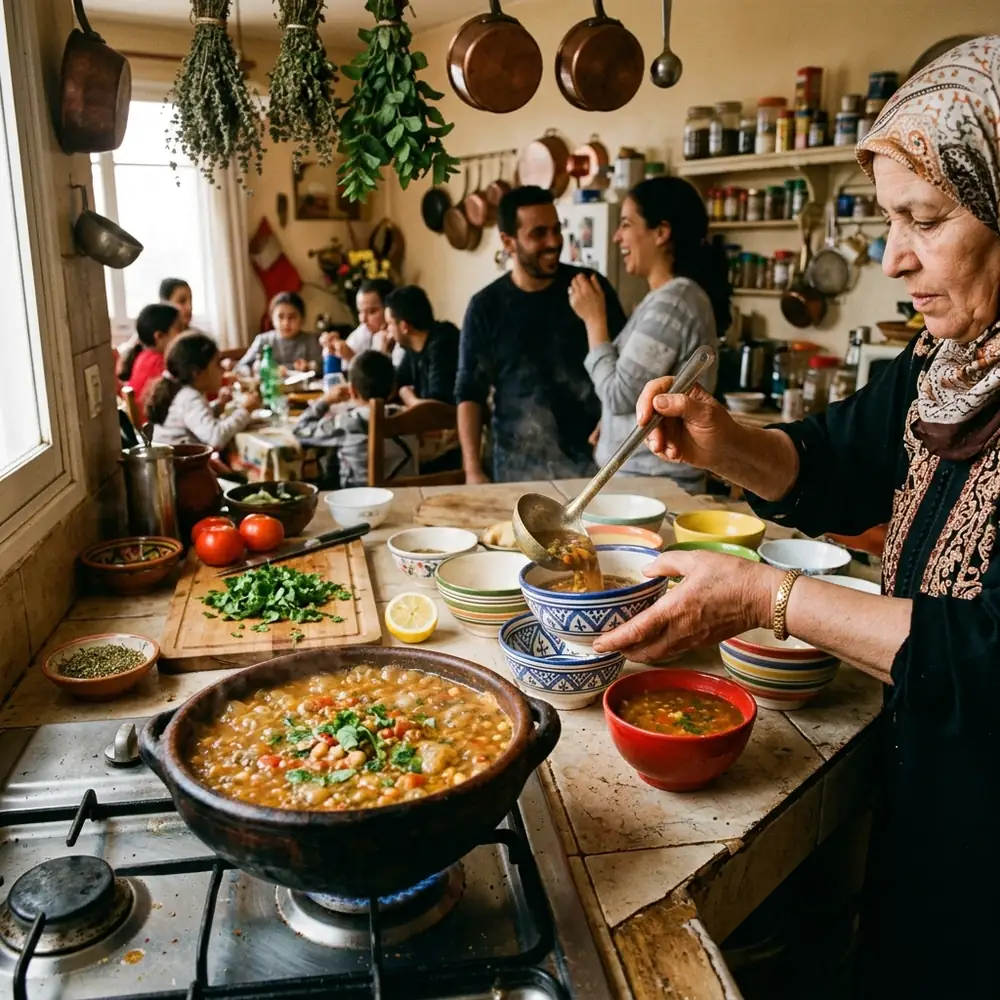
Harira: The Economics of the Most Important Soup in Morocco
The ingredients list for harira: tomatoes (canned is fine), red lentils, dried chickpeas (or canned), a small amount of lamb or beef bone (optional — the soup is very good without), celery, onion, fresh cilantro, fresh parsley, lemon, saffron, ginger, cumin, flour or cornstarch for the taddouira (the thickening), and sometimes a small amount of vermicelli.
The cost per serving, for a batch that feeds eight people: genuinely minimal. The satisfaction per serving: maximum. Harira is the soup that breaks the Ramadan fast for 37 million people because it works. It genuinely, reliably, nutritionally works — high in protein from the legumes, warming from the spices, acid-balanced from the lemon and tomato, filling in a way that lighter soups are not.
The trick is the taddouira — a small amount of flour dissolved in water, added in the last few minutes of cooking, which gives harira its characteristic body without making it heavy. Many home cooks skip this step and wonder why their harira is thin. Don't skip the taddouira.
Slow Cooking: How Cheap Cuts Become the Best Cuts
The cheapest parts of any animal — the neck, the shoulder, the feet, the tail, the ribs — are the parts with the most collagen. Collagen, when cooked for a long time at low heat, converts to gelatin. Gelatin gives body to cooking liquid, produces a silky sauce, and keeps the meat moist in a way that lean, expensive cuts — which have no collagen — cannot do.
This is why a lamb neck tagine cooked for three hours is better than a lamb loin tagine cooked for thirty minutes. Not despite the cheap cut. Because of the cheap cut. The Moroccan kitchen understood this not through food science but through generations of practical experience, and the result is a culinary tradition in which the most economical cuts produce the most celebrated dishes.
- Lamb neck, shoulder, or ribs — for tagines, best cooked slowly, minimum 2 hours
- Beef shin or cheek — for M'rouzia-style long-braised dishes
- Whole chicken, including the back and neck — for chicken tagines and broths; the entire bird adds flavor that breast-only cooking cannot
- Lamb or beef bone — for harira broth; adds richness for the cost of almost nothing
The Weekly Menu That Costs Very Little and Satisfies Completely
Monday: Harira with bread. Full meal, almost no cost.
Tuesday: Loubia — white bean stew with tomato, cumin, and paprika. Served with olive oil and bread.
Wednesday: Vegetable couscous with chickpeas and whatever vegetables are cheapest at the market.
Thursday: Bissara for breakfast, Zaalouk with bread for lunch.
Friday: The big meal — whatever you can afford this week. Even a modest Friday couscous with a small amount of lamb and plenty of vegetables is the celebratory meal it's supposed to be.
Weekend: Leftovers. In the Moroccan kitchen, nothing is thrown out. Day-old harira is reheated. Day-old couscous is reconstituted with a small amount of hot water and more butter. Yesterday's tagine is served again, and it's often better the second day.
This isn't austerity. This is a system. A complete, satisfying, genuinely good system that the Moroccan kitchen developed over centuries and that the global food economy, with its emphasis on novelty and convenience, has largely forgotten how to do.
Experience the true heart of Moroccan heritage through its culinary traditions. Join us in preserving and honoring these ancestral recipes.
What People Are Saying
No comments yet. Be the first — we'd love to hear from you.
Khadija Tahiri
Culturally Verified & Fact-CheckedThe Moroccan Food editorial team brings together native culinary researchers, heritage preservationists, and experienced home cooks across Marrakech, Fes, and Casablanca. Every recipe and cultural guide is reviewed against ancestral oral traditions and authentic regional practices.